Respiratory rate 22/min or more
Count breaths for a full 60 seconds.
Systolic blood pressure 100 mm Hg or less
Use the current measured systolic pressure.
Altered mentation
Any new change from the patient's usual mental status, or a Glasgow Coma Scale below 15.
Result
0range 0 to 3
Review or change your answers
Supports, never replaces, clinical judgment and your facility's protocols. · Reviewed September 30, 2026 by the editorial team under our editorial policy · Seymour, Singer et al., Sepsis-3 task force, 2016
What it measures
qSOFA gives one point each for fast breathing, low systolic blood pressure and altered mental status. The Sepsis-3 task force introduced it in 2016 as a quick way to spot infected patients outside the ICU who are more likely to die or stay long in the ICU. It does not define sepsis: Sepsis-3 defines sepsis by an acute rise of 2 or more points in the full SOFA score. Surviving Sepsis Campaign guidelines advise against using qSOFA alone to screen for sepsis because it misses many cases.
Used for: Adults with suspected or confirmed infection outside the ICU: emergency department, medical and surgical wards, and prehospital care.
qSOFA Score interpretation
| Score | Result | What it means |
|---|---|---|
| 0–1 | Negative qSOFA | Lower risk of a poor outcome, but sepsis is not ruled out. Keep monitoring vital signs and use your facility's sepsis screening tool if infection is suspected. |
| 2–3 | Positive qSOFA | Higher risk of death or prolonged ICU stay. Notify the provider promptly, assess for organ dysfunction and follow your facility's sepsis protocol. |
Versions and other cut-offs: Sepsis-3 defines sepsis with the full SOFA score (a rise of 2 or more points), which needs lab values. The Surviving Sepsis Campaign (2021, reaffirmed in 2026) recommends NEWS, MEWS or SIRS over qSOFA as a single screening tool, so many US hospitals screen with SIRS or an early warning score and use qSOFA only as a risk flag.
qSOFA Score chart and printable PDF
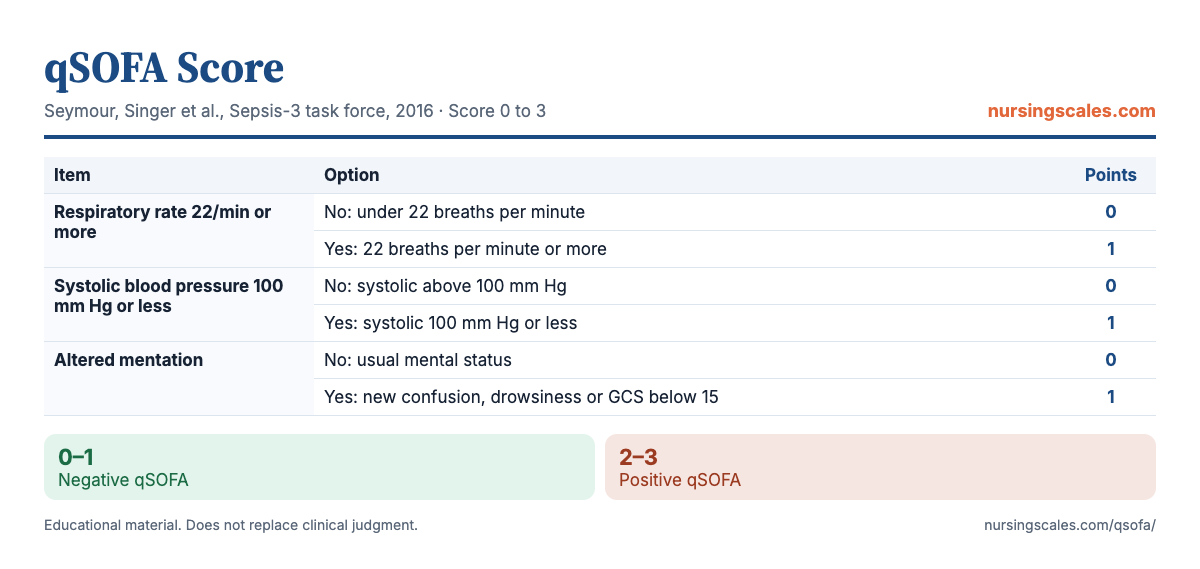
See every item and its points as a table
| Item | Option | Points |
|---|---|---|
| Respiratory rate 22/min or more | No: Under 22 breaths per minute | 0 |
| Yes: 22 breaths per minute or more | 1 | |
| Systolic blood pressure 100 mm Hg or less | No: Systolic above 100 mm Hg | 0 |
| Yes: Systolic 100 mm Hg or less | 1 | |
| Altered mentation | No: Usual mental status | 0 |
| Yes: New confusion, drowsiness or GCS below 15 | 1 |
When to use it
- When an adult on a ward or in the emergency department has suspected infection
- During routine vital sign checks on a patient being treated for infection
- When a patient with infection becomes newly confused or drowsy
- In prehospital or triage settings to flag high-risk infected patients
- Alongside your facility's sepsis screen to support escalation
How to score it step by step
- Confirm the patient has suspected or confirmed infection.
- Count the respiratory rate for a full minute.
- Measure the systolic blood pressure.
- Compare mental status with the patient's baseline, using family or records if needed.
- Give 1 point for each criterion met and document the total with the vital signs.
- Escalate a score of 2 or more, and escalate any patient you are worried about regardless of score.
Common mistakes
- Treating a qSOFA of 0 or 1 as proof the patient does not have sepsis
- Using qSOFA as the only sepsis screening tool
- Estimating the respiratory rate instead of counting it
- Scoring chronic confusion from dementia as new altered mentation
- Delaying escalation while waiting for the score to reach 2
Example case
Patient. Rosa, 71, admitted to a medical ward with a urinary tract infection. On the evening check she says she feels worse.
- Respiratory rate: 24 breaths per minute (1)
- Systolic blood pressure: 96 mm Hg (1)
- Mental status: alert and oriented, GCS 15, same as baseline (0)
Score: 2. A qSOFA of 2 is positive. Rosa has a higher risk of a poor outcome and needs a prompt assessment for sepsis and organ dysfunction.
Nursing actions:
- Notify the provider or rapid response team per facility policy
- Start your facility's sepsis screen and protocol
- Increase the frequency of vital signs and mental status checks
- Monitor urine output and report the findings using SBAR
Frequently asked questions
What qSOFA score is positive?
A score of 2 or 3 is positive and signals a higher risk of death or a long ICU stay in a patient with infection. A score of 0 or 1 is negative but does not rule out sepsis.
Does a positive qSOFA mean the patient has sepsis?
No. qSOFA is a risk prompt. Sepsis-3 defines sepsis as life-threatening organ dysfunction from infection, measured by a rise of 2 or more points in the full SOFA score.
Why do guidelines advise against qSOFA for sepsis screening?
qSOFA misses many patients who have sepsis. The Surviving Sepsis Campaign recommends NEWS, MEWS or SIRS over qSOFA as a single screening tool.
What counts as altered mentation?
Any new change from the patient's usual mental status, such as confusion or drowsiness. Sepsis-3 used a Glasgow Coma Scale below 15.
Can I use qSOFA in the ICU?
qSOFA was designed for patients outside the ICU. In the ICU, teams use the full SOFA score.
Related scales and guides
All scales:
Sources: Third International Consensus Definitions for Sepsis (Sepsis-3), JAMA 2016 · Surviving Sepsis Campaign Adult Guidelines 2026, SCCM · What is new in the 2021 Surviving Sepsis Campaign guidelines (PMC) · qSOFA (Quick SOFA) Score for Sepsis, MDCalc. Explanations and example case written by our editorial team. Reviewed September 30, 2026.