Which level best describes the patient?
Test one muscle group at a time and always compare with the same group on the other side.
Result
0range 0/5 to 5/5
MRC muscle scale used with the permission of the Medical Research Council.
Supports, never replaces, clinical judgment and your facility's protocols. · Reviewed September 30, 2026 by the editorial team under our editorial policy · Medical Research Council (UK), 1943 (War Memorandum No. 7; later republished as Memorandum No. 45)
What it measures
The MRC scale turns a manual muscle test into a number the whole team understands. You grade each muscle group by whether it contracts, moves with gravity removed, moves against gravity, and holds against your resistance. Comparing sides and tracking grades over time helps you detect stroke, spinal cord or nerve problems, ICU-acquired weakness and recovery during rehabilitation.
Used for: Adults and older children who can cooperate with a manual muscle test: neurological, neurosurgical, trauma, orthopedic, rehabilitation and ICU patients.
Muscle Strength Scale (MRC 0-5) interpretation
| Score | Result | What it means |
|---|---|---|
| 0/5–2/5 | Severe weakness | The muscle cannot move the limb against gravity. Report new or worsening findings right away, since sudden weakness may signal stroke or spinal cord compromise; protect the limb and prevent falls. |
| 3/5 | Moderate weakness | Functional movement against gravity only. Compare sides and with the baseline, report any new change, and assess fall risk and need for assistance. |
| 4/5 | Mild weakness | Reduced strength against resistance. Track the trend and report any drop from the previous exam. |
| 5/5 | Normal strength | Normal power for that muscle group. Continue routine checks at the ordered frequency. |
Versions and other cut-offs: Many clinicians add plus and minus grades (for example 4-, 4, 4+) to describe near-normal strength, although these subgrades are less reliable between examiners. In the ICU, the MRC sum score tests six muscle groups on both sides (shoulder abduction, elbow flexion, wrist extension, hip flexion, knee extension, ankle dorsiflexion) for a total of 0-60; a score below 48 suggests ICU-acquired weakness.
Muscle Strength Scale (MRC 0-5) chart and printable PDF
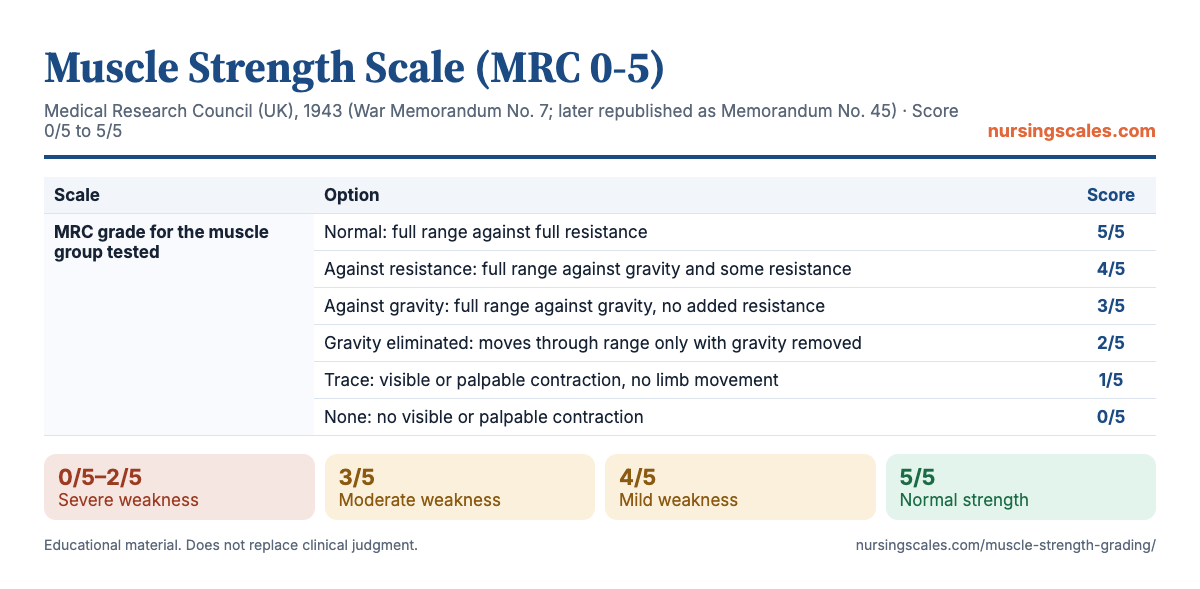
See every item and its points as a table
| Level | Option | Score |
|---|---|---|
| MRC grade for the muscle group tested | Normal: Full range against full resistance | 5/5 |
| Against resistance: Full range against gravity and some resistance | 4/5 | |
| Against gravity: Full range against gravity, no added resistance | 3/5 | |
| Gravity eliminated: Moves through range only with gravity removed | 2/5 | |
| Trace: Visible or palpable contraction, no limb movement | 1/5 | |
| None: No visible or palpable contraction | 0/5 |
When to use it
- Neuro checks after stroke, spinal cord injury or neurosurgery
- New complaint of weakness, numbness or falls
- Monitoring Guillain-Barre syndrome, myasthenia gravis or other neuromuscular disease
- Screening for ICU-acquired weakness in awake, cooperative ICU patients
- Before mobilizing a patient and during rehabilitation to track progress
How to score it step by step
- Explain the test, make sure the patient is awake and able to follow commands, and ask about pain.
- Position the limb so the muscle can move against gravity (for example, sitting for knee extension).
- Ask the patient to move through the full range. If they cannot, reposition to remove gravity to test grade 2, or palpate for a contraction to test grade 1.
- If they complete the range against gravity, apply resistance at the end of the movement and ask them to hold.
- Test the same muscle group on the other side and compare.
- Document the grade per muscle group and side (for example, right elbow flexion 4/5) and report any new asymmetry.
Common mistakes
- Testing only against gravity and skipping the gravity-eliminated position when the limb cannot lift.
- Grading a limb limited by pain, contracture or poor effort as true weakness without noting it.
- Documenting "weak" without the muscle group, side and grade.
- Comparing grades from examiners who use different resistance or positions.
- Using the scale in a sedated or confused patient who cannot follow commands.
Example case
Patient. Mr. J., 71, admitted with a urinary tract infection. On your morning neuro check he says his left arm "feels heavy." Yesterday strength was 5/5 in all limbs.
- Right elbow flexion holds against full resistance (5/5)
- Left elbow flexion: lifts the forearm through full range against gravity but gives way to any added resistance (3)
- Mild left facial droop noted
Score: 3/5. New left-arm weakness graded 3/5 with facial droop is a sudden change from baseline and may indicate a stroke.
Nursing actions:
- Activate the stroke alert or rapid response per facility protocol
- Note the time last known well
- Check blood glucose and vital signs, and complete a full neuro assessment
- Keep the patient NPO until a swallow screen is done
- Document each muscle group grade and side
Frequently asked questions
What is normal muscle strength on the MRC scale?
Grade 5/5 is normal. Grades 0-2 mean the muscle cannot move the limb against gravity, grade 3 means movement against gravity only, and grade 4 means some but not full resistance.
What does 4/5 muscle strength mean?
The muscle moves through its full range against gravity and some resistance, but less than normal. Some clinicians add 4- or 4+ to describe it in more detail.
What is the difference between grade 1 and grade 0?
At grade 1 you can see or feel a flicker of contraction, but the limb does not move. At grade 0 there is no contraction at all.
What is the MRC sum score?
It adds the grades of six muscle groups tested on both sides, for a total of 0-60. A score below 48 suggests ICU-acquired weakness.
Can you grade strength in a sedated patient?
No. The test needs an awake patient who can follow commands and give full effort. Document that strength could not be assessed and why.
Related scales and guides
All scales:
Sources: Muscle Strength Grading - StatPearls (NCBI Bookshelf) · MRC Muscle Scale - UK Research and Innovation · Aids to the Examination of the Peripheral Nervous System (MRC) · Two-tier strength assessment for ICU-acquired weakness (Critical Care, 2015). MRC muscle scale used with the permission of the Medical Research Council.Explanations and example case written by our editorial team. Reviewed September 30, 2026.