Cervical dilation
Estimate the opening of the internal os in centimeters during a sterile vaginal exam.
Cervical effacement
Estimate how much the cervix has thinned compared with an uneffaced length of about 3-4 cm.
Fetal station
Locate the leading bony part of the fetal head relative to the ischial spines (station 0), on a -3 to +3 scale.
Cervical consistency
Feel the texture of the cervix between your fingers.
Cervical position
Note where the cervix points in relation to the vaginal axis.
Result
0range 0 to 13
Review or change your answers
Supports, never replaces, clinical judgment and your facility's protocols. · Reviewed September 30, 2026 by the editorial team under our editorial policy · Edward H. Bishop, 1964
What it measures
The Bishop score puts a number on cervical ripeness before labor induction. You combine cervical dilation, effacement, consistency and position with the station of the fetal head. The team uses the total to decide whether the cervix needs ripening before oxytocin and to estimate the chance of a vaginal birth after induction. It predicts how induction is likely to go; it does not decide on its own whether induction is indicated.
Used for: Pregnant patients at term or near term being considered for labor induction, usually with a single fetus in cephalic presentation and intact membranes. Findings are less reliable after membranes rupture or with a scarred cervix.
Bishop Score interpretation
| Score | Result | What it means |
|---|---|---|
| 0–5 | Unfavorable | Unripe cervix: induction without ripening is less likely to lead to vaginal birth. The provider usually considers mechanical or pharmacologic cervical ripening first, per protocol. |
| 6–7 | Intermediate | Borderline cervix: many trials still class 6 as unfavorable. The provider weighs ripening versus oxytocin using the full clinical picture. |
| 8–13 | Favorable | Ripe cervix: the chance of vaginal birth after induction approaches that of spontaneous labor. Induction can often start without a ripening agent, per the provider's orders. |
Versions and other cut-offs: Cut-offs vary: ACOG notes most trials define an unfavorable cervix as 6 or less and that a score above 8 gives a vaginal birth rate similar to spontaneous labor; AAFP calls 5 or less unfavorable; Bishop's original paper used 9 or more for safe elective induction in multiparas. The modified Bishop score replaces effacement with cervical length in centimeters (often by ultrasound), and the simplified Bishop score uses only dilation, effacement and station (range 0-9, favorable above 5).
Bishop Score chart and printable PDF
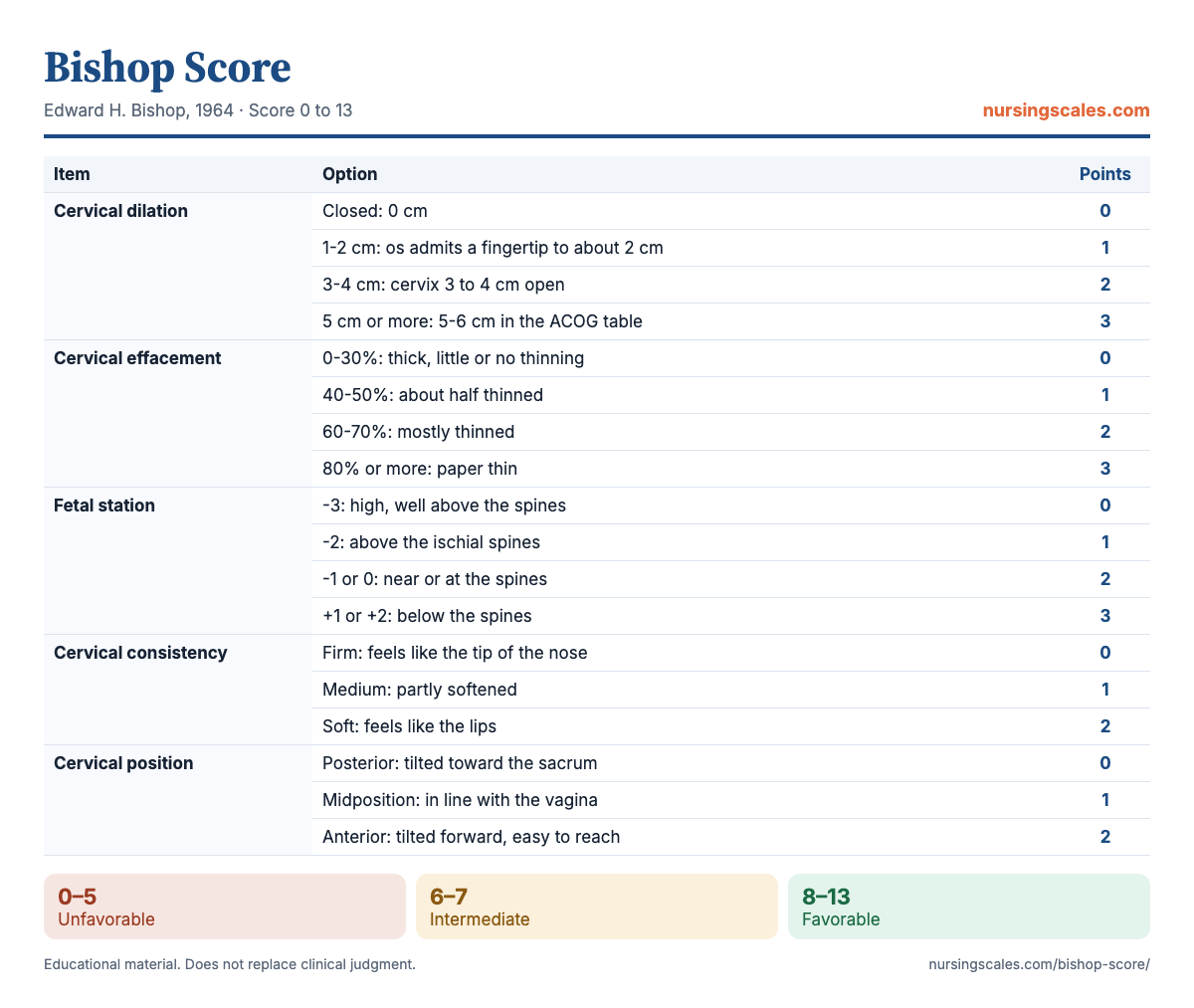
See every item and its points as a table
| Item | Option | Points |
|---|---|---|
| Cervical dilation | Closed: 0 cm | 0 |
| 1-2 cm: Os admits a fingertip to about 2 cm | 1 | |
| 3-4 cm: Cervix 3 to 4 cm open | 2 | |
| 5 cm or more: 5-6 cm in the ACOG table | 3 | |
| Cervical effacement | 0-30%: Thick, little or no thinning | 0 |
| 40-50%: About half thinned | 1 | |
| 60-70%: Mostly thinned | 2 | |
| 80% or more: Paper thin | 3 | |
| Fetal station | -3: High, well above the spines | 0 |
| -2: Above the ischial spines | 1 | |
| -1 or 0: Near or at the spines | 2 | |
| +1 or +2: Below the spines | 3 | |
| Cervical consistency | Firm: Feels like the tip of the nose | 0 |
| Medium: Partly softened | 1 | |
| Soft: Feels like the lips | 2 | |
| Cervical position | Posterior: Tilted toward the sacrum | 0 |
| Midposition: In line with the vagina | 1 | |
| Anterior: Tilted forward, easy to reach | 2 |
When to use it
- Before a scheduled or medically indicated labor induction
- Choosing between cervical ripening and oxytocin as the first step
- Reassessing the cervix after a ripening agent or balloon catheter
- Documenting a baseline cervical exam on admission to labor and delivery
- Handoff between nurses and providers about induction progress
How to score it step by step
- Confirm the indication, fetal presentation and membrane status, and get consent for the exam.
- Perform a sterile vaginal exam unless contraindicated (for example, suspected placenta previa or unexplained bleeding).
- Score dilation, effacement, station, consistency and position using the table.
- Add the five scores to get a total from 0 to 13.
- Document each component, the total and the time, and report it to the provider.
- Repeat the score after ripening or at the interval your protocol sets.
Common mistakes
- Scoring station on the caput succedaneum instead of the bony fetal head.
- Giving effacement points as a percent without a shared reference for cervical length.
- Treating one cut-off as universal when your unit uses a different threshold.
- Doing the exam when a vaginal exam is contraindicated.
- Recording only the total, which hides which components changed after ripening.
Example case
Patient. Nulliparous patient at 41 weeks admitted for induction for late-term pregnancy. Intact membranes, cephalic fetus. Sterile vaginal exam findings:
- Dilation 1 cm (1)
- Effacement 50% (1)
- Station -2 (1)
- Medium consistency (1)
- Midposition cervix (1)
Score: 5. A Bishop score of 5 is unfavorable. Induction without ripening is less likely to succeed.
Nursing actions:
- Report the score and each component to the provider
- Prepare for the cervical ripening method ordered (balloon catheter or medication) per protocol
- Monitor fetal heart rate and uterine activity as your unit requires
- Reassess the Bishop score after ripening and before starting oxytocin
Frequently asked questions
What is a favorable Bishop score?
A score of 8 or more is usually called favorable. A score of 5 or less is unfavorable, and 6-7 is a gray zone where units differ.
What happens if the Bishop score is low?
The provider usually orders cervical ripening, with a balloon catheter or a prostaglandin, before or instead of starting oxytocin.
What is the maximum Bishop score?
13. Dilation, effacement and station give up to 3 points each; consistency and position give up to 2 each.
What is the modified Bishop score?
It replaces effacement with cervical length in centimeters. Some versions measure length by transvaginal ultrasound to reduce differences between examiners.
Which parts of the Bishop score matter most?
Dilation, effacement and station carry the most predictive weight. The simplified Bishop score keeps only those three.
Can nurses calculate the Bishop score?
Yes, when your facility credentials nurses to perform cervical exams. Report the score to the provider, who decides on the induction method.
Related scales and guides
All scales:
Sources: ACOG Practice Bulletin No. 107: Induction of Labor (Table 1) · AAFP: Cervical Ripening and Induction of Labor (2022) · Bishop EH. Pelvic Scoring for Elective Induction (1964) - Embryo Project, ASU. Explanations and example case written by our editorial team. Reviewed September 30, 2026.