Nausea and vomiting
Ask: "Do you feel sick to your stomach? Have you vomited?" and observe.
Tactile disturbances
Ask about itching, pins and needles, burning, numbness, or a feeling of bugs crawling on or under the skin, and observe.
Tremor
Have the patient extend the arms with fingers spread apart and observe.
Auditory disturbances
Ask if sounds seem harsh or frightening, and if the patient hears things that are disturbing or that they know are not there.
Paroxysmal sweats
Observe the palms, face and forehead.
Visual disturbances
Ask if light seems too bright, a different color or painful, and if the patient sees things that are disturbing or not there.
Anxiety
Ask: "Do you feel nervous?" and observe.
Headache, fullness in head
Ask if the head feels different or like there is a band around it. Do not rate dizziness or lightheadedness.
Agitation
Observe the patient's activity level during the interview.
Orientation and clouding of sensorium
Ask: "What day is this? Where are you? Who am I?" This item is scored 0 to 4.
Result
0range 0 to 67
Review or change your answers
Supports, never replaces, clinical judgment and your facility's protocols. · Reviewed September 30, 2026 by the editorial team under our editorial policy · Sullivan, Sykora, Schneiderman, Naranjo & Sellers, 1989
What it measures
The CIWA-Ar measures how severe alcohol withdrawal is right now. It combines what you observe (tremor, sweating, agitation, orientation) with what the patient reports (nausea, anxiety, headache, sensory disturbances). Repeating it at set intervals shows whether withdrawal is getting better or worse, which helps the team decide how closely to monitor and when to treat under symptom-triggered protocols.
Used for: Adults with known or suspected alcohol withdrawal who can communicate and answer questions. It is less reliable in patients who are intubated, heavily sedated, delirious or unable to talk.
CIWA-Ar interpretation
| Score | Result | What it means |
|---|---|---|
| 0–9 | Mild withdrawal | Mild or minimal withdrawal. Keep reassessing on schedule, because symptoms can climb over the first 24 to 72 hours after the last drink. |
| 10–18 | Moderate withdrawal | Moderate withdrawal. Notify the provider, follow your facility's symptom-triggered protocol and increase the frequency of monitoring. |
| 19–67 | Severe withdrawal | Severe withdrawal with higher risk of seizures and delirium. Escalate care promptly, monitor closely and follow facility protocol. |
Versions and other cut-offs: The cut-offs above follow the 2020 ASAM guideline (under 10 mild, 10 to 18 moderate, 19 or more severe). StatPearls uses 8 or less for mild, 9 to 15 for moderate and above 15 for severe, and the original form notes that patients scoring under 10 do not usually need additional medication. Always use the thresholds written in your facility's protocol.
Nursing interventions by CIWA-Ar score
Use these nursing actions as a starting point and follow your facility's alcohol withdrawal protocol and provider orders.
0–9 Mild withdrawal
- Reassess with the CIWA-Ar per protocol; the ASAM guideline suggests every 1 to 4 hours for the first 24 hours in inpatient care.
- Once scores stay below 10 for 24 hours, extend reassessment to every 4 to 8 hours if your protocol allows.
- Check vital signs with each assessment and note the time of the last drink.
- Encourage non-caffeinated fluids and meals, and record intake and output.
- Keep the room quiet and evenly lit, and reorient the patient as needed.
- Notify the provider if the score rises, vital signs worsen or new confusion appears.
10–18 Moderate withdrawal
- Notify the provider and give symptom-triggered medication per order or protocol.
- Reassess about 1 hour after each dose, or at the interval your protocol sets, and document the score and response.
- Monitor vital signs, level of consciousness and signs of over-sedation.
- Keep the environment calm, low-stimulus and evenly lit; offer frequent reassurance and reorientation.
- Support hydration and nutrition, and give vitamin supplements as ordered.
- Apply fall precautions: bed in low position, call light within reach, assist with walking.
- Escalate if the score keeps rising despite treatment or vomiting prevents oral intake.
19–67 Severe withdrawal
- Notify the provider right away and follow your escalation pathway; severe withdrawal may need a higher level of care.
- Start seizure precautions: padded side rails per policy, suction and oxygen at the bedside, bed low and locked.
- Reassess often, for example every hour or more often per protocol, including vital signs and orientation.
- Give symptom-triggered medication per order or protocol and watch closely for respiratory depression.
- Place the patient in a quiet, evenly lit room close to the nursing station, with close observation.
- Monitor fluid balance and electrolytes as ordered, and support IV fluids and nutrition per orders.
- Watch for hallucinations, agitation or confusion that suggest delirium, and escalate at once if present.
Interventions follow ASAM Clinical Practice Guideline on Alcohol Withdrawal Management, 2020 (PDF), StatPearls: Alcohol Withdrawal. Your facility's protocol and the provider's orders take priority.
CIWA-Ar chart and printable PDF
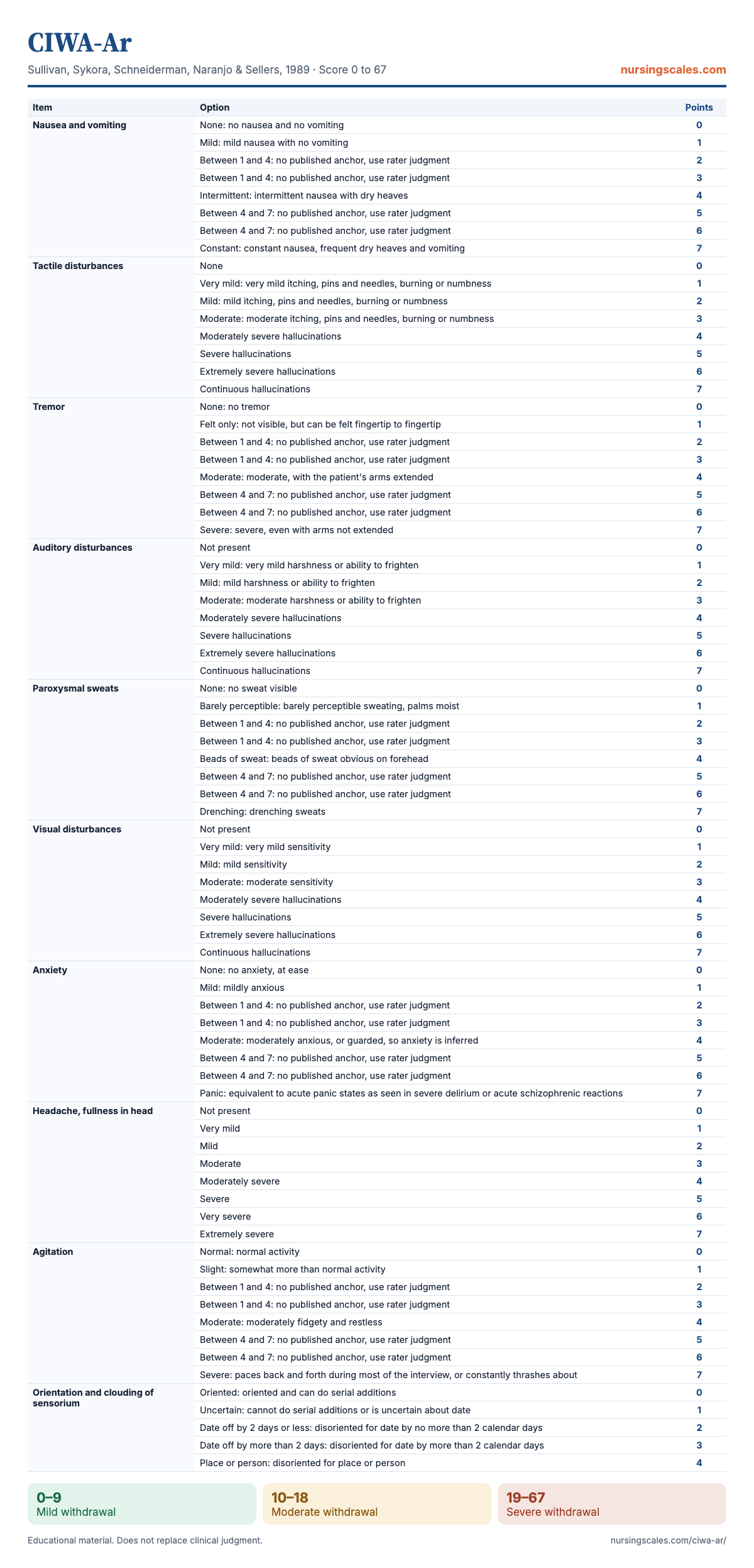
See every item and its points as a table
| Item | Option | Points |
|---|---|---|
| Nausea and vomiting | None: no nausea and no vomiting | 0 |
| Mild: mild nausea with no vomiting | 1 | |
| Between 1 and 4: no published anchor, use rater judgment | 2 | |
| Between 1 and 4: no published anchor, use rater judgment | 3 | |
| Intermittent: intermittent nausea with dry heaves | 4 | |
| Between 4 and 7: no published anchor, use rater judgment | 5 | |
| Between 4 and 7: no published anchor, use rater judgment | 6 | |
| Constant: constant nausea, frequent dry heaves and vomiting | 7 | |
| Tactile disturbances | None | 0 |
| Very mild: Very mild itching, pins and needles, burning or numbness | 1 | |
| Mild: Mild itching, pins and needles, burning or numbness | 2 | |
| Moderate: Moderate itching, pins and needles, burning or numbness | 3 | |
| Moderately severe hallucinations | 4 | |
| Severe hallucinations | 5 | |
| Extremely severe hallucinations | 6 | |
| Continuous hallucinations | 7 | |
| Tremor | None: no tremor | 0 |
| Felt only: not visible, but can be felt fingertip to fingertip | 1 | |
| Between 1 and 4: no published anchor, use rater judgment | 2 | |
| Between 1 and 4: no published anchor, use rater judgment | 3 | |
| Moderate: moderate, with the patient's arms extended | 4 | |
| Between 4 and 7: no published anchor, use rater judgment | 5 | |
| Between 4 and 7: no published anchor, use rater judgment | 6 | |
| Severe: severe, even with arms not extended | 7 | |
| Auditory disturbances | Not present | 0 |
| Very mild: Very mild harshness or ability to frighten | 1 | |
| Mild: Mild harshness or ability to frighten | 2 | |
| Moderate: Moderate harshness or ability to frighten | 3 | |
| Moderately severe hallucinations | 4 | |
| Severe hallucinations | 5 | |
| Extremely severe hallucinations | 6 | |
| Continuous hallucinations | 7 | |
| Paroxysmal sweats | None: no sweat visible | 0 |
| Barely perceptible: barely perceptible sweating, palms moist | 1 | |
| Between 1 and 4: no published anchor, use rater judgment | 2 | |
| Between 1 and 4: no published anchor, use rater judgment | 3 | |
| Beads of sweat: beads of sweat obvious on forehead | 4 | |
| Between 4 and 7: no published anchor, use rater judgment | 5 | |
| Between 4 and 7: no published anchor, use rater judgment | 6 | |
| Drenching: drenching sweats | 7 | |
| Visual disturbances | Not present | 0 |
| Very mild: Very mild sensitivity | 1 | |
| Mild: Mild sensitivity | 2 | |
| Moderate: Moderate sensitivity | 3 | |
| Moderately severe hallucinations | 4 | |
| Severe hallucinations | 5 | |
| Extremely severe hallucinations | 6 | |
| Continuous hallucinations | 7 | |
| Anxiety | None: no anxiety, at ease | 0 |
| Mild: mildly anxious | 1 | |
| Between 1 and 4: no published anchor, use rater judgment | 2 | |
| Between 1 and 4: no published anchor, use rater judgment | 3 | |
| Moderate: moderately anxious, or guarded, so anxiety is inferred | 4 | |
| Between 4 and 7: no published anchor, use rater judgment | 5 | |
| Between 4 and 7: no published anchor, use rater judgment | 6 | |
| Panic: equivalent to acute panic states as seen in severe delirium or acute schizophrenic reactions | 7 | |
| Headache, fullness in head | Not present | 0 |
| Very mild | 1 | |
| Mild | 2 | |
| Moderate | 3 | |
| Moderately severe | 4 | |
| Severe | 5 | |
| Very severe | 6 | |
| Extremely severe | 7 | |
| Agitation | Normal: normal activity | 0 |
| Slight: somewhat more than normal activity | 1 | |
| Between 1 and 4: no published anchor, use rater judgment | 2 | |
| Between 1 and 4: no published anchor, use rater judgment | 3 | |
| Moderate: moderately fidgety and restless | 4 | |
| Between 4 and 7: no published anchor, use rater judgment | 5 | |
| Between 4 and 7: no published anchor, use rater judgment | 6 | |
| Severe: paces back and forth during most of the interview, or constantly thrashes about | 7 | |
| Orientation and clouding of sensorium | Oriented: Oriented and can do serial additions | 0 |
| Uncertain: Cannot do serial additions or is uncertain about date | 1 | |
| Date off by 2 days or less: Disoriented for date by no more than 2 calendar days | 2 | |
| Date off by more than 2 days: Disoriented for date by more than 2 calendar days | 3 | |
| Place or person: Disoriented for place or person | 4 |
When to use it
- On admission when a patient reports heavy or daily alcohol use or has a positive alcohol screen
- At scheduled intervals during a symptom-triggered alcohol withdrawal protocol
- After each treatment dose given under protocol, to check the response
- When a patient with recent alcohol use develops tremor, sweating, anxiety or new confusion
- Before transfer or discharge, to document that withdrawal is settling
How to score it step by step
- Confirm the symptoms are likely from alcohol withdrawal and not another cause such as infection, hypoglycemia or head injury.
- Take the pulse for one full minute and the blood pressure, and record the time of the last drink if known.
- Ask the scripted questions for nausea, tactile, auditory and visual disturbances, anxiety, headache and orientation.
- Observe tremor with arms extended and fingers spread, sweating and agitation during the interview.
- Score each item on its own scale, add the 10 items for a total from 0 to 67, and document it with the time.
- Act on the total according to your protocol and set the time of the next reassessment.
Common mistakes
- Using the CIWA-Ar in a patient who cannot communicate, such as an intubated, sedated or delirious patient.
- Scoring symptoms from another cause, such as anxiety disorder, sepsis or pain, as alcohol withdrawal.
- Rating the orientation item from 0 to 7; it only goes from 0 to 4.
- Leading the patient with suggestive questions, which inflates the subjective items.
- Skipping reassessments once the score drops, even though withdrawal can worsen again within the first days.
Example case
Patient. A 52-year-old man admitted for a hip fracture reports drinking about a fifth of whiskey daily. His last drink was 30 hours ago.
- Nausea and vomiting 1: mild nausea, no vomiting
- Tactile disturbances 0: none
- Tremor 4: moderate tremor with arms extended
- Auditory disturbances 0: not present
- Paroxysmal sweats 4: beads of sweat on forehead
- Visual disturbances 1: says the room light seems a bit bright
- Anxiety 4: guarded and moderately anxious
- Headache 2: mild
- Agitation 1: somewhat more active than normal
- Orientation 0: oriented and can do serial additions
Score: 17. A total of 17 falls in the moderate withdrawal range (10 to 18).
Nursing actions:
- Notify the provider and start or follow the symptom-triggered protocol ordered for the patient.
- Reassess the CIWA-Ar at the interval your protocol sets for moderate scores.
- Institute seizure and fall precautions per facility policy.
- Monitor vital signs, fluid intake and any change in orientation.
- Document the score, findings and actions taken.
Frequently asked questions
What CIWA-Ar score is normal, and what score is high?
There is no true normal, but scores under 10 reflect mild or minimal withdrawal. Under the ASAM guideline, 10 to 18 is moderate and 19 or more is severe. Some sources use 8 or less as mild and above 15 as severe.
Why do some items have no description for 2, 3, 5 and 6?
The published form only defines anchors at 0, 1, 4 and 7 for nausea, tremor, sweats, anxiety and agitation. You can still choose the in-between numbers when the finding falls between two anchors.
How often should I repeat the CIWA-Ar?
Follow your facility's protocol. Reassessment is usually more frequent when scores are higher and spaced out as scores stay low.
Can I use the CIWA-Ar in an intubated or delirious patient?
Not reliably. Several items need the patient to answer questions. Use a tool your facility approves for these patients, such as a sedation or delirium scale.
Is the CIWA-Ar free to use?
Yes. The form states that it is not copyrighted and may be reproduced freely.
Related scales and guides
All scales:
Sources: Sullivan et al. 1989, Assessment of alcohol withdrawal: the revised CIWA-Ar (PubMed) · CIWA-Ar form (public domain) · ASAM Clinical Practice Guideline on Alcohol Withdrawal Management, 2020 · StatPearls: Alcohol Withdrawal. Explanations and example case written by our editorial team. Reviewed September 30, 2026.