Heart rate (Pulse)
Auscultate the chest or palpate the umbilical cord base; many teams use a cardiac monitor during resuscitation.
Respiratory effort (Respiration)
Watch chest movement and listen to the cry.
Muscle tone (Activity)
Observe posture and gently extend a limb to see if it resists and returns to flexion.
Reflex irritability (Grimace)
Assess the response to stimulation such as gentle suctioning or flicking the sole of the foot.
Color (Appearance)
Check the trunk, lips and extremities; in infants with darker skin, look at mucous membranes, palms and soles.
Result
0range 0 to 10
Review or change your answers
Supports, never replaces, clinical judgment and your facility's protocols. · Reviewed September 30, 2026 by the editorial team under our editorial policy · Virginia Apgar, 1952 (published 1953)
What it measures
The Apgar score gives the delivery team a shared, quick snapshot of how the baby is transitioning to life outside the womb and how the baby responds to resuscitation. You score heart rate, respiratory effort, muscle tone, reflex irritability and color at 1 and 5 minutes after birth. It is a documentation and communication tool: it does not decide whether to resuscitate, and a single score does not diagnose asphyxia or predict long-term neurological outcome.
Used for: All newborns immediately after birth, term and preterm. In preterm infants, lower tone, color and reflex scores can reflect immaturity rather than illness.
Apgar Score interpretation
| Score | Result | What it means |
|---|---|---|
| 0–3 | Low | Low score: the newborn needs immediate support. Resuscitation follows the Neonatal Resuscitation Program algorithm, and scoring continues every 5 minutes. |
| 4–6 | Moderately abnormal | Moderately abnormal: the baby may need stimulation, airway clearance or breathing support. Keep scoring every 5 minutes up to 20 minutes while the score stays below 7. |
| 7–10 | Reassuring | Reassuring: the newborn is transitioning well. Continue routine newborn care and observation. |
Versions and other cut-offs: AAP and ACOG recommend scoring at 1 and 5 minutes for every newborn, then every 5 minutes up to 20 minutes when the 5-minute score is below 7. They also encourage an expanded Apgar reporting form that records the resuscitation steps in place (such as oxygen, positive-pressure ventilation or chest compressions) at each time point.
Apgar Score chart and printable PDF
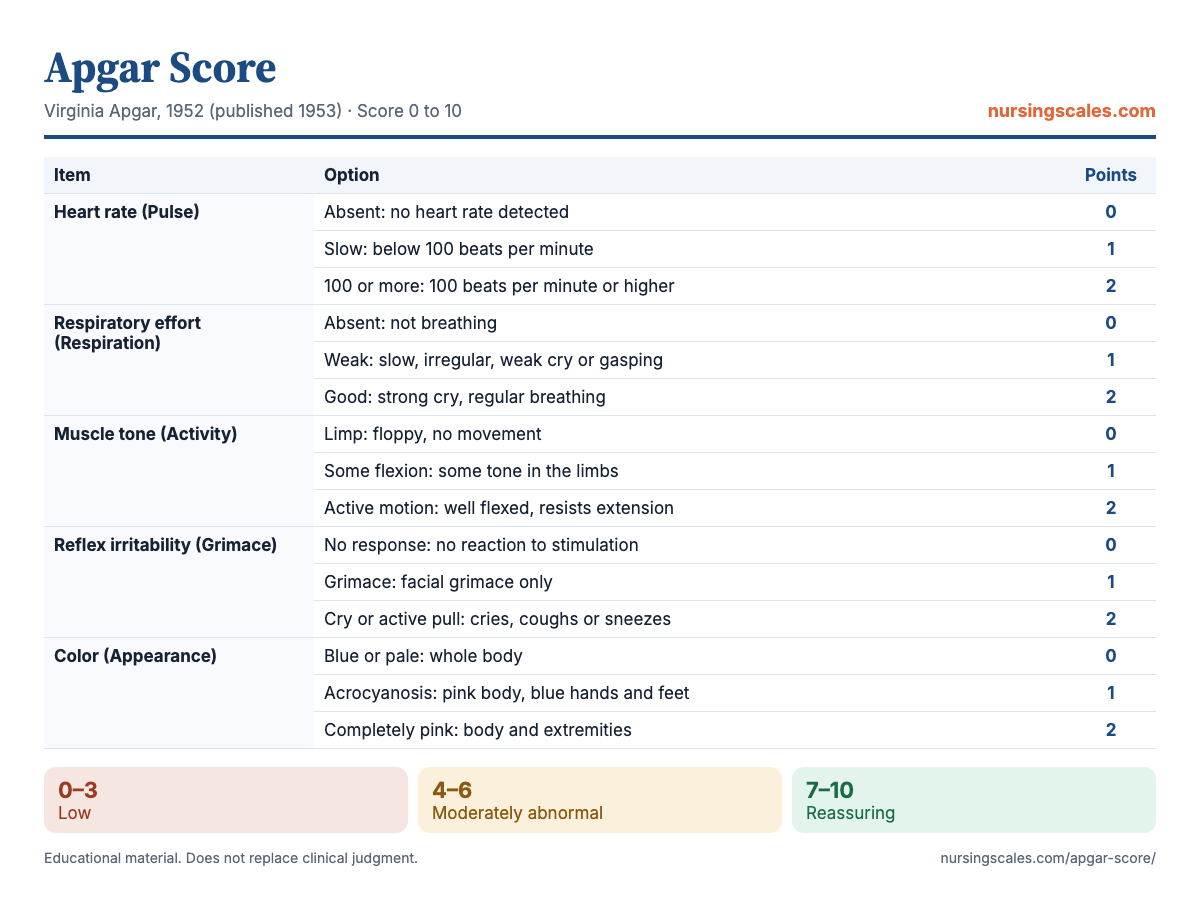
See every item and its points as a table
| Item | Option | Points |
|---|---|---|
| Heart rate (Pulse) | Absent: No heart rate detected | 0 |
| Slow: Below 100 beats per minute | 1 | |
| 100 or more: 100 beats per minute or higher | 2 | |
| Respiratory effort (Respiration) | Absent: Not breathing | 0 |
| Weak: Slow, irregular, weak cry or gasping | 1 | |
| Good: Strong cry, regular breathing | 2 | |
| Muscle tone (Activity) | Limp: Floppy, no movement | 0 |
| Some flexion: Some tone in the limbs | 1 | |
| Active motion: Well flexed, resists extension | 2 | |
| Reflex irritability (Grimace) | No response: No reaction to stimulation | 0 |
| Grimace: Facial grimace only | 1 | |
| Cry or active pull: Cries, coughs or sneezes | 2 | |
| Color (Appearance) | Blue or pale: Whole body | 0 |
| Acrocyanosis: Pink body, blue hands and feet | 1 | |
| Completely pink: Body and extremities | 2 |
When to use it
- Every birth, at 1 minute and at 5 minutes
- Every 5 minutes up to 20 minutes when the 5-minute score is below 7
- Documenting the newborn's response during and after resuscitation
- Handoff communication between the delivery team and the nursery or NICU
- Birth records and quality reporting
How to score it step by step
- Start a timer at the moment of complete birth.
- At 1 minute, rate each of the five signs 0, 1 or 2 and add them up.
- Repeat the full score at 5 minutes.
- If the 5-minute score is below 7, keep scoring every 5 minutes until 20 minutes or until the score reaches 7 or higher.
- Document each score with its time and any resuscitation in progress (expanded Apgar form if your unit uses it).
- Never delay resuscitation to assign a score; begin care as soon as it is needed.
Common mistakes
- Waiting for the 1-minute score before starting resuscitation.
- Using a single low score as proof of birth asphyxia or to predict long-term outcome.
- Rounding up because the baby "looks fine" instead of scoring each sign.
- Stopping at 5 minutes when the score is still below 7.
- Misjudging color in infants with darker skin by not checking mucous membranes, palms and soles.
Example case
Patient. Baby girl born at 39 weeks after a long second stage of labor. She needed drying and stimulation at birth. Findings at 5 minutes:
- Heart rate 130 beats per minute (2)
- Weak, irregular cry (1)
- Some flexion of arms and legs (1)
- Grimaces when the soles of the feet are flicked (1)
- Pink body with blue hands and feet (1)
Score: 6. A 5-minute Apgar of 6 is moderately abnormal. She needs continued support and repeat scoring.
Nursing actions:
- Keep supporting breathing and warmth per the NRP algorithm and unit protocol
- Repeat the Apgar score at 10 minutes and every 5 minutes up to 20 minutes while it stays below 7
- Document each score with the interventions in place
- Notify the pediatric provider and prepare for NICU evaluation if ordered
Frequently asked questions
What is a normal Apgar score?
A score of 7-10 is reassuring. A score of 4-6 is moderately abnormal, and 0-3 is low in term and late-preterm babies.
Why is the Apgar score taken at 1 and 5 minutes?
The 1-minute score shows how the baby tolerated birth. The 5-minute score shows how the baby is adapting and responding to any support.
When do you keep scoring after 5 minutes?
When the 5-minute score is below 7, AAP and ACOG recommend repeating it every 5 minutes up to 20 minutes.
Does a low Apgar score mean brain damage?
No. A low score alone does not prove asphyxia and does not predict an individual baby's neurological outcome. It has to be read with the full clinical picture.
Is the Apgar score used to decide on resuscitation?
No. Resuscitation must start before the 1-minute score is assigned. Heart rate, breathing and tone guide the resuscitation algorithm directly.
Why do many babies score 9 instead of 10?
Blue hands and feet (acrocyanosis) are common in the first minutes after birth and give only 1 point for color.
Related scales and guides
All scales:
Sources: ACOG/AAP Committee Opinion No. 644: The Apgar Score · APGAR Score - StatPearls (NCBI Bookshelf) · AAP Policy Statement: The Apgar Score (Pediatrics). Explanations and example case written by our editorial team. Reviewed September 30, 2026.