Feeding
Food is placed within reach. Score what the patient does, not what they could do.
Bathing
Bath or shower, getting in and out without supervision.
Grooming
Face, hair, teeth and shaving, with supplies set up.
Dressing
Includes buttons, zippers and laces.
Bowels
Bowel control over the preceding days.
Bladder
A patient with a catheter who manages it alone counts as continent.
Toilet use
Getting on and off, handling clothes and wiping.
Transfers (bed to chair and back)
Watch the whole transfer, including sitting up in bed.
Mobility (level surfaces)
Walking about 50 yards indoors. Walking aids are allowed.
Stairs
Up and down one flight.
Result
0range 0 to 100
Review or change your answers
Supports, never replaces, clinical judgment and your facility's protocols. · Reviewed September 30, 2026 by the editorial team under our editorial policy · Mahoney & Barthel, 1965
What it measures
The Barthel Index scores what the patient actually does in feeding, bathing, grooming, dressing, bowel and bladder control, toilet use, transfers, walking and stairs. Each item is weighted, so mobility and transfers carry more points than grooming or bathing. Nurses and therapists use it to set a functional baseline, plan care and staffing, track rehabilitation progress, and support discharge planning.
Used for: Adults with limited function from stroke, neuromuscular or musculoskeletal conditions, hip fracture, or frailty, in acute care, rehabilitation, long-term care and home care.
Barthel Index interpretation
| Score | Result | What it means |
|---|---|---|
| 0–20 | Total dependency | The patient needs help with almost all ADLs. Plan full assistance, pressure injury and fall prevention, and involve the care team in discharge planning early. |
| 21–60 | Severe dependency | The patient needs substantial help with many ADLs. Plan hands-on assistance and refer to physical and occupational therapy as your facility allows. |
| 61–90 | Moderate dependency | The patient does many tasks but needs help with some. Target the weak items in the care plan and reassess to track progress. |
| 91–99 | Slight dependency | The patient is nearly independent and needs help or supervision with one or two tasks. Check safety for those tasks before discharge. |
| 100 | Independent | The patient performs all 10 basic ADLs without help. A score of 100 does not rule out problems with cooking, shopping or living alone. |
Versions and other cut-offs: The original Mahoney and Barthel version scores 0-100 in steps of 5. Collin and Wade (1988) rescaled it to 0-20 (divide the 0-100 score by 5). The dependency bands above come from Shah et al. (1989), whose Modified Barthel Index uses more levels per item; some facilities use other cut-offs, so follow your local policy.
Barthel Index chart and printable PDF
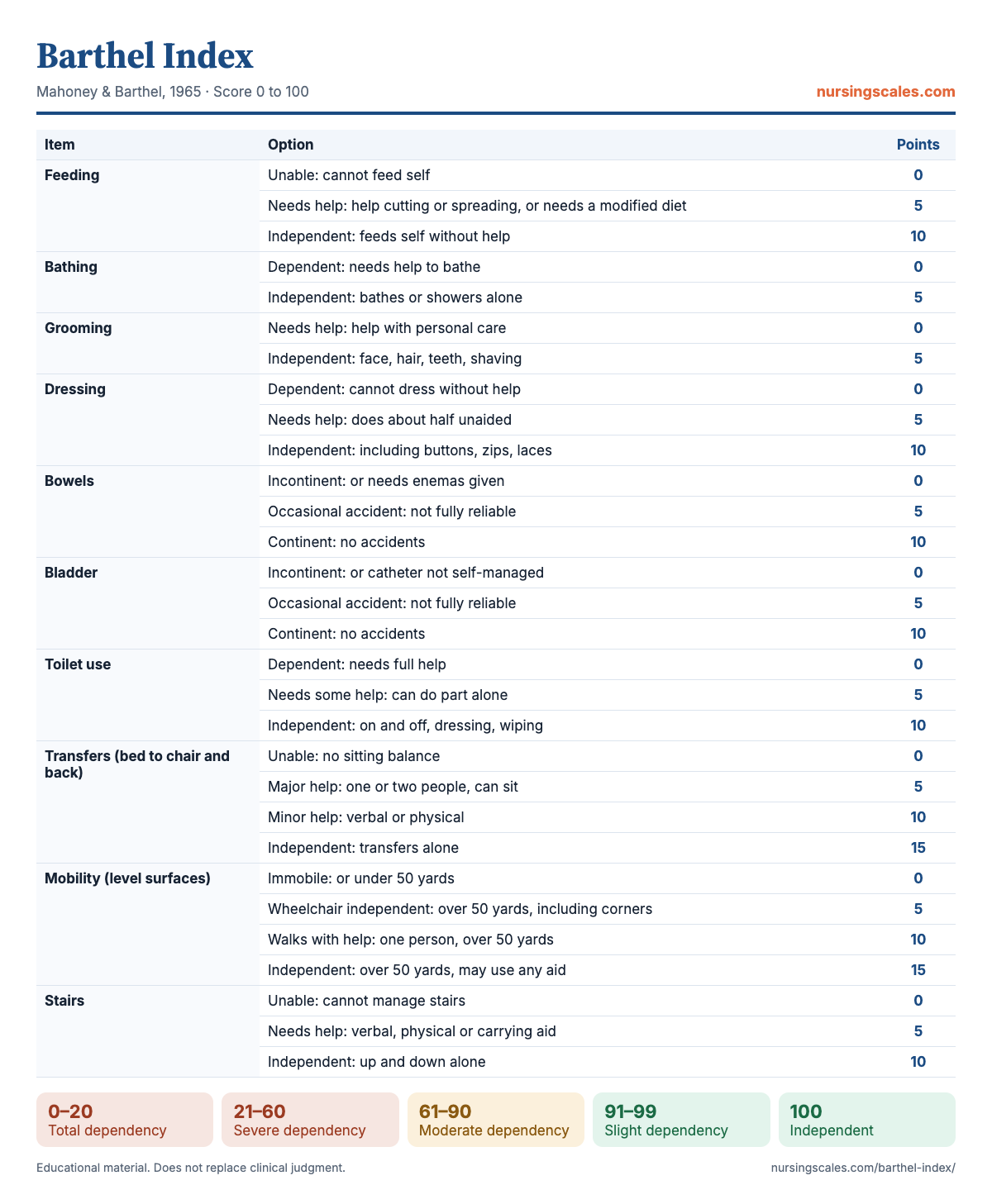
See every item and its points as a table
| Item | Option | Points |
|---|---|---|
| Feeding | Unable: Cannot feed self | 0 |
| Needs help: Help cutting or spreading, or needs a modified diet | 5 | |
| Independent: Feeds self without help | 10 | |
| Bathing | Dependent: Needs help to bathe | 0 |
| Independent: Bathes or showers alone | 5 | |
| Grooming | Needs help: Help with personal care | 0 |
| Independent: Face, hair, teeth, shaving | 5 | |
| Dressing | Dependent: Cannot dress without help | 0 |
| Needs help: Does about half unaided | 5 | |
| Independent: Including buttons, zips, laces | 10 | |
| Bowels | Incontinent: Or needs enemas given | 0 |
| Occasional accident: Not fully reliable | 5 | |
| Continent: No accidents | 10 | |
| Bladder | Incontinent: Or catheter not self-managed | 0 |
| Occasional accident: Not fully reliable | 5 | |
| Continent: No accidents | 10 | |
| Toilet use | Dependent: Needs full help | 0 |
| Needs some help: Can do part alone | 5 | |
| Independent: On and off, dressing, wiping | 10 | |
| Transfers (bed to chair and back) | Unable: No sitting balance | 0 |
| Major help: One or two people, can sit | 5 | |
| Minor help: Verbal or physical | 10 | |
| Independent: Transfers alone | 15 | |
| Mobility (level surfaces) | Immobile: Or under 50 yards | 0 |
| Wheelchair independent: Over 50 yards, including corners | 5 | |
| Walks with help: One person, over 50 yards | 10 | |
| Independent: Over 50 yards, may use any aid | 15 | |
| Stairs | Unable: Cannot manage stairs | 0 |
| Needs help: Verbal, physical or carrying aid | 5 | |
| Independent: Up and down alone | 10 |
When to use it
- On admission to rehabilitation, geriatric or stroke units to set a functional baseline
- After stroke, hip fracture or major surgery to track recovery
- Before discharge to plan home support, equipment or placement
- At regular intervals in long-term care to detect decline
- When deciding staffing and level of nursing assistance
- In home care assessments of older adults
How to score it step by step
- Observe or ask the patient, family and care staff about the last 24-48 hours.
- Score what the patient actually does, not what they might be able to do.
- Count any supervision as not independent.
- Use a middle score only when the patient provides more than half the effort.
- Allow walking aids and devices; using them does not lower the score.
- Add the 10 items, document the total and item scores, and repeat at set intervals.
Common mistakes
- Scoring potential ability instead of actual performance
- Scoring a supervised task as independent
- Recording only the total and losing the item scores that guide care
- Treating a score of 100 as proof the patient can live alone safely
- Mixing up the 0-100 and 0-20 versions when comparing scores
Example case
Patient. Margaret, 78, day 10 after surgical repair of a hip fracture, on a rehabilitation unit.
- Feeding: independent (10)
- Bathing: needs help in the shower (0)
- Grooming: independent with supplies set up (5)
- Dressing: does about half, needs help with socks and shoes (5)
- Bowels: continent (10)
- Bladder: one accident this week (5)
- Toilet use: needs help with clothing (5)
- Transfers: needs verbal cues and light touch (10)
- Mobility: walks 60 yards with a walker and one helper (10)
- Stairs: needs physical help (5)
Score: 65. A score of 65 means moderate dependency. Margaret is safe with some tasks but needs help with bathing, lower body dressing, toileting and stairs.
Nursing actions:
- Document item scores so the team can see which tasks need help
- Coordinate with physical and occupational therapy on transfers, stairs and dressing aids
- Keep fall precautions and toileting assistance in the care plan
- Reassess weekly and start discharge planning for home support or equipment
Frequently asked questions
What is a normal Barthel Index score?
A score of 100 means the patient is independent in all 10 basic ADLs. Scores of 91-99 show slight dependency, 61-90 moderate, 21-60 severe and 0-20 total dependency.
Does using a walker or cane lower the score?
No. Aids are allowed. A patient who walks over 50 yards alone with a walker still scores 15 for mobility.
How often should I repeat the Barthel Index?
Use it on admission, at regular intervals during rehabilitation or long-term care, and before discharge. Follow your facility's schedule.
What is the difference between the 0-100 and 0-20 versions?
They measure the same items. The 0-20 version by Collin and Wade divides each score by 5. Always note which version you used.
Does the Barthel Index measure cognition or household tasks?
No. It covers basic self-care and mobility only. Use other tools for cognition and for instrumental ADLs like cooking or managing money.
Related scales and guides
All scales:
Sources: Barthel Index form (Mahoney & Barthel, via Internet Stroke Center) · Mahoney & Barthel 1965, Functional evaluation: the Barthel Index (PubMed) · Common Measures of Disability, StatPearls (NCBI) · Barthel Index, StrokEngine. Explanations and example case written by our editorial team. Reviewed September 30, 2026.