Resting pulse rate
Measure after the patient has been sitting or lying down for one minute.
Sweating
Rate over the past half hour, not counting sweating explained by room temperature or activity.
Restlessness
Observe during the assessment.
Pupil size
Compare with what is expected for the room light.
Bone or joint aches
If the patient already had pain, score only the extra part attributed to opioid withdrawal.
Runny nose or tearing
Do not count symptoms explained by a cold or allergies.
GI upset
Rate over the last half hour.
Tremor
Observe the outstretched hands.
Yawning
Observe during the assessment.
Anxiety or irritability
Combine what the patient reports with what you observe.
Gooseflesh skin
Look at and feel the skin of the arms.
Result
0range 0 to 48
Review or change your answers
Supports, never replaces, clinical judgment and your facility's protocols. · Reviewed September 30, 2026 by the editorial team under our editorial policy · Wesson & Ling, 2003
What it measures
The COWS measures how severe opioid withdrawal is at the moment you assess it. Most items are things you can observe, such as pulse, pupil size, sweating, tremor, yawning and gooseflesh, which makes the score more reproducible than patient report alone. Repeated scores show whether withdrawal is progressing or settling and help the team time treatment decisions under facility protocols.
Used for: Adults with known or suspected opioid dependence who may be in withdrawal, in inpatient, outpatient, emergency and addiction treatment settings.
Clinical Opiate Withdrawal Scale (COWS) interpretation
| Score | Result | What it means |
|---|---|---|
| 0–4 | Below mild range | The score is below the published mild band. Withdrawal is absent or minimal at this time; reassess if symptoms appear or per protocol. |
| 5–12 | Mild withdrawal | Mild withdrawal. Keep monitoring, offer comfort measures and reassess on schedule. |
| 13–24 | Moderate withdrawal | Moderate withdrawal. Notify the provider and follow your facility's withdrawal or treatment protocol. |
| 25–36 | Moderately severe | Moderately severe withdrawal. Notify the provider promptly, monitor closely and watch fluid balance. |
| 37–48 | Severe withdrawal | Severe withdrawal. Escalate care right away and follow facility protocol for close monitoring and treatment. |
Versions and other cut-offs: The published form defines bands only from 5 upward (5-12 mild, 13-24 moderate, 25-36 moderately severe, more than 36 severe); scores of 0-4 are shown here as below the mild range. Buprenorphine induction protocols often require a minimum COWS score before the first dose, and that threshold varies by protocol, so check yours.
Nursing interventions by Clinical Opiate Withdrawal Scale (COWS) score
Use these nursing actions as a starting point and follow your facility's opioid withdrawal protocol and provider orders.
0–4 Below mild range
- Reassess with the COWS if symptoms appear or at the interval your protocol sets.
- Document the time and type of the last opioid used, since timing affects when withdrawal starts.
- Check vital signs and ask about pain, cravings and mood.
- Encourage fluids and regular meals.
- Tell the patient which symptoms to report, such as sweating, cramps, vomiting or diarrhea.
5–12 Mild withdrawal
- Reassess on the schedule in your protocol and after any treatment.
- Offer comfort measures: warm blankets, a quiet room, rest and reassurance.
- Encourage oral fluids and small, frequent meals, and track intake and output.
- Monitor vital signs, especially heart rate and blood pressure.
- Notify the provider if the score reaches the treatment threshold in your protocol so treatment can be considered.
13–24 Moderate withdrawal
- Notify the provider to consider treatment and follow your withdrawal or treatment protocol.
- Reassess the COWS after each intervention, for example 1 to 2 hours later, or per protocol.
- Give symptom-relief medication for nausea, diarrhea or aches per order.
- Monitor for dehydration: vital signs, intake and output, mucous membranes and skin turgor.
- Keep the environment calm and offer support to reduce anxiety and cravings.
- Watch for signs of other substance use or withdrawal that can change the picture.
25–36 Moderately severe
- Notify the provider promptly and follow orders for treatment.
- Increase monitoring of vital signs and reassess the COWS often, per protocol.
- Assess fluid losses from vomiting and diarrhea; support IV fluids and electrolyte checks as ordered.
- Apply fall precautions if the patient is weak, dizzy or restless.
- Stay with the patient during peaks of distress and offer frequent reassurance.
- Escalate if the patient cannot keep fluids down or vital signs worsen.
37–48 Severe withdrawal
- Escalate care right away per your facility's escalation pathway.
- Keep the patient under close observation with frequent vital signs and COWS scores.
- Support IV fluids and electrolyte replacement as ordered, and monitor intake and output closely.
- Assess for complications such as dehydration, aspiration risk from vomiting, or cardiac strain.
- Follow provider orders for treatment and document the response to each intervention.
- Plan early for addiction consult and referral to ongoing treatment.
Interventions follow SAMHSA TIP 63: Medications for Opioid Use Disorder, ASAM National Practice Guideline for the Treatment of Opioid Use Disorder, 2020 Focused Update, NIDA: Clinical Opiate Withdrawal Scale form. Your facility's protocol and the provider's orders take priority.
Clinical Opiate Withdrawal Scale (COWS) chart and printable PDF
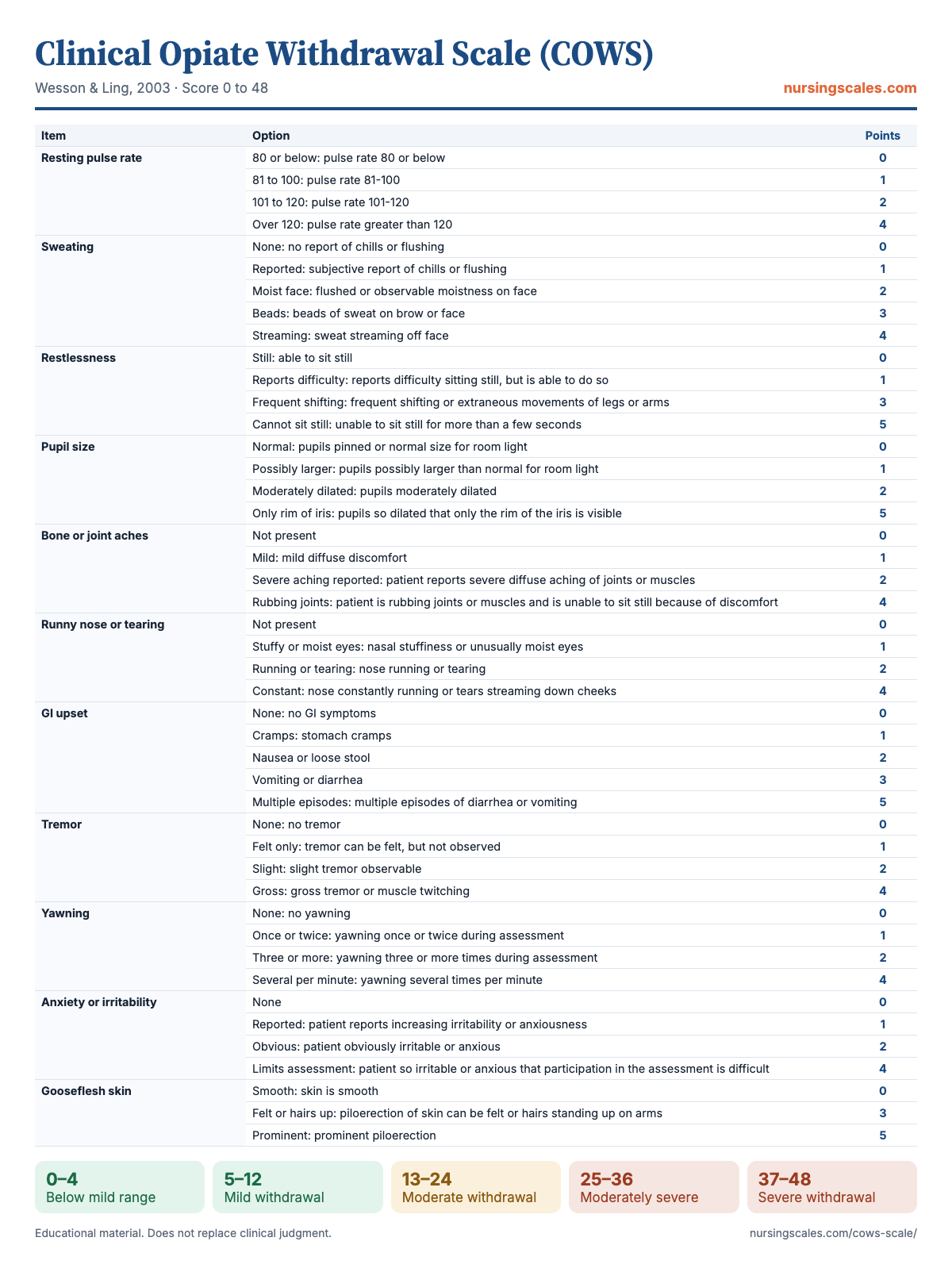
See every item and its points as a table
| Item | Option | Points |
|---|---|---|
| Resting pulse rate | 80 or below: Pulse rate 80 or below | 0 |
| 81 to 100: Pulse rate 81-100 | 1 | |
| 101 to 120: Pulse rate 101-120 | 2 | |
| Over 120: Pulse rate greater than 120 | 4 | |
| Sweating | None: No report of chills or flushing | 0 |
| Reported: Subjective report of chills or flushing | 1 | |
| Moist face: Flushed or observable moistness on face | 2 | |
| Beads: Beads of sweat on brow or face | 3 | |
| Streaming: Sweat streaming off face | 4 | |
| Restlessness | Still: Able to sit still | 0 |
| Reports difficulty: Reports difficulty sitting still, but is able to do so | 1 | |
| Frequent shifting: Frequent shifting or extraneous movements of legs or arms | 3 | |
| Cannot sit still: Unable to sit still for more than a few seconds | 5 | |
| Pupil size | Normal: Pupils pinned or normal size for room light | 0 |
| Possibly larger: Pupils possibly larger than normal for room light | 1 | |
| Moderately dilated: Pupils moderately dilated | 2 | |
| Only rim of iris: Pupils so dilated that only the rim of the iris is visible | 5 | |
| Bone or joint aches | Not present | 0 |
| Mild: Mild diffuse discomfort | 1 | |
| Severe aching reported: Patient reports severe diffuse aching of joints or muscles | 2 | |
| Rubbing joints: Patient is rubbing joints or muscles and is unable to sit still because of discomfort | 4 | |
| Runny nose or tearing | Not present | 0 |
| Stuffy or moist eyes: Nasal stuffiness or unusually moist eyes | 1 | |
| Running or tearing: Nose running or tearing | 2 | |
| Constant: Nose constantly running or tears streaming down cheeks | 4 | |
| GI upset | None: No GI symptoms | 0 |
| Cramps: Stomach cramps | 1 | |
| Nausea or loose stool | 2 | |
| Vomiting or diarrhea | 3 | |
| Multiple episodes: Multiple episodes of diarrhea or vomiting | 5 | |
| Tremor | None: No tremor | 0 |
| Felt only: Tremor can be felt, but not observed | 1 | |
| Slight: Slight tremor observable | 2 | |
| Gross: Gross tremor or muscle twitching | 4 | |
| Yawning | None: No yawning | 0 |
| Once or twice: Yawning once or twice during assessment | 1 | |
| Three or more: Yawning three or more times during assessment | 2 | |
| Several per minute: Yawning several times per minute | 4 | |
| Anxiety or irritability | None | 0 |
| Reported: Patient reports increasing irritability or anxiousness | 1 | |
| Obvious: Patient obviously irritable or anxious | 2 | |
| Limits assessment: Patient so irritable or anxious that participation in the assessment is difficult | 4 | |
| Gooseflesh skin | Smooth: Skin is smooth | 0 |
| Felt or hairs up: Piloerection of skin can be felt or hairs standing up on arms | 3 | |
| Prominent: Prominent piloerection | 5 |
When to use it
- When a patient who uses opioids shows signs of withdrawal, such as yawning, tearing, sweating or dilated pupils
- Before starting opioid use disorder treatment, to document the level of withdrawal the protocol requires
- At scheduled intervals during inpatient or outpatient withdrawal management
- After an opioid antagonist has been given, to track precipitated withdrawal
- When a hospitalized patient with opioid dependence has missed doses of their usual opioid
How to score it step by step
- Have the patient sit or lie down for one minute, then take the resting pulse.
- Observe the patient during the interview for restlessness, yawning, tremor with hands outstretched and gooseflesh.
- Check pupil size against the room light and look for sweating, tearing and runny nose.
- Ask about GI symptoms and sweating over the past half hour, bone or joint aches, and anxiety or irritability.
- Score only what is due to opioid withdrawal, add the 11 items for a total from 0 to 48, and document it with the time.
- Act on the band according to your protocol and set the next reassessment time.
Common mistakes
- Counting signs with another cause, such as a fast pulse after walking, sweating from a warm room or a runny nose from allergies.
- Scoring chronic pain as withdrawal aches instead of only the extra pain attributed to withdrawal.
- Taking the pulse right after the patient moves instead of after one minute at rest.
- Choosing point values that are not on the form, such as 3 for pulse or 4 for restlessness.
- Relying on a single score instead of trending repeated assessments.
Example case
Patient. A 34-year-old woman admitted for cellulitis reports daily use of illicit opioids. Her last use was about 14 hours ago and she says she feels sick.
- Resting pulse 1: 92 beats per minute
- Sweating 2: face flushed and moist
- Restlessness 3: frequent shifting of legs and arms
- Pupil size 2: moderately dilated
- Bone or joint aches 2: reports severe diffuse aching of muscles
- Runny nose or tearing 2: nose running
- GI upset 2: nausea and loose stool
- Tremor 1: can be felt but not seen
- Yawning 2: yawned three times during the assessment
- Anxiety or irritability 2: obviously anxious
- Gooseflesh 3: hairs standing up on arms
Score: 22. A total of 22 falls in the moderate withdrawal band (13-24).
Nursing actions:
- Notify the provider and share the COWS score and time of last opioid use.
- Follow the withdrawal or treatment protocol ordered for the patient.
- Offer comfort measures, fluids and a calm environment.
- Reassess the COWS at the interval your protocol sets.
- Document the score, findings and actions taken.
Frequently asked questions
What COWS score is normal, and what score is severe?
Scores under 5 fall below the published mild band. 5-12 is mild, 13-24 moderate, 25-36 moderately severe and more than 36 severe withdrawal.
What is the highest possible COWS score?
48. Seven items go up to 4 points and four items (restlessness, pupil size, GI upset and gooseflesh) go up to 5.
Why can't I pick 3 points for some items?
The COWS uses fixed point values for each item, and several items skip numbers. Choose only the values printed on the form.
How often should I repeat the COWS?
Follow your facility's protocol. Repeat it at set intervals and whenever symptoms change, so you can trend the scores.
Is the COWS free to use?
Yes. The version published by the authors and distributed by NIDA states that it may be copied and used clinically.
Related scales and guides
All scales:
Sources: Wesson & Ling 2003, The Clinical Opiate Withdrawal Scale (PubMed) · NIDA: Clinical Opiate Withdrawal Scale form. Explanations and example case written by our editorial team. Reviewed September 30, 2026.