Posture
Place the baby supine, quiet, and pick the drawing that best matches the resting position. There is no -1 column.
Square window (wrist)
Flex the hand toward the forearm with gentle pressure and estimate the angle between palm and forearm.
Arm recoil
Flex the elbow, extend the arm briefly, release and note the angle the forearm springs back to. There is no -1 column.
Popliteal angle
With the thigh on the abdomen, extend the lower leg until you feel resistance and measure the knee angle.
Scarf sign
With the head midline, move the hand across the chest and note where the elbow reaches before resistance.
Heel to ear
Hold the thigh alongside the body, draw the foot toward the ear on the same side and note where resistance starts.
Skin
Look at and touch the skin on the trunk and limbs; pick the column that describes it best.
Lanugo
Look at the fine hair on the back and shoulders.
Plantar surface
Look at the sole creases; if there are none, measure heel-to-toe length with a metric tape.
Breast
Look at the areola and gently feel the breast bud between two fingers.
Eye / Ear
Fold the pinna forward and release to judge recoil and cartilage; if lids are fused, check whether gentle traction opens them.
Genitals (male or female)
Use only the row that matches the baby's sex. Male: look at the scrotum and feel for testes. Female: look at the clitoris and labia with hips half abducted.
Result
0range -12 to 50
Review or change your answers
Supports, never replaces, clinical judgment and your facility's protocols. · Reviewed September 30, 2026 by the editorial team under our editorial policy · Jeanne L. Ballard and colleagues, 1991 (original Ballard score, 1979)
What it measures
The New Ballard Score (NBS) is a bedside exam of maturity after birth. You rate passive muscle tone (posture, square window, arm recoil, popliteal angle, scarf sign, heel to ear) and physical traits (skin, lanugo, plantar creases, breast, eye and ear, genitals). The total converts to gestational age in weeks. It helps confirm or challenge dates from the last menstrual period or ultrasound, and classify the baby as preterm, term or post-term, which guides care, growth plotting and risk screening.
Used for: Newborns, including extremely preterm infants from about 20 weeks, sick or ventilated babies (not pharmacologically paralyzed). Most accurate when done in the first hours to days of life; for the most immature infants, ideally within the first day.
New Ballard Score interpretation
| Score | Result | What it means |
|---|---|---|
| -12 to 9 | Extremely preterm (under 28 wk) | Score -10 to 9 matches about 20 to 27 weeks; scores below -10 fall under the table (20 weeks or less). The baby needs NICU-level care; compare with obstetric dating and report to the neonatal provider. |
| 10–19 | Very preterm (28-31 wk) | Score 10-19 matches about 28 to 31 weeks. Expect NICU care; plot growth on a preterm chart and follow unit protocols for thermoregulation and feeding. |
| 20–32 | Moderate to late preterm (32-36 wk) | Score 20-32 matches about 32 to 36 weeks. Watch closely for temperature instability, hypoglycemia, feeding problems and jaundice per protocol. |
| 33–44 | Term (37-41 wk) | Score 33-44 matches about 37 to 41 weeks. Provide routine newborn care and still plot weight to screen for small or large for gestational age. |
| 45–50 | Post-term (42 wk or more) | Score 45-50 matches 42 to 44 weeks. Watch for dry peeling skin, meconium exposure, hypoglycemia and poor growth, and report to the provider. |
Versions and other cut-offs: Maturity table (total score = weeks): -10 = 20, -5 = 22, 0 = 24, 5 = 26, 10 = 28, 15 = 30, 20 = 32, 25 = 34, 30 = 36, 35 = 38, 40 = 40, 45 = 42, 50 = 44, which equals 24 + 0.4 x score; Dr. Ballard advises recording completed weeks, so round down (a score of 27 is 34 weeks). The 1991 New Ballard Score expanded the original 1979 Ballard score (which started at 26 weeks) by adding -1 and -2 columns for extremely preterm infants. Plantar surface and eye/ear allow -2, so the sheet can total below -10; the table's lowest point is 20 weeks.
New Ballard Score chart and printable PDF
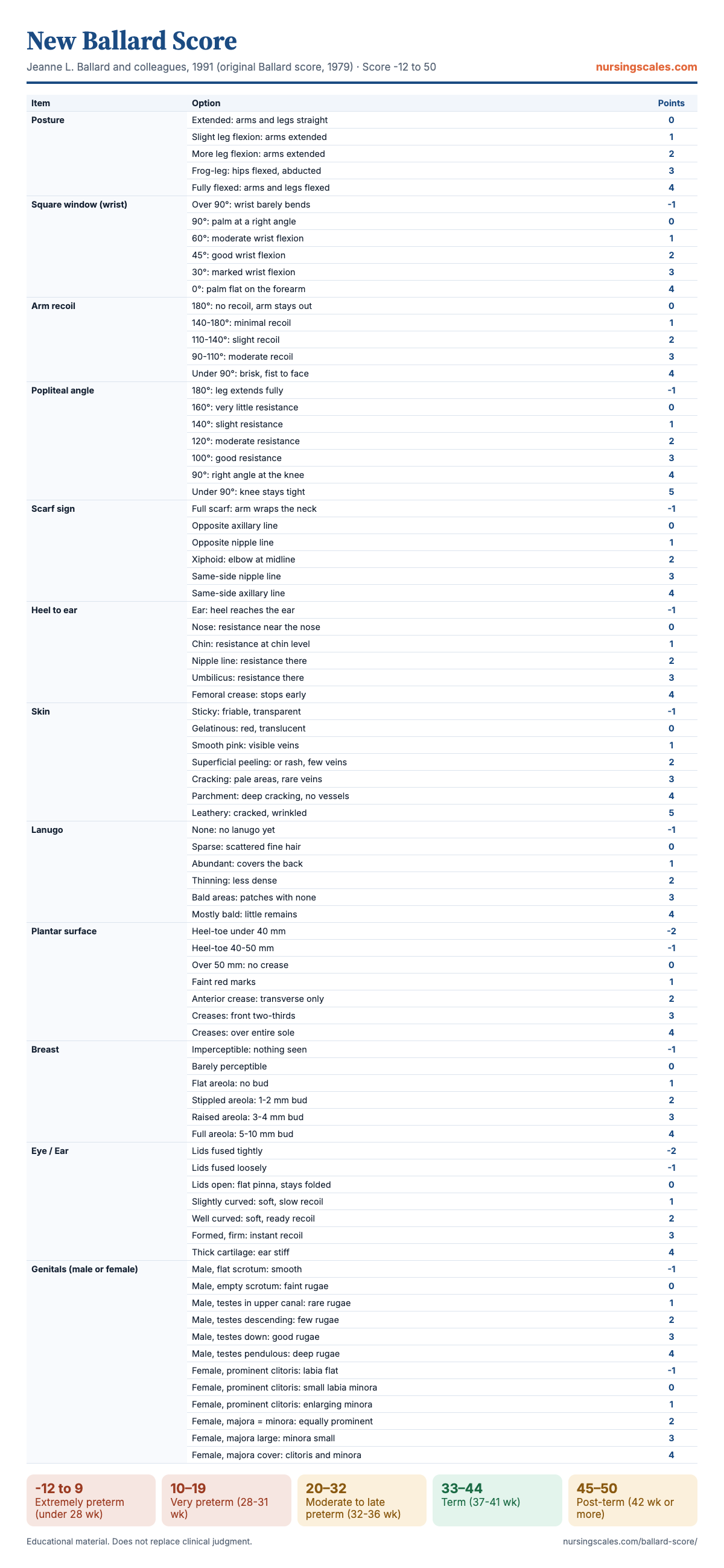
See every item and its points as a table
| Item | Option | Points |
|---|---|---|
| Posture | Extended: Arms and legs straight | 0 |
| Slight leg flexion: Arms extended | 1 | |
| More leg flexion: Arms extended | 2 | |
| Frog-leg: Hips flexed, abducted | 3 | |
| Fully flexed: Arms and legs flexed | 4 | |
| Square window (wrist) | Over 90°: Wrist barely bends | -1 |
| 90°: Palm at a right angle | 0 | |
| 60°: Moderate wrist flexion | 1 | |
| 45°: Good wrist flexion | 2 | |
| 30°: Marked wrist flexion | 3 | |
| 0°: Palm flat on the forearm | 4 | |
| Arm recoil | 180°: No recoil, arm stays out | 0 |
| 140-180°: Minimal recoil | 1 | |
| 110-140°: Slight recoil | 2 | |
| 90-110°: Moderate recoil | 3 | |
| Under 90°: Brisk, fist to face | 4 | |
| Popliteal angle | 180°: Leg extends fully | -1 |
| 160°: Very little resistance | 0 | |
| 140°: Slight resistance | 1 | |
| 120°: Moderate resistance | 2 | |
| 100°: Good resistance | 3 | |
| 90°: Right angle at the knee | 4 | |
| Under 90°: Knee stays tight | 5 | |
| Scarf sign | Full scarf: Arm wraps the neck | -1 |
| Opposite axillary line | 0 | |
| Opposite nipple line | 1 | |
| Xiphoid: Elbow at midline | 2 | |
| Same-side nipple line | 3 | |
| Same-side axillary line | 4 | |
| Heel to ear | Ear: Heel reaches the ear | -1 |
| Nose: Resistance near the nose | 0 | |
| Chin: Resistance at chin level | 1 | |
| Nipple line: Resistance there | 2 | |
| Umbilicus: Resistance there | 3 | |
| Femoral crease: Stops early | 4 | |
| Skin | Sticky: Friable, transparent | -1 |
| Gelatinous: Red, translucent | 0 | |
| Smooth pink: Visible veins | 1 | |
| Superficial peeling: Or rash, few veins | 2 | |
| Cracking: Pale areas, rare veins | 3 | |
| Parchment: Deep cracking, no vessels | 4 | |
| Leathery: Cracked, wrinkled | 5 | |
| Lanugo | None: No lanugo yet | -1 |
| Sparse: Scattered fine hair | 0 | |
| Abundant: Covers the back | 1 | |
| Thinning: Less dense | 2 | |
| Bald areas: Patches with none | 3 | |
| Mostly bald: Little remains | 4 | |
| Plantar surface | Heel-toe under 40 mm | -2 |
| Heel-toe 40-50 mm | -1 | |
| Over 50 mm: no crease | 0 | |
| Faint red marks | 1 | |
| Anterior crease: transverse only | 2 | |
| Creases: front two-thirds | 3 | |
| Creases: over entire sole | 4 | |
| Breast | Imperceptible: Nothing seen | -1 |
| Barely perceptible | 0 | |
| Flat areola: No bud | 1 | |
| Stippled areola: 1-2 mm bud | 2 | |
| Raised areola: 3-4 mm bud | 3 | |
| Full areola: 5-10 mm bud | 4 | |
| Eye / Ear | Lids fused tightly | -2 |
| Lids fused loosely | -1 | |
| Lids open: Flat pinna, stays folded | 0 | |
| Slightly curved: Soft, slow recoil | 1 | |
| Well curved: Soft, ready recoil | 2 | |
| Formed, firm: Instant recoil | 3 | |
| Thick cartilage: Ear stiff | 4 | |
| Genitals (male or female) | Male, flat scrotum: smooth | -1 |
| Male, empty scrotum: faint rugae | 0 | |
| Male, testes in upper canal: rare rugae | 1 | |
| Male, testes descending: few rugae | 2 | |
| Male, testes down: good rugae | 3 | |
| Male, testes pendulous: deep rugae | 4 | |
| Female, prominent clitoris: labia flat | -1 | |
| Female, prominent clitoris: small labia minora | 0 | |
| Female, prominent clitoris: enlarging minora | 1 | |
| Female, majora = minora: equally prominent | 2 | |
| Female, majora large: minora small | 3 | |
| Female, majora cover: clitoris and minora | 4 |
When to use it
- Newborns whose dates are unknown, uncertain or conflict with the baby's size
- Preterm infants admitted to the NICU, to confirm gestational age
- Mothers with no prenatal care or no early ultrasound
- Classifying a baby as small, appropriate or large for gestational age
- Teaching and competency checks for newborn assessment
How to score it step by step
- Do the exam with the baby warm, quiet and supine, ideally in the first 12-24 hours for very preterm infants and before 96 hours for others.
- Score the six neuromuscular signs using passive tone; do not hold limbs extended long, which tires the flexors.
- Score the six physical signs, choosing the column that best matches; use heel-to-toe length and eyelid fusion for the most immature infants.
- If a sign cannot be tested (limb anomaly, frank breech, cryptorchidism), assign a score similar to the other items instead of zero.
- Add the neuromuscular and physical totals and convert to weeks with the maturity table, rounding down to completed weeks.
- Compare with obstetric dating: if the exam is within 2 weeks of reliable dates, keep the dates; document the score and report findings.
Common mistakes
- Scoring a missing sign as 0, which lowers the total and underestimates gestational age.
- Rounding weeks up instead of recording completed weeks.
- Testing tone right after birth stress, during crying, or after holding the arm extended, which lowers neuromuscular scores.
- Scoring popliteal angle in a frank breech baby in the first 24-48 hours.
- Replacing reliable early-ultrasound dating with the exam when the two differ by less than 2 weeks.
Example case
Patient. Baby boy born to a mother with no prenatal care and an unknown last menstrual period. Birth weight 2,150 g. Ballard exam at 10 hours of life:
- Posture: frog-leg, arms slightly flexed (3)
- Square window 45° (2)
- Arm recoil 110-140° (2)
- Popliteal angle 120° (2)
- Scarf sign: elbow reaches the xiphoid (2)
- Heel to ear: resistance at the nipple line (2)
- Skin: superficial peeling, few veins (2)
- Lanugo thinning (2)
- Anterior transverse crease only (2)
- Stippled areola, 1-2 mm bud (2)
- Well-curved pinna, soft with ready recoil (2)
- Testes descending, few rugae (2)
Score: 25. A New Ballard Score of 25 matches 34 weeks. He is a late preterm infant.
Nursing actions:
- Document the score, estimated gestational age and time of the exam
- Plot weight, length and head circumference for 34 weeks to classify growth
- Monitor temperature, blood glucose and feeding per late-preterm protocol
- Report findings to the pediatric provider
Frequently asked questions
What is a normal New Ballard Score?
A total of about 33 to 44 matches term (37 to 41 weeks). Lower totals mean a preterm baby, and 45 or more suggests post-term.
How do you convert the Ballard score to weeks?
Use the maturity table: 0 is 24 weeks and every 5 points adds 2 weeks, up to 50 = 44 weeks. That equals 24 + 0.4 x score; record completed weeks by rounding down.
Why does the score go below zero?
The -1 and -2 columns were added in 1991 so the exam can rate extremely preterm infants down to about 20 weeks.
When should the Ballard exam be done?
As early as the baby is stable. For extremely preterm infants, accuracy is best in the first day of life; for others, within the first few days.
How accurate is the New Ballard Score?
It usually estimates gestational age within about 2 weeks. Early ultrasound dating is more precise, so the exam mostly helps when dates are missing or doubtful.
What if a sign cannot be assessed?
Give it a score similar to the other items. Scoring it 0 falsely lowers the gestational age.
Related scales and guides
All scales:
Sources: The New Ballard Score - official score sheet (ballardscore.com) · Ballard Score FAQ: calculation, timing, missing items · Ballard JL et al. New Ballard Score, expanded to include extremely premature infants. J Pediatr 1991 · WHO: Preterm birth fact sheet (preterm categories) · ACOG Committee Opinion 579: Definition of Term Pregnancy. Explanations and example case written by our editorial team. Reviewed September 30, 2026.