Physical condition
Rate the patient's general physical health and medical stability.
Mental condition
Rate level of consciousness and orientation.
Activity
Rate how far the patient can walk.
Mobility
Rate the ability to move and control the limbs and change position.
Incontinence
Rate bladder and bowel control.
Result
0range 5 to 20
Review or change your answers
Supports, never replaces, clinical judgment and your facility's protocols. · Reviewed September 30, 2026 by the editorial team under our editorial policy · Norton, McLaren & Exton-Smith, 1962
What it measures
The Norton Scale rates physical condition, mental condition, activity, mobility and incontinence. It was the first pressure sore risk tool, built from research in older hospital patients. Its short format makes it quick at the bedside, and a low score tells you to start prevention and look closer at the weakest areas.
Used for: Adults, especially older adults in hospital, long-term care and home care. It was developed in geriatric inpatients.
Norton Scale interpretation
| Score | Result | What it means |
|---|---|---|
| 5–11 | High risk | High risk of pressure injury. Start intensive prevention now, including pressure redistribution, scheduled repositioning and frequent skin checks, and follow your facility protocol. |
| 12–14 | At risk | At risk. Start a prevention plan with repositioning, moisture control and nutrition support, and focus on the lowest-scoring items. |
| 15–20 | Low risk | Low risk by score. Continue routine skin care and reassess when the patient's condition changes. |
Versions and other cut-offs: The standard cut-off is 14 or less for at risk. Norton's original work considered a score below 12 very high risk, and Norton later suggested 15 or 16 to catch more patients at the cost of more false positives. Some facilities use a modified Norton with extra items, so check your local form.
Nursing interventions by Norton Scale score
Use the total score to set the intensity of prevention, then target each item that scored low, such as mobility, activity or incontinence.
5–11 High risk
- Place the patient on a pressure-redistribution support surface.
- Reposition bed-bound and chair-bound patients on a written schedule, at least every 1 to 2 hours unless your protocol or the patient's condition says otherwise.
- Float or offload the heels and use pillows or wedges to keep bony prominences apart.
- Check the skin over bony prominences and under devices at least daily.
- Manage incontinence with prompt cleansing, barrier products and absorbent pads that wick moisture.
- Request a nutritional assessment and keep fluids and supplements available as ordered.
- Keep the head of bed at the lowest angle the patient's condition allows to limit shear.
12–14 At risk
- Start a written repositioning schedule and encourage small weight shifts between turns.
- Use a pressure-redistribution surface if the patient spends most of the day in bed or a chair.
- Protect the heels and get the patient moving as much as safely possible.
- Keep the skin clean and dry, and pair toileting with the repositioning schedule.
- Screen nutrition and fluid intake, and refer to a dietitian if intake is poor.
15–20 Low risk
- Continue routine skin care and a daily skin assessment.
- Encourage mobility and frequent position changes.
- Offer fluids during routine room visits.
- Plan care for any single item that scores low, even though the total is in the low-risk range.
- Reassess when the patient's condition, mobility or continence changes.
Interventions follow AHRQ Preventing Pressure Ulcers in Hospitals: best practices and care planning, AHRQ Quality Indicators Toolkit: pressure ulcer prevention best practices. Your facility's protocol and the provider's orders take priority.
Norton Scale chart and printable PDF
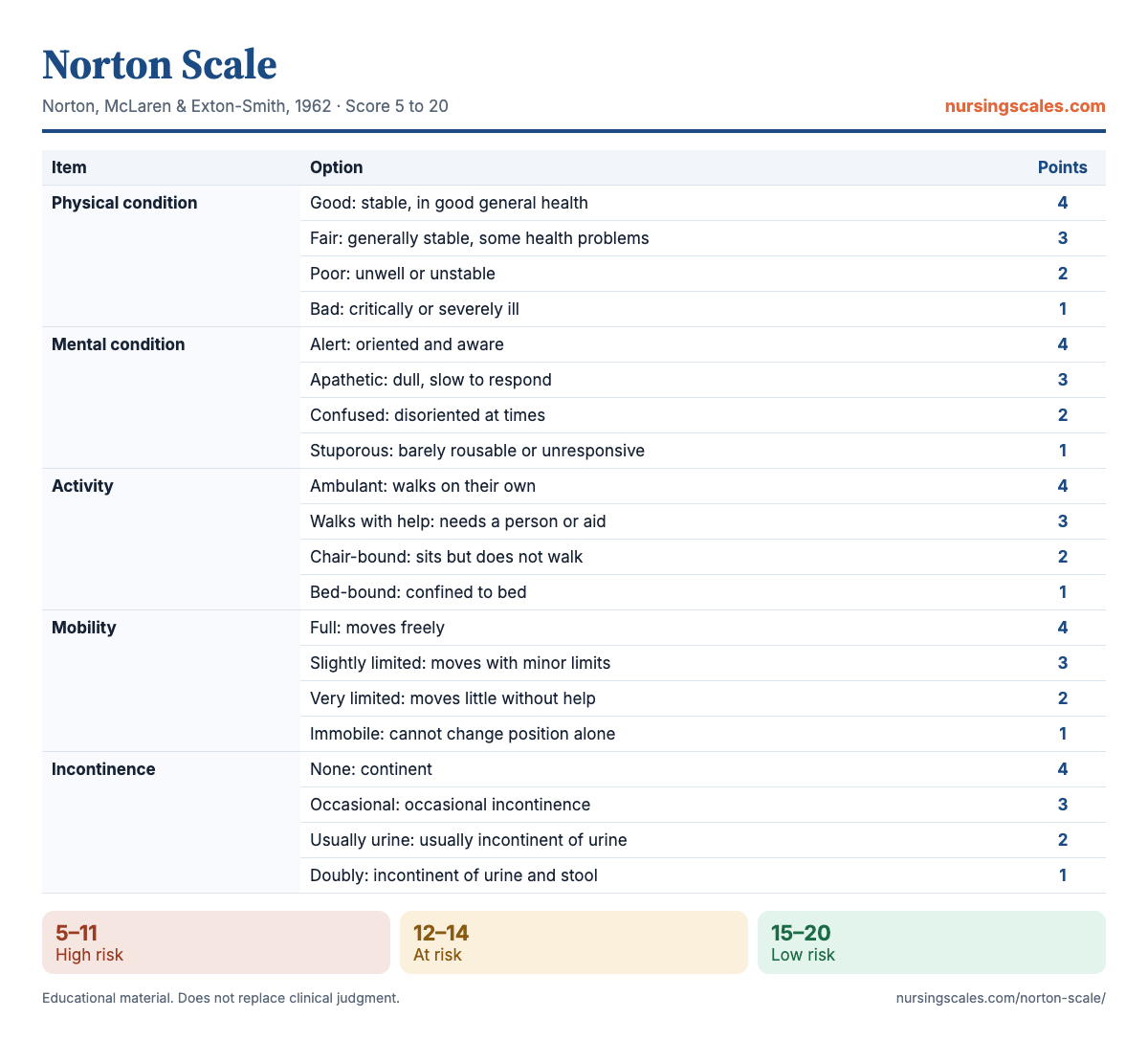
See every item and its points as a table
| Item | Option | Points |
|---|---|---|
| Physical condition | Good: Stable, in good general health | 4 |
| Fair: Generally stable, some health problems | 3 | |
| Poor: Unwell or unstable | 2 | |
| Bad: Critically or severely ill | 1 | |
| Mental condition | Alert: Oriented and aware | 4 |
| Apathetic: Dull, slow to respond | 3 | |
| Confused: Disoriented at times | 2 | |
| Stuporous: Barely rousable or unresponsive | 1 | |
| Activity | Ambulant: Walks on their own | 4 |
| Walks with help: Needs a person or aid | 3 | |
| Chair-bound: Sits but does not walk | 2 | |
| Bed-bound: Confined to bed | 1 | |
| Mobility | Full: Moves freely | 4 |
| Slightly limited: Moves with minor limits | 3 | |
| Very limited: Moves little without help | 2 | |
| Immobile: Cannot change position alone | 1 | |
| Incontinence | None: Continent | 4 |
| Occasional: Occasional incontinence | 3 | |
| Usually urine: Usually incontinent of urine | 2 | |
| Doubly: Incontinent of urine and stool | 1 |
When to use it
- On admission, especially for older adults
- In long-term care and home care as a quick bedside screen
- When mobility drops, such as after surgery or a fall
- When new incontinence or confusion appears
- At regular intervals set by your facility
How to score it step by step
- Observe the patient and review recent notes on health, alertness, walking and continence.
- Score each of the five items from 4 (best) to 1 (worst).
- Add the items for a total between 5 and 20.
- Match the total to a risk level and inspect the skin over bony prominences.
- Plan care around the lowest-scoring items.
- Document the score and reassess on schedule or with any change.
Common mistakes
- Reading a high score as high risk; on the Norton Scale, lower is worse
- Ignoring nutrition, which the Norton Scale does not score directly
- Scoring physical condition from diagnosis alone without looking at the patient
- Not rescoring after new incontinence, sedation or reduced mobility
Example case
Patient. Mrs. T., 84, in a skilled nursing facility after a hip fracture repair. She is slow to respond, sits in a chair with help and has occasional urinary leaks.
- Physical condition: fair, recovering but stable (3)
- Mental condition: apathetic, slow to respond (3)
- Activity: chair-bound (2)
- Mobility: very limited, moves little on her own (2)
- Incontinence: occasional (3)
Score: 13. A total of 13 means Mrs. T. is at risk for a pressure injury.
Nursing actions:
- Set a repositioning schedule in bed and chair
- Use a pressure redistribution cushion and mattress per protocol
- Offer toileting at set times and protect the skin from moisture
- Screen nutrition and hydration, since the scale does not score them
- Rescore with each change and at the facility's set interval
Frequently asked questions
What Norton score is normal and what score is high risk?
Scores of 15 to 20 suggest low risk. A score of 14 or less means the patient is at risk, and a score below 12 means high risk.
Is a higher or lower Norton score worse?
Lower is worse. Each item scores 4 for the best function and 1 for the worst.
What is the difference between the Norton and Braden scales?
Both predict pressure injury risk. Braden has six subscales and scores nutrition, moisture and friction; Norton has five items and scores physical and mental condition and incontinence. Braden is more widely used in the US.
Does the Norton Scale assess nutrition?
No. Assess nutrition and hydration separately, because they affect skin tolerance.
How often should I use the Norton Scale?
Score it on admission and then as often as your facility protocol requires, and any time the patient's condition changes.
Related scales and guides
All scales:
Sources: SCIRE Professional: Norton Pressure Ulcer Risk Scale · Hospital Authority Hong Kong: Norton risk assessment scale · Belgian BEST guideline: De Nortonschaal (cut-offs). Explanations and example case written by our editorial team. Reviewed September 30, 2026.