Facial expression
Watch the face at rest and during care; score any change from relaxed that is not a full grimace as 1.
Body movements
No movement does not necessarily mean no pain.
Muscle tension
Assess by passive flexion and extension of the upper limb (elbow) at rest, or while turning the patient.
Compliance with the ventilator (intubated) OR vocalization (extubated)
Score only one: ventilator compliance if the patient is intubated, vocalization if extubated. Auscultate first, since tube position or secretions can cause coughing that is not pain.
Result
0range 0 to 8
Review or change your answers
Supports, never replaces, clinical judgment and your facility's protocols. · Reviewed September 30, 2026 by the editorial team under our editorial policy · Gélinas, Fillion, Puntillo, Viens & Fortier, 2006 (American Journal of Critical Care)
What it measures
CPOT measures pain through what you can observe at the bedside: facial expression, body movements, muscle tension, and either compliance with the ventilator (intubated) or vocalization (extubated). It was built for critically ill adults who are sedated, intubated or otherwise unable to report pain. A structured score helps you decide when to act, and repeating it after an intervention shows whether pain control worked. It is one of the two behavioral tools the SCCM PADIS guideline recommends for ICU adults.
Used for: Critically ill adults, intubated or not, who cannot self-report pain but have observable motor function. Use self-report whenever the patient can give it.
Critical-Care Pain Observation Tool (CPOT) interpretation
| Score | Result | What it means |
|---|---|---|
| 0–2 | Pain unlikely | Behaviors do not suggest significant pain. Keep reassessing on your unit's schedule, before and during procedures, and after any change. |
| 3–8 | Pain likely | A score above 2 suggests pain. Look for the source, treat per your pain protocol or notify the provider, and reassess CPOT after the intervention to confirm the effect. |
Versions and other cut-offs: The >2 cut-off comes from Gélinas et al. 2009, mainly during painful procedures such as turning (sensitivity 86%, specificity 78%); the same study found >1 at rest. Some units use 3 or more, which is the same threshold. CPOT-Neuro is an adapted version for brain-injured patients, and the Behavioral Pain Scale (BPS) is the main alternative tool.
Critical-Care Pain Observation Tool (CPOT) chart and printable PDF
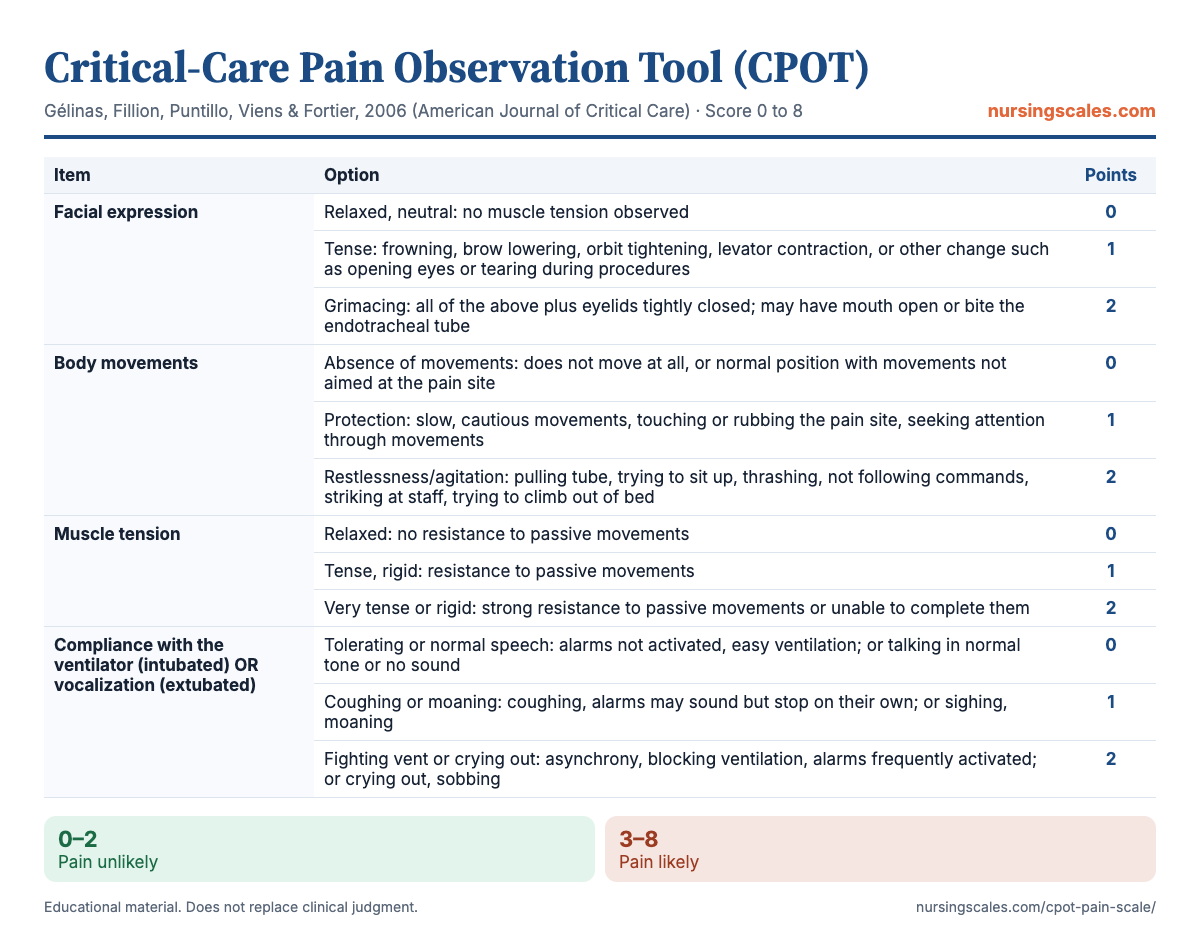
See every item and its points as a table
| Item | Option | Points |
|---|---|---|
| Facial expression | Relaxed, neutral: No muscle tension observed | 0 |
| Tense: Frowning, brow lowering, orbit tightening, levator contraction, or other change such as opening eyes or tearing during procedures | 1 | |
| Grimacing: All of the above plus eyelids tightly closed; may have mouth open or bite the endotracheal tube | 2 | |
| Body movements | Absence of movements: Does not move at all, or normal position with movements not aimed at the pain site | 0 |
| Protection: Slow, cautious movements, touching or rubbing the pain site, seeking attention through movements | 1 | |
| Restlessness/agitation: Pulling tube, trying to sit up, thrashing, not following commands, striking at staff, trying to climb out of bed | 2 | |
| Muscle tension | Relaxed: No resistance to passive movements | 0 |
| Tense, rigid: Resistance to passive movements | 1 | |
| Very tense or rigid: Strong resistance to passive movements or unable to complete them | 2 | |
| Compliance with the ventilator (intubated) OR vocalization (extubated) | Tolerating or normal speech: Alarms not activated, easy ventilation; or talking in normal tone or no sound | 0 |
| Coughing or moaning: Coughing, alarms may sound but stop on their own; or sighing, moaning | 1 | |
| Fighting vent or crying out: Asynchrony, blocking ventilation, alarms frequently activated; or crying out, sobbing | 2 |
When to use it
- Routine pain checks in intubated or sedated ICU adults
- Before, during and after procedures such as turning, suctioning or wound care
- Reassessment after an analgesic or other pain intervention
- Patients with delirium or reduced consciousness who cannot self-report
- Recently extubated patients who cannot yet give a reliable numeric rating
- Alongside sedation scoring (such as RASS) during analgesia-first sedation
How to score it step by step
- Ask the patient to self-report first; use CPOT only if they cannot.
- Observe the patient at rest for about 1 minute and score face, body movements and ventilator compliance or vocalization.
- Assess muscle tension with passive flexion and extension of the arm, or during turning.
- Add the four scores for a total from 0 to 8.
- Document the score, the context (rest or procedure) and any intervention.
- Reassess after treatment within the time your pain policy sets and compare scores.
Common mistakes
- Scoring both ventilator compliance and vocalization instead of only the one that applies
- Reading ventilator alarms or coughing as pain without checking tube position or secretions
- Assuming a still patient has no pain
- Using CPOT in patients who can self-report, or in patients under neuromuscular blockade
- Scoring only at rest and missing pain during turning and other procedures
Example case
Patient. Mr. Johnson, 67 years old, intubated on day 1 after cardiac surgery, assessed during turning.
- Facial expression: tense, frowning and brow lowering (1 point)
- Body movements: slow, cautious movements, reaching toward the sternal wound (1 point)
- Muscle tension: resistance to passive movements (1 point)
- Ventilator compliance: coughing, alarms sound but stop on their own (1 point)
Score: 4. A CPOT of 4 is above the cut-off of 2 and suggests the patient is in pain during turning.
Nursing actions:
- Treat pain per the postoperative order set or notify the provider
- Plan analgesia before the next turn or procedure
- Check the endotracheal tube and suction if secretions are present
- Reassess CPOT after the intervention and document both scores
Frequently asked questions
What is a normal CPOT score and what score means pain?
Scores of 0 to 2 suggest pain is unlikely. A score above 2 (3 or more) suggests pain and should prompt assessment and treatment per your protocol.
What does CPOT stand for?
Critical-Care Pain Observation Tool. It was developed by Céline Gélinas and colleagues in 2006 for ICU adults who cannot report their pain.
Do you score both ventilator compliance and vocalization?
No. Use ventilator compliance for intubated patients and vocalization for extubated patients. The total always stays 0 to 8.
How do you assess muscle tension on the CPOT?
Flex and extend the patient's arm at the elbow while they are at rest, or feel for resistance while turning them. Strong resistance or being unable to complete the movement scores 2.
What is the difference between CPOT and BPS?
Both are behavioral pain tools recommended for ICU adults. BPS scores face, upper limbs and ventilator compliance from 3 to 12. CPOT adds muscle tension, covers extubated patients with vocalization, and scores 0 to 8.
Can you use CPOT for a patient on a paralytic?
No. Neuromuscular blockade removes the behaviors CPOT relies on. Follow your unit's approach for pain management during paralysis.
Related scales and guides
All scales:
Sources: Gélinas et al. Validation of the CPOT in adult patients, Am J Crit Care 2006 (PubMed) · Gélinas et al. Sensitivity and specificity of the CPOT, J Pain Symptom Manage 2009 · CPOT scoring form and behavior descriptions (adapted from Gélinas 2006) · LHSC: Critical-Care Pain Observation Tool form · Health Assessment: Pain Assessment in Critical Care (TMU Pressbooks). Explanations and example case written by our editorial team. Reviewed September 30, 2026.