Result
0points
Supports, never replaces, clinical judgment and your facility's protocols. · Reviewed September 30, 2026 by the editorial team under our editorial policy · Joseph A. Caprini, 2005 version (Dis Mon 2005), based on a model first described in 1991
What it measures
The Caprini score assesses how likely a hospitalized patient, mainly a surgical patient, is to develop a blood clot in the veins. It combines age, the type of surgery, recent illness, mobility, personal and family history of clots, inherited clotting disorders and, for women, hormone and pregnancy factors. Factors that carry a stronger link to VTE earn more points. The total places the patient in a risk category that guides the choice between early walking, mechanical prophylaxis, pharmacologic prophylaxis or both.
Used for: Adult hospitalized patients, especially general, abdominal-pelvic, bariatric, vascular, plastic and reconstructive surgery patients. It is also used for some medical inpatients. Not designed for children.
Caprini Risk Assessment Model (Caprini Score) interpretation
| Score | Result | What it means |
|---|---|---|
| 0 | Very low risk | No risk factors checked. Early and frequent ambulation is usually enough; reassess if the patient's condition or mobility changes. |
| 1–2 | Low risk | Mechanical prophylaxis, such as intermittent pneumatic compression, is usually suggested along with early ambulation. Follow your facility protocol. |
| 3–4 | Moderate risk | Pharmacologic and/or mechanical prophylaxis per protocol, weighed against the patient's bleeding risk. Confirm the plan with the provider. |
| 5–88 | High risk (5 or more) | Pharmacologic prophylaxis, often combined with mechanical prophylaxis, is usually indicated unless bleeding risk is high. Make sure an order is in place and document it. |
Versions and other cut-offs: The categories used here (0 very low, 1-2 low, 3-4 moderate, 5 or more high) come from the 2012 ACCP guideline for nonorthopedic surgical patients. The original 2005 form and the Bahl 2010 validation used 0-1 low, 2 moderate, 3-4 high and 5 or more highest, and Bahl found VTE rates keep rising at 7-8 and above 8. Later revisions (2010, 2013) add or reweight some factors, so check which form your facility uses.
Nursing interventions by Caprini Risk Assessment Model (Caprini Score) score
The Caprini category points to the prophylaxis the provider is likely to order; your role is early mobility, correct use of mechanical devices, and making sure the ordered plan matches the risk and the bleeding-risk review.
0 Very low risk
- Get the patient out of bed and walking early and often.
- Teach the patient to avoid long periods of sitting or lying still.
- Encourage fluids unless restricted.
- Recalculate the score if the patient's mobility, surgery plan or condition changes.
1–2 Low risk
- Promote early and frequent ambulation.
- Apply mechanical prophylaxis, such as intermittent pneumatic compression, per order.
- Check that devices fit correctly, are on whenever the patient is in bed, and do not injure the skin.
- Teach leg and ankle exercises for times the patient is in bed.
- Recalculate the score if risk factors change.
3–4 Moderate risk
- Confirm there is a prophylaxis order, pharmacologic or mechanical, and that a bleeding-risk review has been documented.
- Apply mechanical prophylaxis per order and document device use each shift.
- Promote early and frequent ambulation.
- Monitor for bleeding if pharmacologic prophylaxis is ordered, and report any signs promptly.
- Teach the patient the signs of DVT and PE and to report them right away.
5–88 High risk (5 or more)
- Confirm a pharmacologic prophylaxis order and a documented bleeding-risk review; if pharmacologic prophylaxis is held for bleeding risk, make sure mechanical prophylaxis is ordered.
- Apply mechanical prophylaxis per order, often in addition to the pharmacologic order.
- Give prophylaxis on time and document any missed or refused doses.
- Promote early and frequent ambulation as the patient's condition allows.
- Monitor for bleeding and for signs of DVT or PE, and escalate right away.
- Ask whether extended prophylaxis after discharge is planned, and teach the patient how to follow it.
Interventions follow Gould et al. Prevention of VTE in nonorthopedic surgical patients, CHEST 2012, Merck Manual: Prophylaxis based on Caprini score. Your facility's protocol and the provider's orders take priority.
Caprini Risk Assessment Model (Caprini Score) chart and printable PDF
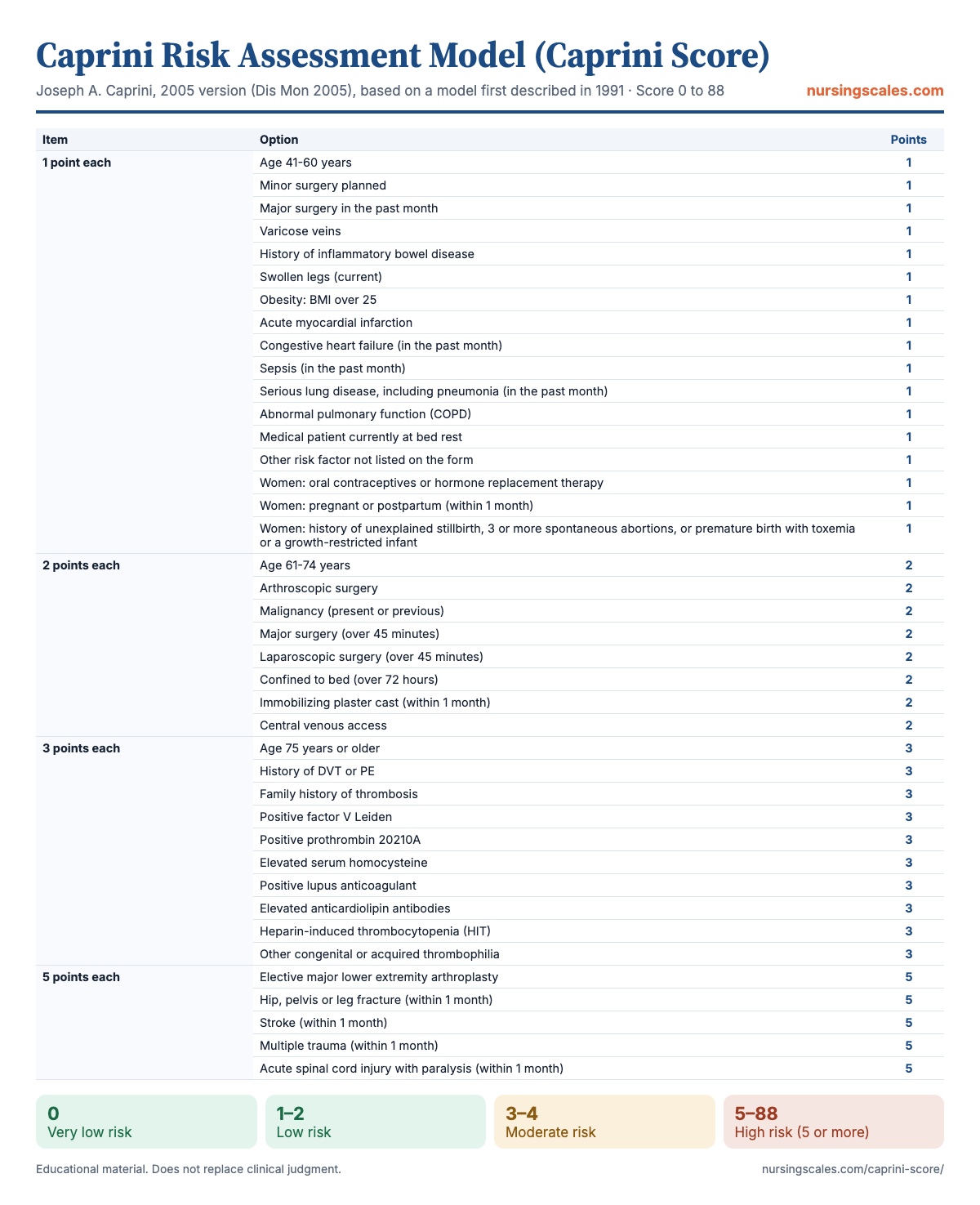
See every item and its points as a table
| Item | Option | Points |
|---|---|---|
| 1 point each | Age 41-60 years | 1 |
| Minor surgery planned | 1 | |
| Major surgery in the past month | 1 | |
| Varicose veins | 1 | |
| History of inflammatory bowel disease | 1 | |
| Swollen legs (current) | 1 | |
| Obesity: BMI over 25 | 1 | |
| Acute myocardial infarction | 1 | |
| Congestive heart failure (in the past month) | 1 | |
| Sepsis (in the past month) | 1 | |
| Serious lung disease, including pneumonia (in the past month) | 1 | |
| Abnormal pulmonary function (COPD) | 1 | |
| Medical patient currently at bed rest | 1 | |
| Other risk factor not listed on the form | 1 | |
| Women: oral contraceptives or hormone replacement therapy | 1 | |
| Women: pregnant or postpartum (within 1 month) | 1 | |
| Women: history of unexplained stillbirth, 3 or more spontaneous abortions, or premature birth with toxemia or a growth-restricted infant | 1 | |
| 2 points each | Age 61-74 years | 2 |
| Arthroscopic surgery | 2 | |
| Malignancy (present or previous) | 2 | |
| Major surgery (over 45 minutes) | 2 | |
| Laparoscopic surgery (over 45 minutes) | 2 | |
| Confined to bed (over 72 hours) | 2 | |
| Immobilizing plaster cast (within 1 month) | 2 | |
| Central venous access | 2 | |
| 3 points each | Age 75 years or older | 3 |
| History of DVT or PE | 3 | |
| Family history of thrombosis | 3 | |
| Positive factor V Leiden | 3 | |
| Positive prothrombin 20210A | 3 | |
| Elevated serum homocysteine | 3 | |
| Positive lupus anticoagulant | 3 | |
| Elevated anticardiolipin antibodies | 3 | |
| Heparin-induced thrombocytopenia (HIT) | 3 | |
| Other congenital or acquired thrombophilia | 3 | |
| 5 points each | Elective major lower extremity arthroplasty | 5 |
| Hip, pelvis or leg fracture (within 1 month) | 5 | |
| Stroke (within 1 month) | 5 | |
| Multiple trauma (within 1 month) | 5 | |
| Acute spinal cord injury with paralysis (within 1 month) | 5 |
When to use it
- Before elective surgery, at the preoperative visit or on admission
- On admission of a surgical or trauma patient
- After a change in the surgical plan or a return to the operating room
- When a patient becomes immobile or confined to bed
- At transfer between units or levels of care
- Before discharge, to help decide on extended prophylaxis per protocol
How to score it step by step
- Review the history, surgical plan, medication list, labs and family history of clots.
- Check only one age band that matches the patient's age.
- Check every other factor that is present; factors marked 'within 1 month' count only if recent.
- Add the points of all checked factors to get the total.
- Find the risk category and review prophylaxis with the provider, considering bleeding risk.
- Document the score, the category and the prophylaxis in place, and reassess when the condition changes.
Common mistakes
- Checking more than one age band
- Skipping the family history of clots or the thrombophilia questions
- Scoring the type of surgery by its name instead of its expected length
- Scoring once on admission and not again after surgery or a new immobility
- Treating a low score as a reason to skip early ambulation
Example case
Patient. Linda, 67, admitted for an open colon resection for colon cancer.
- Age 67 years (2 points)
- Malignancy (2 points)
- Major surgery over 45 minutes (2 points)
- BMI 31 (1 point)
- Varicose veins (1 point)
Score: 8. A Caprini score of 8 is high risk (5 or more).
Nursing actions:
- Confirm pharmacologic and/or mechanical prophylaxis per protocol with the surgeon
- Check for bleeding risk and contraindications before the first dose
- Apply intermittent pneumatic compression devices and check their fit each shift
- Encourage early ambulation after surgery as soon as allowed
- Document the score, category and prophylaxis ordered
Frequently asked questions
What is a normal Caprini score?
A score of 0 means very low risk. Scores of 1-2 are low risk, 3-4 moderate risk, and 5 or more high risk under the 2012 ACCP categories.
Why can I check only one age band?
Age is scored once. A patient aged 41-60 earns 1 point, 61-74 earns 2 and 75 or older earns 3. Checking more than one would count age twice.
Does a high Caprini score mean the patient needs an anticoagulant?
It means the risk of a clot is high, so pharmacologic prophylaxis is usually considered. The provider decides after weighing bleeding risk and your facility protocol.
Is the Caprini score used for medical patients?
It was built mainly for surgical patients, and most validation studies are surgical. Many hospitals use the Padua score or IMPROVE for medical inpatients.
What is the difference between the 2005 and 2013 Caprini versions?
Later revisions add or reweight some factors. The 2005 version is the one most often cited in validation studies, so check which form your facility uses.
How often should I recalculate the Caprini score?
Reassess after surgery, when mobility changes, at transfer and before discharge, or as your facility policy requires.
Related scales and guides
All scales:
Sources: ASPS VTE Task Force: 2005 Caprini risk assessment form · Merck Manual: Prophylaxis based on Caprini score (Gould, CHEST 2012) · Gould et al. Prevention of VTE in nonorthopedic surgical patients, CHEST 2012 · Bahl et al. Validation of a retrospective VTE risk assessment model, Ann Surg 2010 · J Pers Med 2019: Caprini risk categories and subgroups. Explanations and example case written by our editorial team. Reviewed September 30, 2026.