In the past 7 days: I have been able to laugh and see the funny side of things
The patient picks the answer closest to how she has felt over the past 7 days, not just today.
In the past 7 days: I have looked forward with enjoyment to things
In the past 7 days: I have blamed myself unnecessarily when things went wrong
Reverse-scored item: the first answer scores 3.
In the past 7 days: I have been anxious or worried for no good reason
In the past 7 days: I have felt scared or panicky for no very good reason
Reverse-scored item: the first answer scores 3.
In the past 7 days: Things have been getting on top of me
Reverse-scored item: the first answer scores 3.
In the past 7 days: I have been so unhappy that I have had difficulty sleeping
Reverse-scored item: the first answer scores 3.
In the past 7 days: I have felt sad or miserable
Reverse-scored item: the first answer scores 3.
In the past 7 days: I have been so unhappy that I have been crying
Reverse-scored item: the first answer scores 3.
In the past 7 days: The thought of harming myself has occurred to me
Reverse-scored item. Check this answer every time, whatever the total: any answer other than "Never" needs same-day assessment.
Result
0range 0 to 30
Item 10 is above 0: the patient reports thoughts of harming herself. This needs same-day assessment of safety and suicide risk under your facility's protocol, regardless of the total score. Do not leave the patient alone if risk seems immediate, and notify the provider or crisis team. In the US, the 988 Suicide & Crisis Lifeline (call or text 988) is available 24/7 for patients and families.
Review or change your answers
Safety item: "The thought of harming myself has occurred to me". Any answer scoring above 0 needs same-day safety assessment under your facility's protocol, whatever the total score.
EPDS items reproduced with the authors’ permission: Cox JL, Holden JM, Sagovsky R. Detection of postnatal depression: development of the 10-item Edinburgh Postnatal Depression Scale. Br J Psychiatry. 1987;150:782-786.
Supports, never replaces, clinical judgment and your facility's protocols. · Reviewed September 30, 2026 by the editorial team under our editorial policy · Cox, Holden & Sagovsky, 1987 (British Journal of Psychiatry)
What it measures
The EPDS asks how the person has felt in the past 7 days: mood, loss of enjoyment, self-blame, anxiety, panic, coping, sleep problems linked to unhappiness, sadness, crying and thoughts of self-harm. It leaves out physical symptoms such as fatigue and appetite change, which are common after birth anyway, so it picks up depression that could be missed. It is a screening tool, not a diagnosis: a positive result tells you who needs a full clinical assessment. Item 10 also flags possible suicidal thinking that needs action regardless of the total.
Used for: People who are pregnant or up to 12 months after birth, screened in prenatal, postpartum, pediatric well-baby and primary care visits. It has also been studied in partners and fathers with a lower cut-off.
Edinburgh Postnatal Depression Scale (EPDS) interpretation
| Score | Result | What it means |
|---|---|---|
| 0–9 | Negative screen | Depression is unlikely based on this screen. Still check item 10, give anticipatory guidance, and rescreen at the next scheduled visit or sooner if symptoms appear. |
| 10–12 | Possible depression | Positive screen at the common US cut-off of 10. Arrange a full clinical assessment and follow-up per your protocol, and check item 10. |
| 13–19 | Probable depression | Score above the original 12/13 cut-off: depression is probable. Refer for prompt diagnostic evaluation and treatment planning, and check item 10. |
| 20–30 | Probable severe depression | High score consistent with severe symptoms. Notify the provider for urgent evaluation the same day per protocol and assess safety, including item 10. |
Versions and other cut-offs: Cox's 1987 validation used above 12 (13 or more) for probable depression. ACOG recommends 10 or more as a positive screen and describes 10-14 as mild, 15-19 as moderate and above 19 as severe symptoms; some studies find 11 or more gives the best balance for major depression. Lower cut-offs (around 5-6 per Postpartum Support International) are suggested for fathers, and an anxiety subscale (items 3, 4 and 5, EPDS-3A) is used in some settings.
Edinburgh Postnatal Depression Scale (EPDS) chart and printable PDF
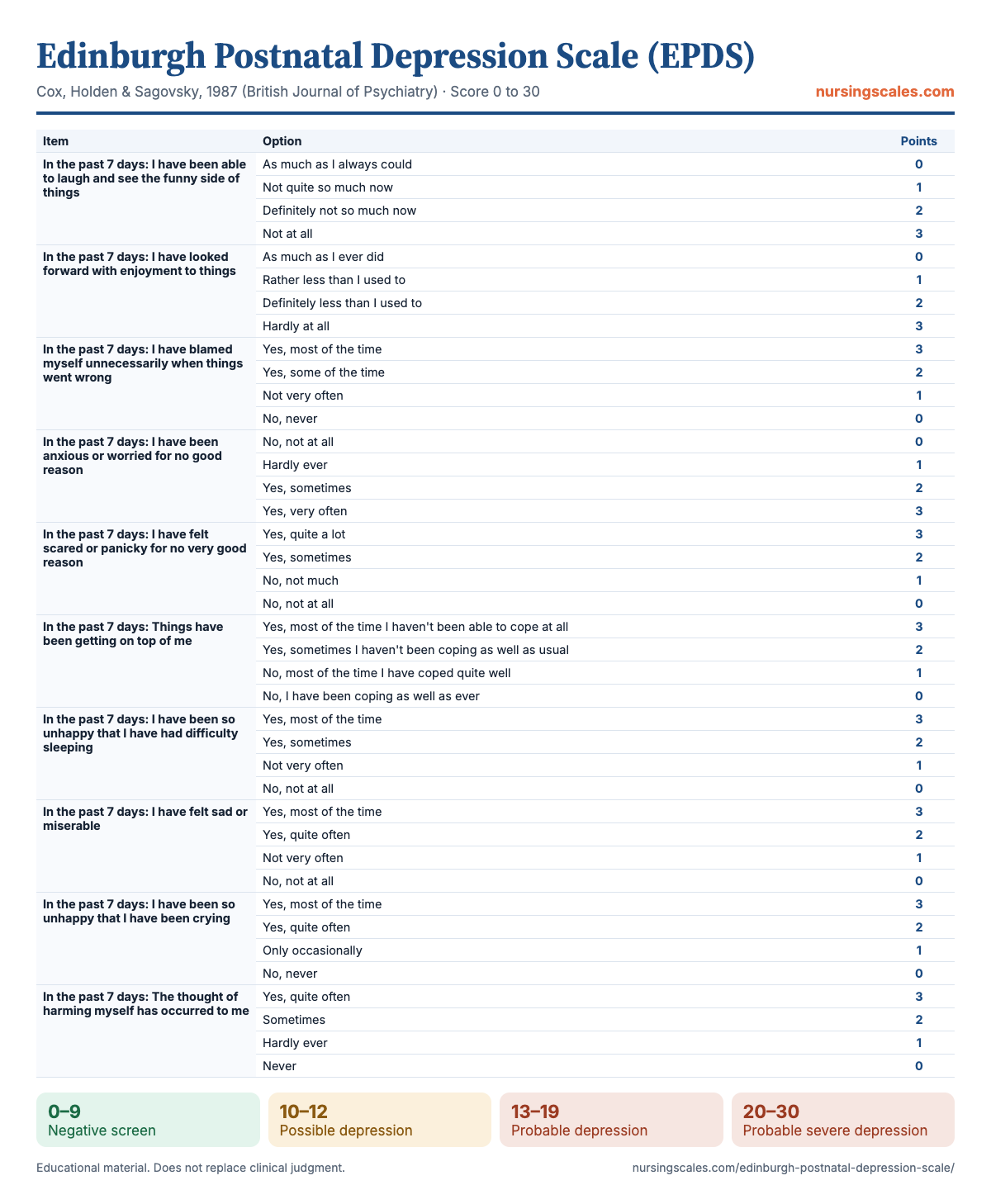
See every item and its points as a table
| Item | Option | Points |
|---|---|---|
| In the past 7 days: I have been able to laugh and see the funny side of things | As much as I always could | 0 |
| Not quite so much now | 1 | |
| Definitely not so much now | 2 | |
| Not at all | 3 | |
| In the past 7 days: I have looked forward with enjoyment to things | As much as I ever did | 0 |
| Rather less than I used to | 1 | |
| Definitely less than I used to | 2 | |
| Hardly at all | 3 | |
| In the past 7 days: I have blamed myself unnecessarily when things went wrong | Yes, most of the time | 3 |
| Yes, some of the time | 2 | |
| Not very often | 1 | |
| No, never | 0 | |
| In the past 7 days: I have been anxious or worried for no good reason | No, not at all | 0 |
| Hardly ever | 1 | |
| Yes, sometimes | 2 | |
| Yes, very often | 3 | |
| In the past 7 days: I have felt scared or panicky for no very good reason | Yes, quite a lot | 3 |
| Yes, sometimes | 2 | |
| No, not much | 1 | |
| No, not at all | 0 | |
| In the past 7 days: Things have been getting on top of me | Yes, most of the time I haven't been able to cope at all | 3 |
| Yes, sometimes I haven't been coping as well as usual | 2 | |
| No, most of the time I have coped quite well | 1 | |
| No, I have been coping as well as ever | 0 | |
| In the past 7 days: I have been so unhappy that I have had difficulty sleeping | Yes, most of the time | 3 |
| Yes, sometimes | 2 | |
| Not very often | 1 | |
| No, not at all | 0 | |
| In the past 7 days: I have felt sad or miserable | Yes, most of the time | 3 |
| Yes, quite often | 2 | |
| Not very often | 1 | |
| No, not at all | 0 | |
| In the past 7 days: I have been so unhappy that I have been crying | Yes, most of the time | 3 |
| Yes, quite often | 2 | |
| Only occasionally | 1 | |
| No, never | 0 | |
| In the past 7 days: The thought of harming myself has occurred to me | Yes, quite often | 3 |
| Sometimes | 2 | |
| Hardly ever | 1 | |
| Never | 0 |
When to use it
- Prenatal visits, at least once during pregnancy
- Postpartum visits, including the comprehensive postpartum visit
- Pediatric well-baby visits in the first 6 months, screening the parent
- When a pregnant or postpartum patient reports low mood, anxiety or poor coping
- Before discharge from the birth hospitalization when your unit screens there
- Follow-up to track symptoms after a positive screen or during treatment
How to score it step by step
- Explain that the questions are about how she has felt in the past 7 days, not just today.
- Let the patient complete all 10 items herself, in private, without discussing answers with others; read aloud only if language or reading limits require it.
- Score each item 0 to 3, taking care with the reverse-scored items 3 and 5-10.
- Add the 10 scores for a total from 0 to 30.
- Check item 10 separately; any score above 0 needs same-day safety assessment.
- Discuss the result, document the score and item 10 answer, and refer or follow up per protocol.
Common mistakes
- Scoring all items the same direction and missing the reverse-scored items 3 and 5-10
- Looking only at the total and not at item 10
- Treating the EPDS as a diagnosis instead of a screen that needs clinical assessment
- Letting a partner or relative answer or influence the answers
- Screening without a plan for referral and follow-up of positive results
Example case
Patient. Maria, 29 years old, 6 weeks after her first vaginal birth, at her postpartum visit.
- Item 1, laugh and see the funny side: not quite so much now (1 point)
- Item 2, looked forward with enjoyment: definitely less than I used to (2 points)
- Item 3, blamed myself unnecessarily: yes, some of the time (2 points)
- Item 4, anxious or worried: yes, sometimes (2 points)
- Item 5, scared or panicky: no, not much (1 point)
- Item 6, things getting on top of me: yes, sometimes not coping as well as usual (2 points)
- Item 7, difficulty sleeping from unhappiness: not very often (1 point)
- Item 8, sad or miserable: yes, quite often (2 points)
- Item 9, crying: only occasionally (1 point)
- Item 10, thought of harming myself: never (0 points)
Score: 14. An EPDS of 14 is a positive screen for probable depression. Item 10 is 0, so there is no reported self-harm thinking at this time.
Nursing actions:
- Discuss the result with Maria in private and without judgment
- Notify the provider for a full diagnostic assessment
- Arrange referral to perinatal mental health services per protocol
- Ask about support at home, sleep and infant care
- Document the total, the item 10 answer and the follow-up plan
Frequently asked questions
What is a normal EPDS score and what score is positive?
Scores of 0 to 9 are a negative screen. ACOG uses 10 or more as a positive screen, and 13 or more points to probable depression. Any answer above 0 on item 10 needs same-day follow-up, whatever the total.
Which EPDS items are reverse scored?
Items 3 and 5 through 10 are reverse scored: the first answer listed scores 3 and the last scores 0. Items 1, 2 and 4 score 0 for the first answer and 3 for the last.
What should you do if item 10 is positive?
Assess safety the same day under your facility's protocol, even if the total is low. Notify the provider or crisis team and do not leave the patient alone if risk seems immediate. Share the 988 Suicide & Crisis Lifeline.
Can the EPDS be used during pregnancy?
Yes. It is validated for use in pregnancy and up to a year after birth. ACOG recommends screening at least once during pregnancy and again after birth.
Is the EPDS free to use?
Yes. The authors allow reproduction without further permission as long as each copy cites Cox, Holden and Sagovsky, the paper title and the British Journal of Psychiatry, 1987.
Does a high EPDS score mean the patient has postpartum depression?
No. The EPDS screens; it does not diagnose. A positive result means the patient needs a clinical assessment to confirm or rule out depression or another condition.
Related scales and guides
All scales:
Sources: Cox, Holden & Sagovsky. Detection of postnatal depression, Br J Psychiatry 1987 (PubMed) · EPDS form with scoring and reproduction notice (WashU) · ACOG Clinical Practice Guideline No. 4: Screening and Diagnosis of Mental Health Conditions During Pregnancy and Postpartum · Postpartum Support International: Screening Recommendations · 988 Suicide & Crisis Lifeline. EPDS items reproduced with the authors’ permission: Cox JL, Holden JM, Sagovsky R. Detection of postnatal depression: development of the 10-item Edinburgh Postnatal Depression Scale. Br J Psychiatry. 1987;150:782-786.Explanations and example case written by our editorial team. Reviewed September 30, 2026.