Systolic blood pressure (mmHg)
Use the current systolic reading.
Heart rate (beats/min)
Count for a full minute if the rhythm is irregular.
Respiratory rate (breaths/min)
Count for a full minute without telling the patient.
Temperature
Use the same route each time when you can.
Level of consciousness (AVPU)
Record the best response you get.
Result
0range 0 to 14
Review or change your answers
Supports, never replaces, clinical judgment and your facility's protocols. · Reviewed September 30, 2026 by the editorial team under our editorial policy · Subbe, Kruger, Rutherford & Gemmel, 2001 (adapted from Morgan's Early Warning Score)
What it measures
MEWS tracks physiological deterioration in adult inpatients. It scores systolic blood pressure, heart rate, respiratory rate, temperature and level of consciousness. Patients often show abnormal vital signs hours before a cardiac arrest or ICU transfer. A single number helps you notice the trend and escalate early instead of waiting for one very abnormal value.
Used for: Adult inpatients, especially on medical and surgical wards and in emergency admissions. Not validated for children or pregnancy.
Modified Early Warning Score (MEWS) interpretation
| Score | Result | What it means |
|---|---|---|
| 0–4 | Below trigger | Below the published trigger of 5. Continue observations per protocol, and escalate for a rising score, any single very abnormal value, or your own concern. |
| 5–14 | High risk (5 or more) | Linked to a higher risk of death and ICU admission. Notify the provider or rapid response team per your escalation policy and increase monitoring. |
Versions and other cut-offs: MEWS was never centrally standardized, so hospitals and EHRs use different ranges and triggers; many escalate at 3 or 4, or for any single parameter scoring 3. Some versions add urine output, oxygen saturation or nurse concern, and the original lists heart rate below 40 for 2 points. NEWS2 is a separate, standardized UK score and is not the same tool.
Nursing interventions by Modified Early Warning Score (MEWS) score
Escalation thresholds, observation frequency and response times are set by each hospital, so use these actions within your local policy.
0–4 Below trigger
- Continue observations at the frequency your policy sets; NICE advises at least every 12 hours for adult inpatients.
- Recalculate the score with every full set of vital signs and compare it with the last one.
- Increase observation frequency and alert the nurse in charge if the score is rising.
- Escalate for any single very abnormal value, even when the total stays low.
- Act on your own concern or the family's concern, whatever the score.
- Document the score, the time and any action taken.
5–14 High risk (5 or more)
- Notify the provider or call the rapid response team per your escalation policy.
- Increase observation frequency as your policy directs, for example every hour or more often.
- Stay with the patient if the score is high or rising quickly, and reassess airway, breathing and circulation.
- Prepare equipment and information for the responding team, using a structured handoff such as SBAR.
- Carry out orders such as oxygen, fluids or blood work, and recheck vital signs after each intervention.
- Discuss transfer to a higher level of care if the patient does not improve.
- Document the score, who you notified, the time and the response.
Interventions follow NICE CG50: Acutely ill adults in hospital, recognising and responding to deterioration, Subbe et al. Validation of a modified Early Warning Score, QJM 2001. Your facility's protocol and the provider's orders take priority.
Modified Early Warning Score (MEWS) chart and printable PDF
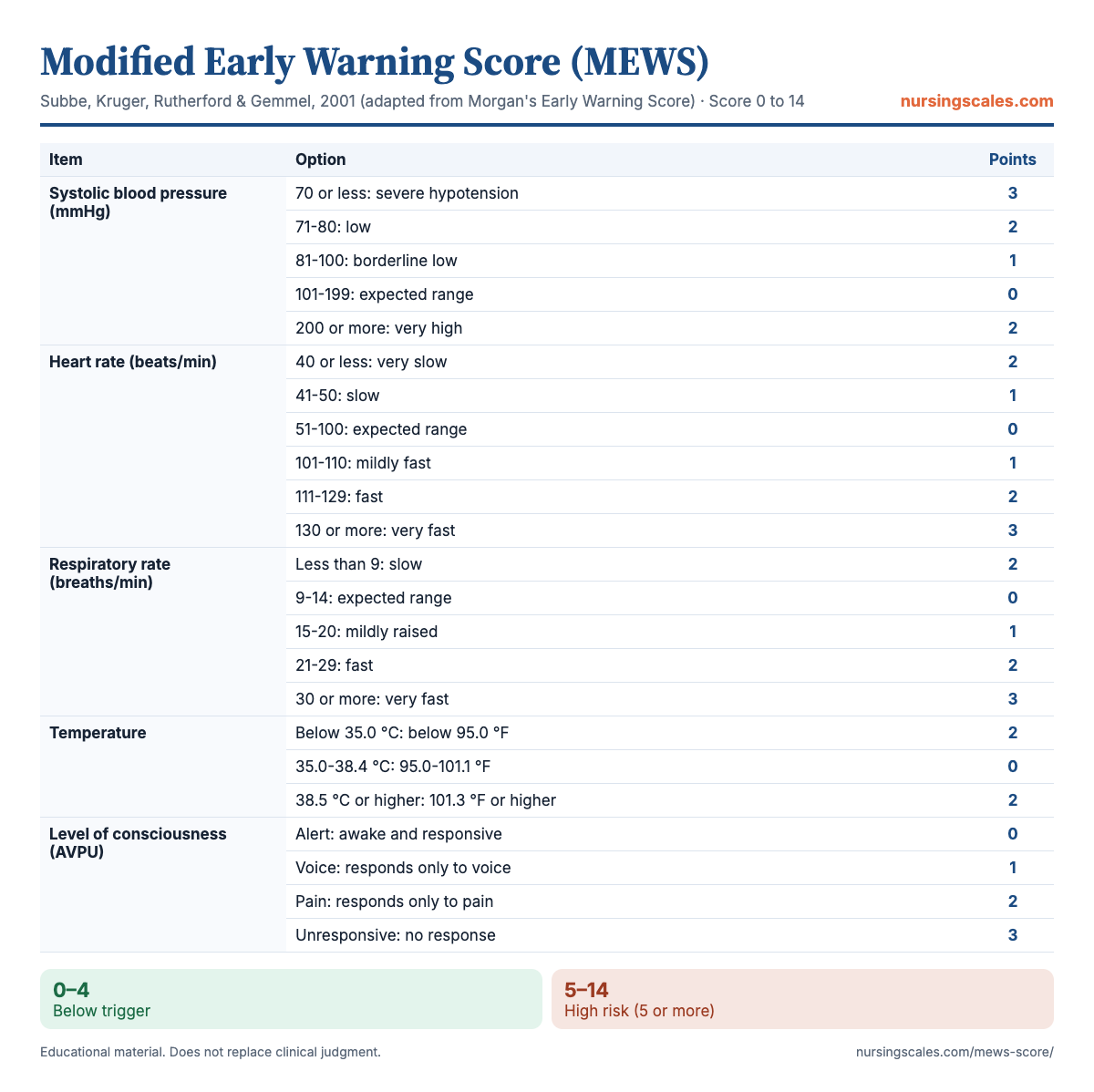
See every item and its points as a table
| Item | Option | Points |
|---|---|---|
| Systolic blood pressure (mmHg) | 70 or less: Severe hypotension | 3 |
| 71-80: Low | 2 | |
| 81-100: Borderline low | 1 | |
| 101-199: Expected range | 0 | |
| 200 or more: Very high | 2 | |
| Heart rate (beats/min) | 40 or less: Very slow | 2 |
| 41-50: Slow | 1 | |
| 51-100: Expected range | 0 | |
| 101-110: Mildly fast | 1 | |
| 111-129: Fast | 2 | |
| 130 or more: Very fast | 3 | |
| Respiratory rate (breaths/min) | Less than 9: Slow | 2 |
| 9-14: Expected range | 0 | |
| 15-20: Mildly raised | 1 | |
| 21-29: Fast | 2 | |
| 30 or more: Very fast | 3 | |
| Temperature | Below 35.0 °C: Below 95.0 °F | 2 |
| 35.0-38.4 °C: 95.0-101.1 °F | 0 | |
| 38.5 °C or higher: 101.3 °F or higher | 2 | |
| Level of consciousness (AVPU) | Alert: Awake and responsive | 0 |
| Voice: Responds only to voice | 1 | |
| Pain: Responds only to pain | 2 | |
| Unresponsive: No response | 3 |
When to use it
- Every set of vital signs on adult medical and surgical wards
- Emergency department admissions to predict who may deteriorate
- After transfer from ICU or a procedure
- When a patient looks worse or a family member voices concern
- Deciding how often to repeat observations
How to score it step by step
- Measure systolic blood pressure, heart rate, respiratory rate and temperature.
- Assess level of consciousness with AVPU: alert, voice, pain or unresponsive.
- Assign points for each parameter from the ranges and add them for a total of 0 to 14.
- Compare the total with the previous score to see the trend.
- Escalate per your facility's trigger; 5 or more was the original high-risk threshold.
- Document the score, who you notified and the plan, then repeat observations as directed.
Common mistakes
- Estimating the respiratory rate instead of counting it for a full minute
- Adding points wrong when a value sits on a range boundary
- Waiting for the total to reach 5 when one parameter is severely abnormal
- Ignoring a rising trend because each single score is still low
- Treating the score as a diagnosis instead of a prompt to assess and escalate
Example case
Patient. James, 71, admitted with pneumonia, reassessed at 02:00.
- Systolic BP 96 mmHg (1 point)
- Heart rate 108/min (1 point)
- Respiratory rate 24/min (2 points)
- Temperature 38.7 °C (2 points)
- Alert (0 points)
Score: 6. A MEWS of 6 meets the high-risk trigger of 5 or more.
Nursing actions:
- Notify the provider or rapid response team per policy
- Check oxygen saturation and apply oxygen as ordered
- Increase the frequency of vital signs
- Document the score, the escalation and the response
Frequently asked questions
What is a normal MEWS score?
A score of 0 means all five values are in the expected range. In Subbe's original study, 5 or more was linked to a higher risk of death and ICU admission. Many hospitals escalate at a lower score, so follow your policy.
What is the highest possible MEWS score?
The maximum is 14: up to 3 points each for blood pressure, heart rate, respiratory rate and consciousness, and up to 2 for temperature.
What does AVPU mean?
Alert, Voice, Pain, Unresponsive. It is a quick check of consciousness: alert scores 0, responds to voice 1, responds to pain 2, and unresponsive 3.
What is the difference between MEWS and NEWS2?
Both are early warning scores. NEWS2 is a single standardized UK chart that also includes oxygen saturation and supplemental oxygen. MEWS versions vary between hospitals.
Should I call for help if the score is below 5?
Yes, if you are worried, a single value is very abnormal, or the score keeps rising. The score supports your judgment; it does not replace it.
Related scales and guides
All scales:
Sources: Subbe et al. Validation of a modified Early Warning Score, QJM 2001 · NCBI Bookshelf: Details of each early warning score (MEWS) · MDApp: MEWS Calculator and references. Explanations and example case written by our editorial team. Reviewed September 30, 2026.