Activity
Movement of the limbs, voluntarily or on command.
Respiration
Ask the patient to take a deep breath and cough.
Circulation
Compare current blood pressure with the pre-anesthesia value.
Consciousness
Speak to the patient before using any touch.
Oxygen saturation (SpO2)
Read SpO2 by pulse oximetry and note any supplemental oxygen.
Result
0range 0 to 10
Review or change your answers
Supports, never replaces, clinical judgment and your facility's protocols. · Reviewed September 30, 2026 by the editorial team under our editorial policy · Aldrete & Kroulik, 1970; modified by Aldrete, 1995
What it measures
The score checks activity, breathing, blood pressure compared with the pre-anesthesia value, level of consciousness and oxygen saturation. It gives PACU nurses a quick, repeatable way to document recovery and decide when a patient can safely leave Phase I care. The 1995 modification replaced skin color with pulse oximetry, which made the oxygenation item more objective.
Used for: Adults and children recovering from general anesthesia, regional anesthesia or procedural sedation in the PACU or a procedural recovery area.
Aldrete Score interpretation
| Score | Result | What it means |
|---|---|---|
| 0–8 | Not ready for discharge | Keep the patient in Phase I recovery, keep monitoring and reassess at set intervals. Any item scored 0 needs prompt assessment and escalation to the anesthesia provider. |
| 9–10 | Meets discharge score | The patient meets the usual Phase I discharge criterion. Confirm pain, nausea, bleeding and your facility's other criteria before transfer or discharge. |
Versions and other cut-offs: The original 1970 Aldrete score used skin color instead of SpO2. Many units add a requirement that no item scores 0. For same-day patients going home, the PADSS (Postanesthetic Discharge Scoring System) adds walking, nausea and vomiting, pain and surgical bleeding.
Aldrete Score chart and printable PDF
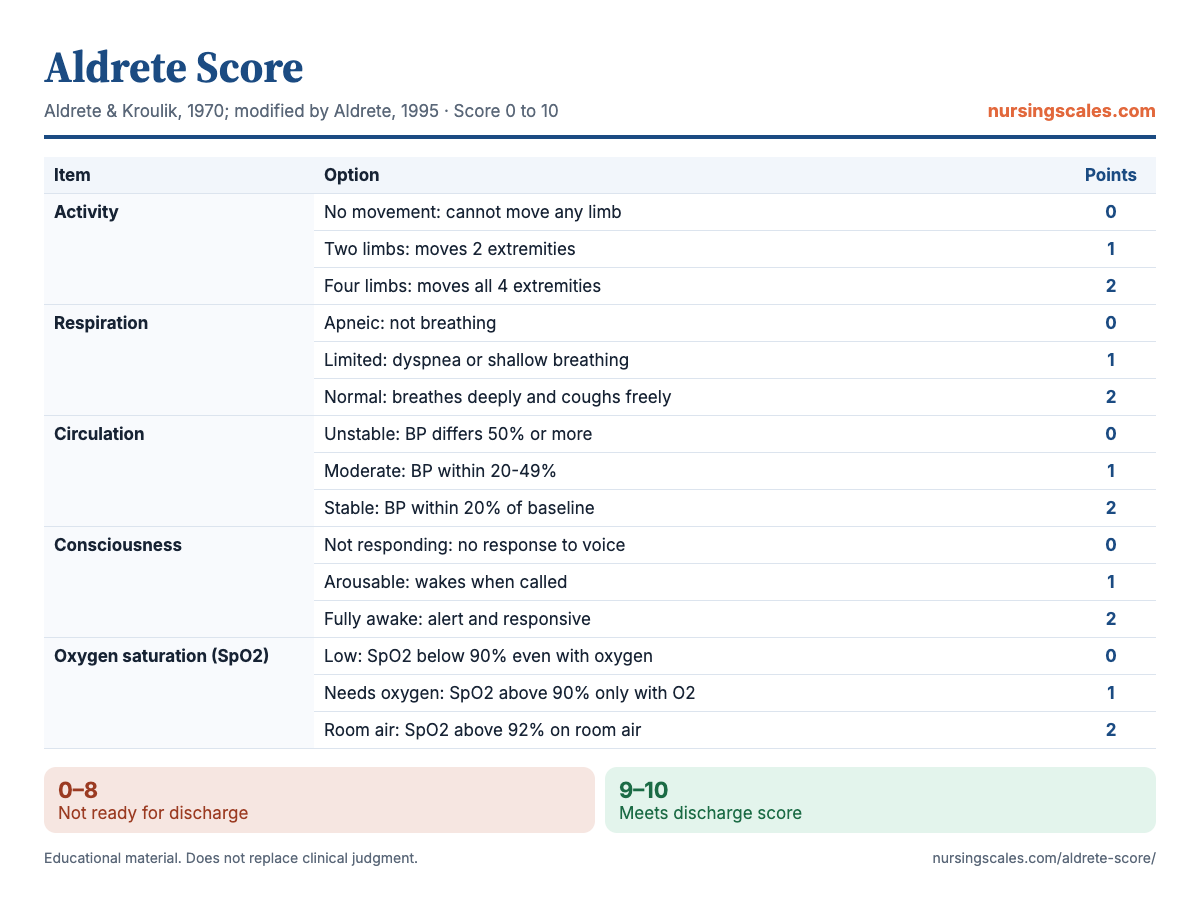
See every item and its points as a table
| Item | Option | Points |
|---|---|---|
| Activity | No movement: Cannot move any limb | 0 |
| Two limbs: Moves 2 extremities | 1 | |
| Four limbs: Moves all 4 extremities | 2 | |
| Respiration | Apneic: Not breathing | 0 |
| Limited: Dyspnea or shallow breathing | 1 | |
| Normal: Breathes deeply and coughs freely | 2 | |
| Circulation | Unstable: BP differs 50% or more | 0 |
| Moderate: BP within 20-49% | 1 | |
| Stable: BP within 20% of baseline | 2 | |
| Consciousness | Not responding: No response to voice | 0 |
| Arousable: Wakes when called | 1 | |
| Fully awake: Alert and responsive | 2 | |
| Oxygen saturation (SpO2) | Low: SpO2 below 90% even with oxygen | 0 |
| Needs oxygen: SpO2 above 90% only with O2 | 1 | |
| Room air: SpO2 above 92% on room air | 2 |
When to use it
- On arrival in the PACU to set a recovery baseline
- At regular intervals during Phase I recovery
- Before transfer from PACU to a nursing unit or Phase II
- After procedural sedation for endoscopy or imaging
- When deciding whether a patient can bypass Phase I recovery
- At handoff between PACU nurses
How to score it step by step
- Record the pre-anesthesia blood pressure so you can compare it.
- Assess each of the 5 signs at the bedside and score 0, 1 or 2.
- Check SpO2 on room air when it is safe to do so, and note any oxygen in use.
- Add the scores and document the total with the time.
- Repeat at the intervals your PACU policy sets until the patient reaches 9 or more.
- Confirm pain control, nausea, bleeding and other facility criteria before discharge.
Common mistakes
- Comparing blood pressure with the PACU arrival value instead of the pre-anesthesia value
- Scoring SpO2 as room air while the patient still has oxygen on
- Using a total of 9 to discharge when one item scores 0
- Relying on the score alone and ignoring pain, nausea or bleeding
- Using the old skin color item instead of pulse oximetry
Example case
Patient. James, 56, 30 minutes after a laparoscopic cholecystectomy under general anesthesia. Pre-anesthesia BP 132/80.
- Activity: moves all 4 limbs on command (2)
- Respiration: breathes deeply and coughs (2)
- Circulation: BP 124/76, within 20% of baseline (2)
- Consciousness: drowsy, opens eyes when called (1)
- SpO2: 94% on 2 L/min nasal cannula, 89% when oxygen was briefly removed (1)
Score: 8. A score of 8 is below the discharge criterion. James is stable but still drowsy and needs oxygen to keep his saturation above 90%.
Nursing actions:
- Keep James in Phase I recovery with continuous pulse oximetry
- Encourage deep breathing and coughing, and elevate the head of the bed
- Reassess consciousness and room air SpO2 at the next scheduled check
- Notify the anesthesia provider if SpO2 or responsiveness does not improve
Frequently asked questions
What Aldrete score is needed for PACU discharge?
A total of 9 or 10 is the usual criterion for Phase I discharge. Many units also require that no single item scores 0. Always follow your facility's policy.
What is the difference between the Aldrete and modified Aldrete score?
The original 1970 score used skin color to judge oxygenation. The 1995 modified version replaced it with SpO2 by pulse oximetry.
How often should I score the patient?
Score on arrival and then at regular intervals set by your PACU policy until the patient meets discharge criteria.
Is a score of 9 enough to send a patient home?
Not by itself. The Aldrete score covers Phase I recovery. Home discharge also needs checks of walking, pain, nausea, bleeding and a responsible adult, often with a tool like PADSS.
How do I score a patient whose baseline SpO2 is low?
Some units accept a return to the patient's documented pre-operative baseline. Check your facility's policy and discuss with the anesthesia provider.
Related scales and guides
All scales:
Sources: Post-Anesthesia Recovery: Sampe, Modified Aldrete and other scores (PMC) · PACU Discharge Criteria, OpenAnesthesia · Modified Aldrete Score, Society for Pediatric Anesthesia. Explanations and example case written by our editorial team. Reviewed September 30, 2026.