Sensory perception
Rate how well the patient can feel pressure-related discomfort and respond to it or tell you about it.
Moisture
Rate how often the skin is wet from sweat, urine, stool or wound drainage.
Activity
Rate the patient's usual level of physical activity.
Mobility
Rate the patient's ability to change and control body position on their own.
Nutrition
Rate the usual food intake pattern, including protein, supplements, tube feeding or TPN.
Friction and shear
Rate how much the skin slides against sheets or the chair during movement. This subscale scores 1 to 3.
Result
0range 6 to 23
Review or change your answers
Supports, never replaces, clinical judgment and your facility's protocols. · Reviewed September 30, 2026 by the editorial team under our editorial policy · Bergstrom, Braden, Laguzza & Holman, 1987
What it measures
The Braden Scale rates six factors that drive pressure injury: sensory perception, moisture, activity, mobility, nutrition, and friction and shear. Each factor reflects either how intense and long the pressure is or how well the skin tolerates it. A structured score helps you spot at-risk patients early, target the specific deficits, and start prevention before skin breaks down.
Used for: Adults in acute care, long-term care, home health and rehabilitation settings. The Braden Q is a separate version for infants and children.
Braden Scale interpretation
| Score | Result | What it means |
|---|---|---|
| 6–9 | Severe risk | Very high risk of pressure injury. Start a full prevention plan now, including a pressure redistribution surface, scheduled repositioning and skin checks every shift. |
| 10–12 | High risk | High risk. Reposition on a set schedule, use pressure redistribution support, manage moisture and nutrition, and involve the wound care team per protocol. |
| 13–14 | Moderate risk | Moderate risk. Use a turning schedule, protect heels and bony prominences, and address the lowest-scoring subscales. |
| 15–18 | Mild risk | At risk. Start basic prevention: frequent turning, early mobility, moisture control and heel protection. Treat as higher risk if other risk factors are present. |
| 19–23 | No risk | No significant risk by score. Continue routine skin care and reassess on schedule or when the patient's condition changes. |
Versions and other cut-offs: The original validation used a cut-off of 16 in acute care, and 18 was later recommended for older adults and patients with darker skin tones. Most US protocols now use 18 or less as at risk. The Braden Q is a separate pediatric version with different items and scoring.
Nursing interventions by Braden Scale score
Match the prevention plan to the total score, then write a specific intervention for every subscale that scored low, such as moisture, nutrition or friction and shear, even when the total looks safe.
6–9 Severe risk
- Carry out every high-risk intervention below; this is the most intensive level of prevention.
- Use a pressure-redistribution support surface, and ask about a specialty surface if the patient has severe pain that worsens with turning.
- Reposition bed-bound and chair-bound patients on a written schedule, at least every 1 to 2 hours unless your protocol or the patient's condition says otherwise.
- Add small weight shifts between full turns and use foam wedges for 30-degree side-lying positions.
- Float or offload the heels and check all bony prominences and skin under devices at least daily.
- Treat low subscores directly: barrier products and wicking pads for moisture, a dietitian consult for poor nutrition, lift sheets and head of bed at 30 degrees or lower for friction and shear.
10–12 High risk
- Increase turning frequency and add small weight shifts between turns.
- Place the patient on a pressure-redistribution support surface.
- Use foam wedges for 30-degree lateral positioning instead of lying flat on the side.
- Protect the heels and get the patient moving as much as safely possible.
- Manage moisture with barrier products and by pairing toileting with the turning schedule.
- Ask for a dietitian consult if intake is poor, and keep fluids within reach.
- Keep the head of bed at 30 degrees or lower when the patient's condition allows, and use lift sheets to move the patient.
13–14 Moderate risk
- Set a written turning schedule and use foam wedges for 30-degree lateral positioning.
- Use a pressure-redistribution support surface.
- Protect the heels and push for maximal remobilization.
- Address the lowest subscores: moisture, nutrition, friction and shear.
- Document the plan and reassess the Braden score on your facility schedule and after any change in condition.
15–18 Mild risk
- Turn and reposition frequently, and encourage the patient to shift weight on their own.
- Mobilize the patient as much as safely possible.
- Protect the heels.
- Use a pressure-redistribution support surface if the patient is bed-bound or chair-bound.
- Address any low subscore for moisture, nutrition, friction or shear.
- Treat the patient as one level higher if major risk factors are present, such as advanced age, fever, poor protein intake, diastolic pressure below 60 or hemodynamic instability.
19–23 No risk
- Continue routine skin care and a daily skin assessment, focusing on the sacrum, heels and skin under devices.
- Encourage mobility and position changes.
- Offer fluids during routine room visits to prevent dehydration.
- Write an intervention for any single subscale that scores low, even though the total is in the safe range.
- Reassess the Braden score on your facility schedule and whenever the patient's condition changes.
Interventions follow Braden Scale prevention protocols by level of risk (Indiana FSSA), AHRQ Preventing Pressure Ulcers in Hospitals: best practices and care planning, AHRQ Quality Indicators Toolkit: pressure ulcer prevention best practices. Your facility's protocol and the provider's orders take priority.
Braden Scale chart and printable PDF
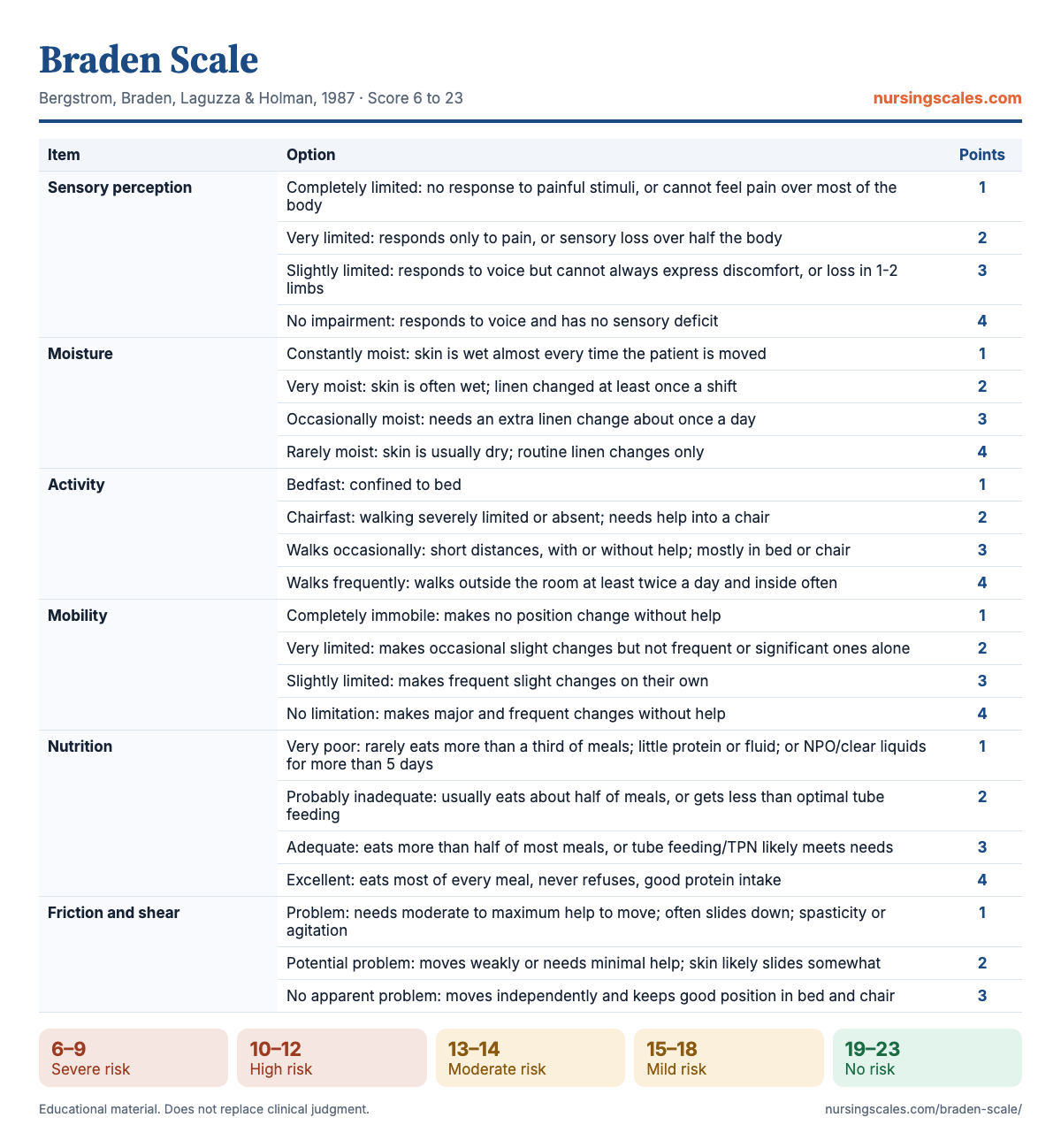
See every item and its points as a table
| Item | Option | Points |
|---|---|---|
| Sensory perception | Completely limited: No response to painful stimuli, or cannot feel pain over most of the body | 1 |
| Very limited: Responds only to pain, or sensory loss over half the body | 2 | |
| Slightly limited: Responds to voice but cannot always express discomfort, or loss in 1-2 limbs | 3 | |
| No impairment: Responds to voice and has no sensory deficit | 4 | |
| Moisture | Constantly moist: Skin is wet almost every time the patient is moved | 1 |
| Very moist: Skin is often wet; linen changed at least once a shift | 2 | |
| Occasionally moist: Needs an extra linen change about once a day | 3 | |
| Rarely moist: Skin is usually dry; routine linen changes only | 4 | |
| Activity | Bedfast: Confined to bed | 1 |
| Chairfast: Walking severely limited or absent; needs help into a chair | 2 | |
| Walks occasionally: Short distances, with or without help; mostly in bed or chair | 3 | |
| Walks frequently: Walks outside the room at least twice a day and inside often | 4 | |
| Mobility | Completely immobile: Makes no position change without help | 1 |
| Very limited: Makes occasional slight changes but not frequent or significant ones alone | 2 | |
| Slightly limited: Makes frequent slight changes on their own | 3 | |
| No limitation: Makes major and frequent changes without help | 4 | |
| Nutrition | Very poor: Rarely eats more than a third of meals; little protein or fluid; or NPO/clear liquids for more than 5 days | 1 |
| Probably inadequate: Usually eats about half of meals, or gets less than optimal tube feeding | 2 | |
| Adequate: Eats more than half of most meals, or tube feeding/TPN likely meets needs | 3 | |
| Excellent: Eats most of every meal, never refuses, good protein intake | 4 | |
| Friction and shear | Problem: Needs moderate to maximum help to move; often slides down; spasticity or agitation | 1 |
| Potential problem: Moves weakly or needs minimal help; skin likely slides somewhat | 2 | |
| No apparent problem: Moves independently and keeps good position in bed and chair | 3 |
When to use it
- On admission to a hospital, nursing home or home health service
- At regular intervals set by your facility, such as every shift or daily in acute care
- After surgery or any procedure that limits mobility
- When the patient's condition changes, such as new sedation, infection or incontinence
- Before transfer or discharge to another level of care
How to score it step by step
- Review the chart and talk with the patient and caregivers about eating, continence and mobility.
- Examine the skin head to toe, with focus on the sacrum, heels, hips and under devices.
- Score each of the six subscales, picking the level that best fits the last 24 hours.
- Add the six scores for a total between 6 and 23.
- Match the total to a risk level and target care to the lowest-scoring subscales.
- Document the score and plan, and reassess at the interval your facility requires.
Common mistakes
- Scoring from memory or the previous shift's score instead of a fresh assessment
- Treating a score of 19 or more as zero risk when the patient has other risk factors
- Using only the total and ignoring low subscales like moisture or nutrition
- Scoring friction and shear on a 1-4 scale instead of 1-3
- Not reassessing after a change in condition, sedation or surgery
Example case
Patient. Mr. R., 78, admitted with pneumonia. He is drowsy but follows commands, has new urinary incontinence and eats about half of his meals.
- Sensory perception: responds to voice but cannot always report discomfort (3)
- Moisture: linen changed at least once a shift due to incontinence (2)
- Activity: sits in a chair with help, does not walk (2)
- Mobility: makes frequent small shifts on his own (3)
- Nutrition: eats about half of each meal (2)
- Friction and shear: needs minimal help to move and slides slightly in bed (2)
Score: 14. A total of 14 places Mr. R. at moderate risk for a pressure injury.
Nursing actions:
- Start a repositioning schedule and float his heels
- Use barrier cream and check for incontinence at set times
- Request a dietitian consult and track meal intake
- Use a lift sheet to reduce sliding and keep the head of bed as low as allowed
- Reassess the Braden score every shift and with any change
Frequently asked questions
What Braden score is normal and what score is high risk?
Scores of 19 to 23 suggest no significant risk. A score of 18 or less means the patient is at risk: 15-18 mild, 13-14 moderate, 10-12 high, and 9 or less severe.
Is a higher or lower Braden score worse?
Lower is worse. Each subscale gives fewer points for greater impairment, so a low total means more risk factors.
Why does friction and shear only go up to 3?
The developers defined three levels for this subscale: problem, potential problem and no apparent problem. That is why the maximum total is 23, not 24.
How often should I score the Braden Scale?
Score it on admission and then at the interval your facility sets, often every shift or daily in acute care. Rescore any time the patient's condition changes.
Can I use the Braden Scale for children?
Use the Braden Q for infants and children. The adult Braden Scale was not built for pediatric patients.
Related scales and guides
All scales:
Sources: AHRQ Preventing Pressure Ulcers Toolkit: Braden Scale · Indiana Department of Health: Braden Scale form · Nursing Fundamentals (Open RN): 10.5 Braden Scale · Official Braden Scale site (licensing). Explanations and example case written by our editorial team. Reviewed September 30, 2026.