Which level best describes the patient?
Observe first; only if the patient is not alert, call their name and ask them to look at you; use physical stimulation only if there is no response to voice.
Result
0range -5 to +4
Supports, never replaces, clinical judgment and your facility's protocols. · Reviewed September 30, 2026 by the editorial team under our editorial policy · Sessler, Gosnell, Grap, et al., 2002 (Virginia Commonwealth University)
What it measures
RASS tells the team how awake or agitated a patient is using a short, standardized sequence: observe, then speak, then touch. It lets nurses titrate sedation to a target the team agrees on, spot oversedation before it causes harm, and catch agitation early. RASS is also the first step of the CAM-ICU delirium screen: patients at -4 or -5 cannot be screened for delirium.
Used for: Adult ICU patients, ventilated or not, especially those receiving sedatives or opioids. Also used in step-down units, emergency departments and palliative care.
Richmond Agitation-Sedation Scale (RASS) interpretation
| Score | Result | What it means |
|---|---|---|
| -5 to -4 | Deep sedation / unarousable | Deeply sedated or unarousable. Unless the team ordered deep sedation, notify the provider, review sedatives and opioids, and check for neurological or metabolic causes. Delirium cannot be screened at this level. |
| -3 | Moderate sedation | Deeper than most light-sedation targets. Compare with the ordered goal and discuss adjusting sedation with the team. |
| -2 to 0 | Calm to lightly sedated | Within the range many ICU protocols target for light sedation. Keep reassessing and screen for delirium (for example with the CAM-ICU). |
| +1–+2 | Restless / agitated | Look for causes such as pain, hypoxia, full bladder, withdrawal or delirium before adding sedation. Notify the provider if agitation persists or threatens lines or the ventilator. |
| +3–+4 | Very agitated / combative | Immediate risk to the patient and staff. Call for help, protect the airway and lines, and follow your facility's agitation and safety protocol. |
Versions and other cut-offs: Target RASS is set by the care team; guidelines from the Society of Critical Care Medicine favor light over deep sedation for most mechanically ventilated adults, often expressed as RASS -2 to 0. A modified RASS (mRASS) has been studied for palliative care and for delirium screening outside the ICU.
Richmond Agitation-Sedation Scale (RASS) chart and printable PDF
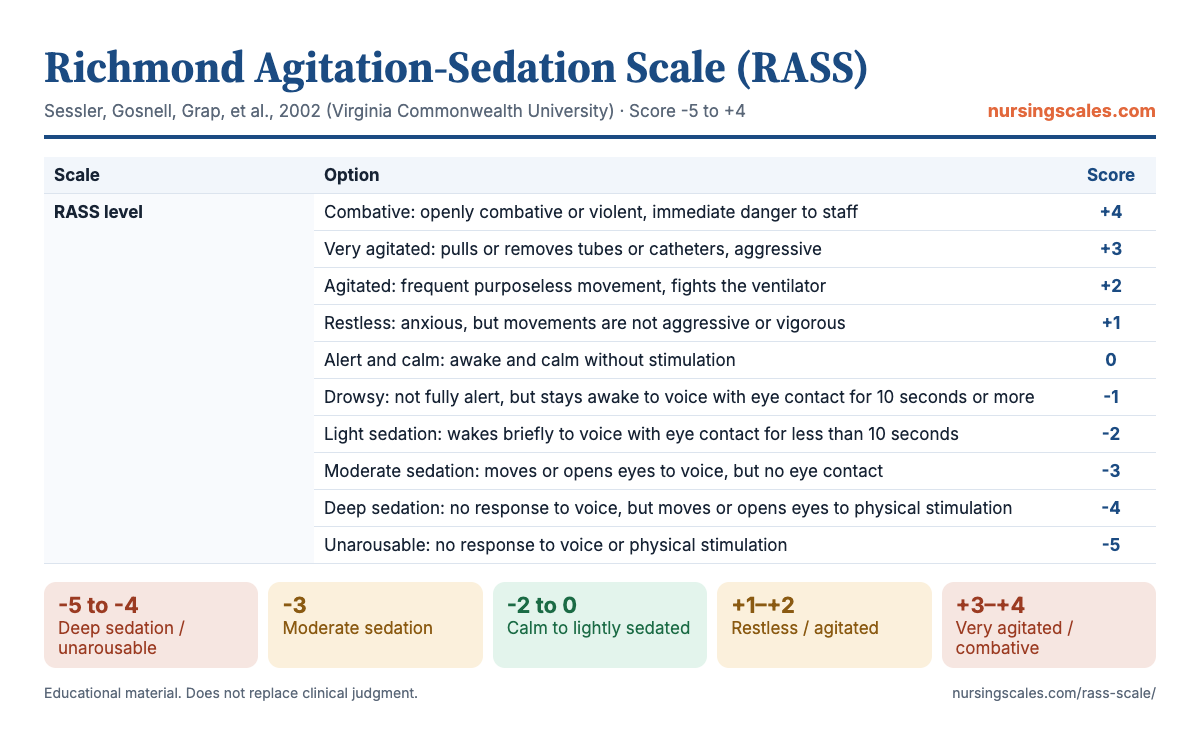
See every item and its points as a table
| Level | Option | Score |
|---|---|---|
| RASS level | Combative: Openly combative or violent, immediate danger to staff | +4 |
| Very agitated: Pulls or removes tubes or catheters, aggressive | +3 | |
| Agitated: Frequent purposeless movement, fights the ventilator | +2 | |
| Restless: Anxious, but movements are not aggressive or vigorous | +1 | |
| Alert and calm: Awake and calm without stimulation | 0 | |
| Drowsy: Not fully alert, but stays awake to voice with eye contact for 10 seconds or more | -1 | |
| Light sedation: Wakes briefly to voice with eye contact for less than 10 seconds | -2 | |
| Moderate sedation: Moves or opens eyes to voice, but no eye contact | -3 | |
| Deep sedation: No response to voice, but moves or opens eyes to physical stimulation | -4 | |
| Unarousable: No response to voice or physical stimulation | -5 |
When to use it
- Routine sedation checks in mechanically ventilated patients
- Before and after giving or titrating sedatives or opioids
- During daily sedation interruption (spontaneous awakening trials)
- As the first step of CAM-ICU delirium screening
- When a patient becomes agitated or unusually drowsy
- Handoff reports in ICU and step-down units
How to score it step by step
- Observe the patient for about 30 seconds without speaking. If alert, restless or agitated, score 0 to +4.
- If not alert, say the patient's name and ask them to open their eyes and look at you.
- If the patient wakes with sustained eye contact (10 seconds or more), score -1; brief eye contact (less than 10 seconds) scores -2; movement or eye opening without eye contact scores -3.
- If there is no response to voice, shake the shoulder and, if still no response, rub the sternum.
- Any movement to physical stimulation scores -4; no response scores -5.
- Document the score, compare it with the target RASS and act on any difference per protocol.
Common mistakes
- Touching or stimulating the patient before first observing and then using voice.
- Not timing eye contact, which blurs the line between -1 and -2.
- Scoring a reflex grimace or cough during suctioning as a response to voice.
- Treating agitation with more sedation without looking for pain, hypoxia or delirium.
- Charting RASS without comparing it with the ordered target.
Example case
Patient. Ms. T., 67, day 3 on mechanical ventilation for pneumonia, on a continuous sedative infusion. The ordered target is RASS 0 to -2.
- Eyes closed and still during 30 seconds of observation
- When you call her name she opens her eyes and looks at you for about 5 seconds, then closes them again (-2)
Score: -2. RASS -2 (light sedation) is within her ordered target of 0 to -2.
Nursing actions:
- Continue the current sedation plan and reassess at the ordered interval
- Screen for delirium with the CAM-ICU
- Assess pain with a validated tool before any sedation change
- Coordinate the daily spontaneous awakening trial with the team
Frequently asked questions
What is a normal RASS score?
RASS 0 means alert and calm. Positive scores (+1 to +4) mean agitation; negative scores (-1 to -5) mean increasing sedation. Many ICU teams target light sedation, often -2 to 0.
What does RASS -5 mean?
The patient does not respond to voice or physical stimulation. Unless deep sedation was ordered, report it and review sedatives and neurological status.
What is the difference between RASS -1 and -2?
Both wake to voice with eye contact. At -1 the eye contact lasts 10 seconds or more; at -2 it lasts less than 10 seconds.
How is RASS related to the CAM-ICU?
RASS is step one of the CAM-ICU. If the score is -4 or -5, the patient cannot be assessed for delirium yet; reassess later.
How often should RASS be assessed?
Follow your unit's protocol. It is commonly checked at regular intervals and whenever sedation is started, changed or interrupted.
Related scales and guides
All scales:
Sources: Sessler et al. 2002, The Richmond Agitation-Sedation Scale (PubMed) · RASS tool and assessment procedure (Minnesota Hospital Association) · Richmond Agitation-Sedation Scale - Merck Manual Professional. Explanations and example case written by our editorial team. Reviewed September 30, 2026.