Face
Watch the face for the whole observation period, not a single moment.
Legs
Uncover the legs so you can see position and tone.
Activity
Look at the whole body, including how the child moves.
Cry
Listen for crying, moaning or verbal complaints.
Consolability
Try touching, holding or talking to the child and note the response.
Result
0range 0 to 10
Review or change your answers
Supports, never replaces, clinical judgment and your facility's protocols. · Reviewed September 30, 2026 by the editorial team under our editorial policy · Merkel, Voepel-Lewis, Shayevitz & Malviya, 1997 (University of Michigan)
What it measures
FLACC measures pain through what you can see and hear: facial expression, leg position, body activity, crying and how easily the child is comforted. It was built for young children after surgery and is now used for procedural and acute pain in patients who are too young or unable to self-report. A structured score makes pain visible in the chart, supports the decision to treat, and lets you check whether an intervention worked.
Used for: Children from 2 months to 7 years, and older children or adults who cannot self-report pain (nonverbal, sedated or cognitively impaired patients).
FLACC Scale interpretation
| Score | Result | What it means |
|---|---|---|
| 0 | Relaxed | The child appears relaxed and comfortable. Keep reassessing on your unit's schedule and after any procedure. |
| 1–3 | Mild discomfort | Mild discomfort. Use comfort measures, check for causes such as position or hunger, and reassess. |
| 4–6 | Moderate pain | Moderate pain. Treat per your pain protocol or notify the prescriber, then reassess to confirm the effect. |
| 7–10 | Severe pain | Severe discomfort or pain. Act promptly under your protocol, notify the provider, and reassess closely after each intervention. |
Versions and other cut-offs: The revised FLACC (r-FLACC, Malviya 2006) adds individualized descriptors for children with cognitive impairment, such as a child's usual pain behaviors; the scoring stays 0-10. Many units use a total of 4 or more as the prompt to treat, while some French-language versions cite 3/10; follow your facility's threshold.
FLACC Scale chart and printable PDF
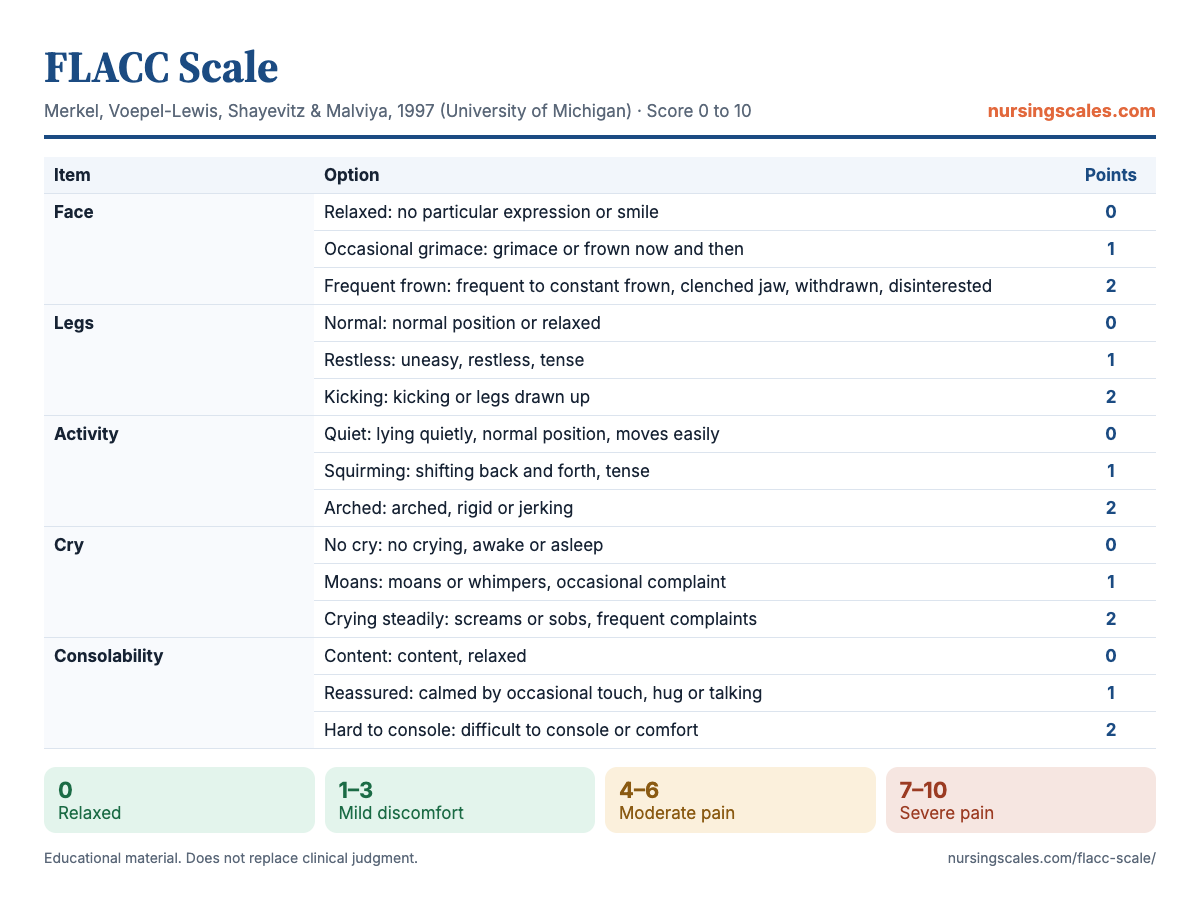
See every item and its points as a table
| Item | Option | Points |
|---|---|---|
| Face | Relaxed: No particular expression or smile | 0 |
| Occasional grimace: Grimace or frown now and then | 1 | |
| Frequent frown: Frequent to constant frown, clenched jaw, withdrawn, disinterested | 2 | |
| Legs | Normal: Normal position or relaxed | 0 |
| Restless: Uneasy, restless, tense | 1 | |
| Kicking: Kicking or legs drawn up | 2 | |
| Activity | Quiet: Lying quietly, normal position, moves easily | 0 |
| Squirming: Shifting back and forth, tense | 1 | |
| Arched: Arched, rigid or jerking | 2 | |
| Cry | No cry: No crying, awake or asleep | 0 |
| Moans: Moans or whimpers, occasional complaint | 1 | |
| Crying steadily: Screams or sobs, frequent complaints | 2 | |
| Consolability | Content: Content, relaxed | 0 |
| Reassured: Calmed by occasional touch, hug or talking | 1 | |
| Hard to console: Difficult to console or comfort | 2 |
When to use it
- Postoperative pain checks in infants and preschool children
- Before, during and after painful procedures such as IV starts or dressing changes
- Pain reassessment after giving an analgesic or comfort intervention
- Children who cannot use a self-report scale because of age or development
- Nonverbal, intubated or cognitively impaired patients of any age when a behavioral tool is approved
- Routine vital sign rounds on pediatric units
How to score it step by step
- Observe the child for a few minutes while awake, with legs and body uncovered; if asleep, observe for at least 5 minutes.
- Score face, legs and activity from what you see during that period.
- Score cry, then try to comfort the child and score consolability.
- Add the five scores for a total from 0 to 10.
- Document the score, the context (rest, movement, procedure) and any intervention.
- Reassess after treatment, within the time your pain policy sets, and compare scores.
Common mistakes
- Scoring from one brief glance instead of watching for a few minutes
- Leaving the child covered, so leg and body behavior cannot be seen
- Treating crying from hunger, fear or separation as pain without looking for other causes
- Using FLACC when the child can reliably self-report with a faces or numeric scale
- Recording a score without documenting the intervention and the reassessment
Example case
Patient. Leo, 3 years old, 4 hours after an inguinal hernia repair.
- Face: occasional grimace (1 point)
- Legs: restless, tense (1 point)
- Activity: squirming, shifting back and forth (1 point)
- Cry: moans and whimpers (1 point)
- Consolability: difficult to comfort (2 points)
Score: 6. A FLACC of 6 means moderate pain.
Nursing actions:
- Treat pain per the postoperative order set or notify the provider
- Add comfort measures: parent holding, positioning, distraction
- Reassess FLACC after the intervention and document both scores
- Check the surgical site and diaper area for other sources of distress
Frequently asked questions
What is a normal FLACC score and what score needs treatment?
A score of 0 means the child looks relaxed and comfortable. Scores of 1-3 show mild discomfort, 4-6 moderate pain and 7-10 severe pain. Many units treat at 4 or more, but follow your facility's threshold and your clinical judgment.
What age is the FLACC scale for?
It was validated for children from 2 months to 7 years. It is also used for older children and adults who cannot report their pain, when your facility approves it.
How long should you observe before scoring FLACC?
Watch for a few minutes with the legs and body uncovered. If the child is asleep, observe for at least 5 minutes before you score.
Can a sleeping child have a FLACC score above 0?
Yes. Sleep does not rule out pain. Look for tension, frowning, restless legs or moaning, and reposition or touch gently to check tone if needed.
What is the difference between FLACC and Wong-Baker FACES?
FLACC is scored by the nurse from behavior. Wong-Baker FACES is a self-report tool the child picks, usually from about age 3. Use self-report whenever the child can give it reliably.
Related scales and guides
All scales:
Sources: Merkel et al. The FLACC, Pediatr Nurs 1997 (PubMed) · FLACC Behavioral Pain Assessment Scale (WA DSHS form) · Nursing Fundamentals: Pain Assessment Methods · Palliative Care Network: Pediatric Pain Assessment Scales. Explanations and example case written by our editorial team. Reviewed September 30, 2026.