Which level best describes the patient?
Press firmly over a bony area for about 5 to 15 seconds, release, and time how long the pit takes to fill.
Result
0range 1+ to 4+
Supports, never replaces, clinical judgment and your facility's protocols. · Reviewed September 30, 2026 by the editorial team under our editorial policy · Traditional bedside grading used in physical examination texts; no single original author
What it measures
The scale estimates how much excess fluid sits in the tissues under the skin. Pitting edema is common in heart failure, kidney and liver disease, venous insufficiency and fluid overload. Grading it the same way every time lets you track trends, compare sides, and spot worsening fluid status early.
Used for: Adults and children with suspected or known edema, most often in the feet, ankles, shins or sacrum.
Pitting Edema Scale interpretation
| Score | Result | What it means |
|---|---|---|
| 1+ | 1+ Trace | Slight pitting that disappears at once. Document the site and extent and compare at the next assessment. |
| 2+ | 2+ Mild | Mild pitting edema. Check weight, intake and output, and lung sounds, and report a new or increasing finding. |
| 3+ | 3+ Moderate | Moderate, deeper pitting. Notify the provider if new or worse, assess for fluid overload, and protect the skin. |
| 4+ | 4+ Severe | Severe pitting that lasts minutes. Report promptly, assess breathing and perfusion, and protect fragile skin from breakdown. |
Versions and other cut-offs: Depth and rebound cut-offs vary by source. A common alternative (Bates-based) lists 1+ up to 2 mm, 2+ 2-4 mm, 3+ 4-6 mm and 4+ 6-8 mm, with rebound up to 2-5 minutes for 4+. Many charts also use 0 for no edema, and some units grade by rebound time only; use your facility's chart consistently.
Pitting Edema Scale chart and printable PDF
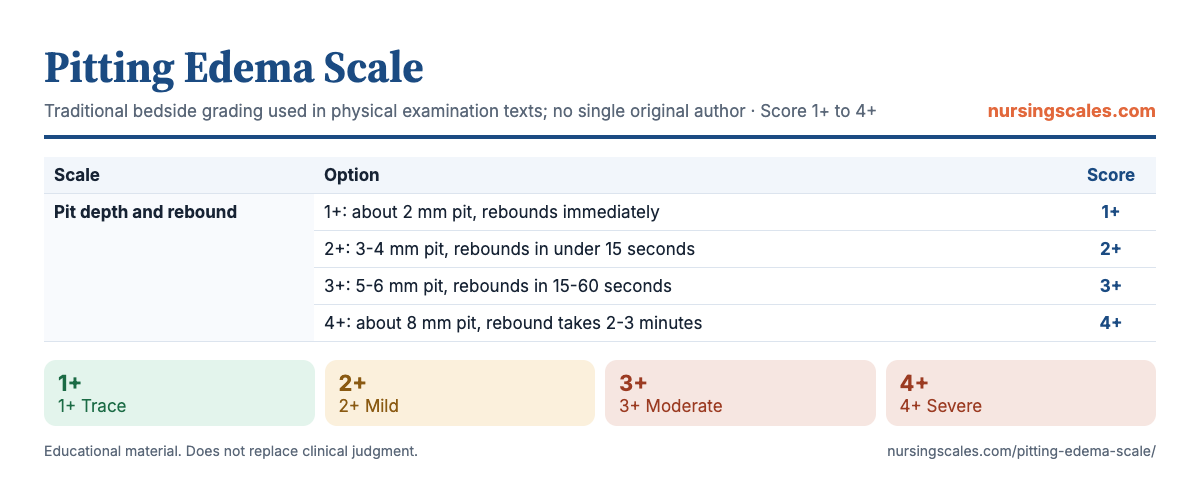
See every item and its points as a table
| Level | Option | Score |
|---|---|---|
| Pit depth and rebound | 1+: About 2 mm pit, rebounds immediately | 1+ |
| 2+: 3-4 mm pit, rebounds in under 15 seconds | 2+ | |
| 3+: 5-6 mm pit, rebounds in 15-60 seconds | 3+ | |
| 4+: About 8 mm pit, rebound takes 2-3 minutes | 4+ |
When to use it
- Admission and daily assessment of patients with heart failure, kidney or liver disease
- Monitoring fluid status during IV fluids or diuretic therapy
- New leg or ankle swelling reported by the patient
- Pregnancy and postpartum checks when swelling is present
- Comparing one limb with the other when a clot or venous problem is a concern
How to score it step by step
- Explain the check and look at both legs for swelling, color and skin changes.
- Press your thumb firmly over a bony area such as the top of the foot, behind the ankle or the shin for about 5 to 15 seconds.
- Release and estimate the pit depth.
- Time how long the skin takes to return to normal.
- Check how far up the limb the edema extends and compare both sides.
- Document the grade, site, extent and side, and report new or worsening edema.
Common mistakes
- Pressing too briefly or too lightly to leave a true pit
- Recording only the grade without site, extent and side
- Checking over soft tissue instead of a bony surface
- Switching between different grading charts from shift to shift
- Ignoring one-sided swelling, which can point to a clot or infection
Example case
Patient. Robert, 74, admitted with worsening heart failure.
- Both shins: pit about 5-6 mm that fills in about 30 seconds, extending to mid-calf (3 points)
Score: 3+. Bilateral 3+ pitting edema to mid-calf, consistent with moderate edema.
Nursing actions:
- Report the finding and compare with the admission assessment
- Weigh daily at the same time and track intake and output
- Assess lung sounds, oxygen saturation and breathing
- Elevate the legs as ordered and protect the skin
Frequently asked questions
What is a normal pitting edema score?
Normal is no pitting at all, often charted as 0. Any grade from 1+ to 4+ is abnormal. 3+ and 4+ are deep pits and need prompt review, especially if new or getting worse.
How long do you press to check pitting edema?
Press firmly for about 5 to 15 seconds over a bony area, then release and time the rebound.
What is the difference between 2+ and 3+ pitting edema?
A 2+ pit is about 3-4 mm and fills in under 15 seconds. A 3+ pit is about 5-6 mm and takes 15 to 60 seconds to fill.
Is edema in one leg different from edema in both legs?
Yes. Swelling in both legs often points to a systemic cause such as heart, kidney or liver disease. Swelling in one leg needs a check for a clot, infection or local injury. Report it.
What is non-pitting edema?
Swelling that does not leave a dent when pressed. It is seen in conditions such as lymphedema and myxedema. This scale does not apply to it.
Related scales and guides
All scales:
Sources: Cleveland Clinic: Pitting Edema, Causes and Grading · EBM Consult: Pitting Edema Assessment. Explanations and example case written by our editorial team. Reviewed September 30, 2026.