Eye opening (E)
Watch first for spontaneous eye opening, then speak to the patient, then apply a physical stimulus only if needed.
Verbal response (V)
Ask the patient's name, where they are, and the month and year.
Motor response (M)
Score the best response from either arm; start with a command, then use central pressure (trapezius pinch or supraorbital notch) if needed.
Result
0range 3 to 15
Review or change your answers
Supports, never replaces, clinical judgment and your facility's protocols. · Reviewed September 30, 2026 by the editorial team under our editorial policy · Graham Teasdale & Bryan Jennett, 1974 (The Lancet)
What it measures
The GCS gives you a quick, repeatable way to describe how awake and responsive a patient is. It is used after head injury and in any patient with an altered level of consciousness. The real value is in the trend: a drop of even 1-2 points between checks can be the first sign of rising intracranial pressure, bleeding or another neurological change that needs prompt escalation. Report each component (E, V, M) along with the total, because the same total can describe very different patients.
Used for: Adults and older children with head injury or altered level of consciousness from any cause (trauma, stroke, overdose, infection, metabolic problems). Young children who cannot talk need a pediatric version.
Glasgow Coma Scale interpretation
| Score | Result | What it means |
|---|---|---|
| 3–8 | Severe | Severe impairment of consciousness; the patient may not be able to protect the airway. Escalate immediately and follow your emergency and airway protocols. |
| 9–12 | Moderate | Moderate impairment. Notify the provider, increase the frequency of neuro checks and watch closely for any further drop. |
| 13–15 | Mild | Mild or no impairment (15 is fully alert and oriented). Keep reassessing at the ordered frequency and compare with the baseline. |
Versions and other cut-offs: The GCS-Pupils score (GCS-P) subtracts a pupil reactivity score (0 if both pupils react, 1 if one does not, 2 if neither reacts) from the GCS, giving a range of 1-15. When a component cannot be tested, record it as NT and do not report a total; for intubated patients the verbal score is recorded as not testable (StatPearls uses the notation V-ET, and many US charts add a "T" suffix).
Pediatric Glasgow Coma Scale
The pediatric GCS keeps the same three components and the same point values, but the verbal and motor responses are adapted to what an infant can do: cooing, crying and spontaneous movement replace orientation and following commands. The total still runs from 3 to 15, and you read it with the same bands: 13-15 mild, 9-12 moderate and 3-8 severe.
Who it is for: Infants and preverbal children, usually under 2 years (the cutoff used by PECARN and StatPearls). Some references apply the pediatric version up to about age 5, because StatPearls notes the standard GCS can be used without changes in children older than 5.
| Component | Infant / preverbal child | Points |
|---|---|---|
| Eye opening (E) | Spontaneous: Eyes open without any stimulus | 4 |
| To voice: Eyes open when spoken to | 3 | |
| To pain: Eyes open only to a painful stimulus | 2 | |
| None: No eye opening | 1 | |
| Verbal response (V) | Coos and babbles: Normal infant sounds | 5 |
| Irritable cries: Cries but can be consoled | 4 | |
| Cries to pain: Cries only with a painful stimulus | 3 | |
| Moans to pain: Moans or grunts with pain | 2 | |
| None: No vocal response | 1 | |
| Motor response (M) | Moves spontaneously: Normal, purposeful movement | 6 |
| Withdraws to touch: Pulls away when touched | 5 | |
| Withdraws to pain: Pulls away from a painful stimulus | 4 | |
| Abnormal flexion: Decorticate posturing to pain | 3 | |
| Extension: Decerebrate posturing to pain | 2 | |
| None: No motor response | 1 |
- Ask the parent or caregiver how the child normally responds, and score against that baseline.
- Score the best response in each component, ideally when the child is calm and not feeding or asleep.
- Document E, V and M separately along with the total, and note the version used (pediatric or standard).
- Rely on the motor score when crying, intubation or sedation limits the verbal score, and escalate any drop from baseline per your facility protocol.
Sources: Modified Glasgow Coma Scale for Infants and Children - Merck Manual Professional · Glasgow Coma Scale - StatPearls (NCBI Bookshelf), pediatric section · Borgialli et al. 2016, Performance of the Pediatric GCS in children with blunt head trauma (PECARN). Use the switch at the top of the calculator to score an infant.
Glasgow Coma Scale chart and printable PDF
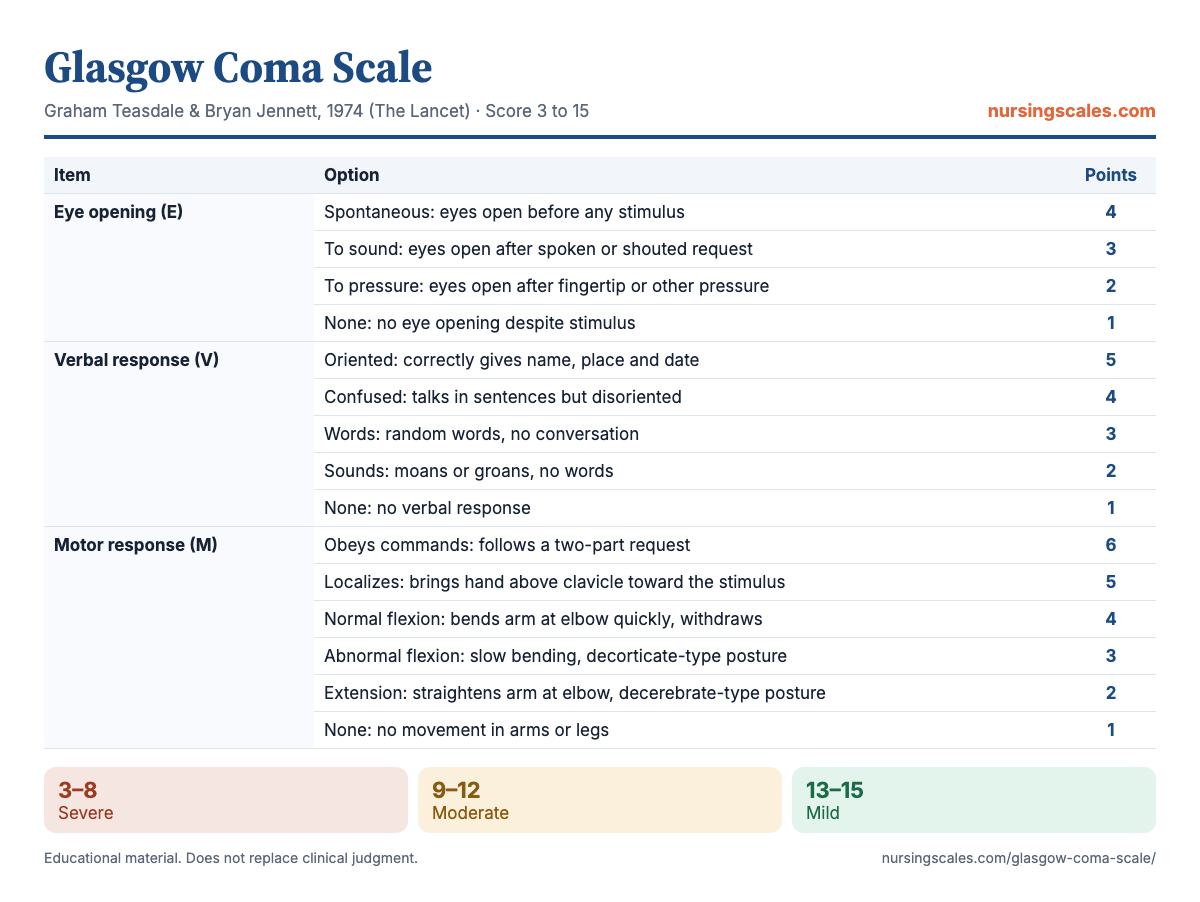
See every item and its points as a table
| Item | Option | Points |
|---|---|---|
| Eye opening (E) | Spontaneous: Eyes open before any stimulus | 4 |
| To sound: Eyes open after spoken or shouted request | 3 | |
| To pressure: Eyes open after fingertip or other pressure | 2 | |
| None: No eye opening despite stimulus | 1 | |
| Verbal response (V) | Oriented: Correctly gives name, place and date | 5 |
| Confused: Talks in sentences but disoriented | 4 | |
| Words: Random words, no conversation | 3 | |
| Sounds: Moans or groans, no words | 2 | |
| None: No verbal response | 1 | |
| Motor response (M) | Obeys commands: Follows a two-part request | 6 |
| Localizes: Brings hand above clavicle toward the stimulus | 5 | |
| Normal flexion: Bends arm at elbow quickly, withdraws | 4 | |
| Abnormal flexion: Slow bending, decorticate-type posture | 3 | |
| Extension: Straightens arm at elbow, decerebrate-type posture | 2 | |
| None: No movement in arms or legs | 1 |
When to use it
- Initial and serial assessment after traumatic brain injury
- Any patient with a sudden change in mental status or confusion
- Neuro checks after stroke, neurosurgery or intracranial bleeding
- Suspected overdose, poisoning or severe metabolic imbalance
- Handoff reports and trauma triage in the ED and prehospital setting
- Monitoring sedated or critically ill patients during interruptions in sedation
How to score it step by step
- Check for factors that interfere with scoring: sedation, intubation, hearing loss, language barrier, swelling around the eyes, fractures or spinal injury.
- Observe the patient without touching them for spontaneous eye opening, speech and movement.
- Speak to the patient in a normal then louder voice, ask orientation questions and give a simple command.
- If there is no response, apply a physical stimulus: fingertip pressure first, then central pressure (trapezius or supraorbital notch) for motor response.
- Score the best response in each component and document E, V and M separately along with the total (for example E3 V4 M6 = 13).
- Compare with the previous score and escalate any drop per your facility protocol.
Common mistakes
- Reporting only the total instead of each component (E, V, M).
- Scoring the worst limb instead of the best motor response.
- Assigning 1 point to a component that cannot be tested (swollen eyes, intubation) instead of recording NT.
- Using sternal rub or excessive force instead of a standardized pressure stimulus.
- Not accounting for sedation, alcohol or drugs when comparing scores over time.
Example case
Patient. Mr. R., 54, admitted after a fall from a ladder with a scalp laceration. Two hours after arrival his wife says he is "not making sense."
- Eyes stay closed until you call his name loudly, then open: E3 (3)
- Answers with random words, no sentences: V3 (3)
- Does not follow commands; moves his hand toward the site of trapezius pressure: M5 (5)
Score: 11. GCS 11 (E3 V3 M5) indicates moderate impairment and a clear decline from his admission score of 15.
Nursing actions:
- Notify the provider or rapid response team right away per protocol
- Check pupils, vital signs and blood glucose
- Keep the head of bed elevated as ordered and maintain airway safety
- Increase neuro check frequency and document each component
- Prepare the patient for urgent imaging if ordered
Frequently asked questions
What is a normal Glasgow Coma Scale score?
A score of 15 is normal: the patient opens their eyes spontaneously, is oriented and obeys commands. Scores of 13-15 are mild, 9-12 moderate and 3-8 severe impairment.
What is the lowest possible GCS score?
The lowest score is 3, not 0, because each of the three components has a minimum of 1 point.
How do you score GCS in an intubated patient?
The verbal response cannot be tested, so record it as not testable instead of giving it 1 point. Document the eye and motor scores and note the intubation (for example V-ET or a "T" suffix, per your facility).
Why report E, V and M separately?
The same total can reflect very different patients. A GCS of 8 made of E1 V2 M5 is not the same as E4 V1 M3, and the motor score in particular carries strong prognostic information.
What change in GCS should you report?
Any decline from the patient's baseline deserves attention. Many protocols call for escalation with a drop of 2 or more points or any drop in the motor score; follow your facility's policy.
What is the GCS-P?
It combines the GCS with pupil reactivity: you subtract 1 point if one pupil does not react and 2 if neither reacts, giving a range of 1-15.
How is the pediatric Glasgow Coma Scale different?
It uses the same eye, verbal and motor components and the same 3-15 total, but adapts the responses for preverbal children, usually under 2 years. For example, a full verbal score is cooing and babbling instead of being oriented, and a full motor score is normal spontaneous movement instead of obeying commands.
Related scales and guides
All scales:
Sources: Glasgow Coma Scale - StatPearls (NCBI Bookshelf) · Glasgow Coma Scale official site (structured approach) · Teasdale & Jennett 1974, Assessment of coma and impaired consciousness (PubMed). Explanations and example case written by our editorial team. Reviewed September 30, 2026.