Behavior
Watch the child before you disturb them, and ask the parent what is normal for this child.
Cardiovascular
Check color and capillary refill, and compare heart rate with the normal range for age. Pick the highest row that matches any finding.
Respiratory
Count the respiratory rate for a full minute and compare it with the normal range for age. Pick the highest row that matches any finding.
Quarter-hourly nebulizers
Add 2 points if the child needs nebulizers every 15 minutes.
Persistent post-operative vomiting
Add 2 points for vomiting that continues after surgery.
Result
0range 0 to 13
Review or change your answers
Supports, never replaces, clinical judgment and your facility's protocols. · Reviewed September 30, 2026 by the editorial team under our editorial policy · Alan Monaghan, Royal Alexandra Children's Hospital, Brighton, UK, 2005
What it measures
PEWS tracks early signs of clinical deterioration in children on general pediatric wards. It looks at how the child behaves, skin color, capillary refill and heart rate, and breathing rate, effort and oxygen need. Children often compensate well and then decline fast, so small changes in these signs matter. A single number makes the trend easy to follow and gives the team a shared trigger to call for help.
Used for: Hospitalized infants and children on general pediatric wards and in pediatric emergency departments. Heart and respiratory rates are judged against age-specific normal ranges.
Pediatric Early Warning Score (PEWS) interpretation
| Score | Result | What it means |
|---|---|---|
| 0–2 | Low score | Continue routine observations per protocol. Escalate anyway if you or the family are worried or one sign is very abnormal. |
| 3 | Increased concern | Inform the nurse in charge, review the child and increase the frequency of observations. A 3 in any single category usually needs escalation on its own. |
| 4 | Escalate | Notify the provider promptly per your escalation policy and reassess often. Many hospitals expect a bedside review within about 30 minutes. |
| 5–13 | High risk (5 or more) | Call for urgent review by the provider or rapid response team per policy and monitor closely. Prepare for possible transfer to a higher level of care. |
Versions and other cut-offs: Escalation thresholds are not standardized; each hospital sets its own, often at 3 or 4, or at any category scoring 3. Many US children's hospitals use modified versions with age-specific heart and respiratory rate bands, SpO2 or oxygen-device rows, or different extra-point rules, and some use a 0-12 total. The UK now uses the national PEWS (NPEWS) charts, which are a different tool.
Nursing interventions by Pediatric Early Warning Score (PEWS) score
Escalation thresholds, reassessment intervals and response times are set by each children's hospital, so use these actions within your local PEWS algorithm.
0–2 Low score
- Reassess the PEWS at the routine interval your policy sets, for example every 4 hours.
- Recalculate with each set of vital signs and compare with the previous score.
- Ask parents or caregivers whether the child seems different from usual, and act on their concern.
- Escalate for any single very abnormal sign, even with a low total.
- Document the score and your assessment.
3 Increased concern
- Notify the charge nurse and have a second nurse confirm the score if your policy asks for it.
- Increase observation frequency, for example every 2 hours, or as your algorithm directs.
- Escalate to the provider if any single category scores 3.
- Look for treatable causes such as pain, fever, dehydration or a missed feed or medication.
- Keep the family informed and ask them to report changes right away.
- Document the score, who you notified and the plan.
4 Escalate
- Notify the provider and charge nurse promptly per your escalation policy.
- Reassess often, for example every 1 to 2 hours, or as your algorithm directs.
- Check airway, breathing, circulation and neurological status at the bedside.
- Carry out orders such as oxygen, fluids or blood work, and rescore after each intervention.
- Call the rapid response team if the score rises or you remain worried.
- Document the score, the time of notification and the response.
5–13 High risk (5 or more)
- Call the rapid response team or provider for urgent bedside review per your hospital's policy.
- Reassess at the interval your algorithm sets, for example every hour at 5 and every 30 minutes at higher scores.
- Stay with the child and support airway, breathing and circulation while help arrives.
- Prepare emergency equipment sized for the child's age and weight.
- Give a structured handoff such as SBAR to the responding team.
- Prepare for possible transfer to the PICU.
- Support and update the family, and document every escalation step and time.
Interventions follow MD Anderson: Pediatric Early Warning Score algorithm, Monaghan's PEWS table (supplement, Pediatric Quality & Safety 2020). Your facility's protocol and the provider's orders take priority.
Pediatric Early Warning Score (PEWS) chart and printable PDF
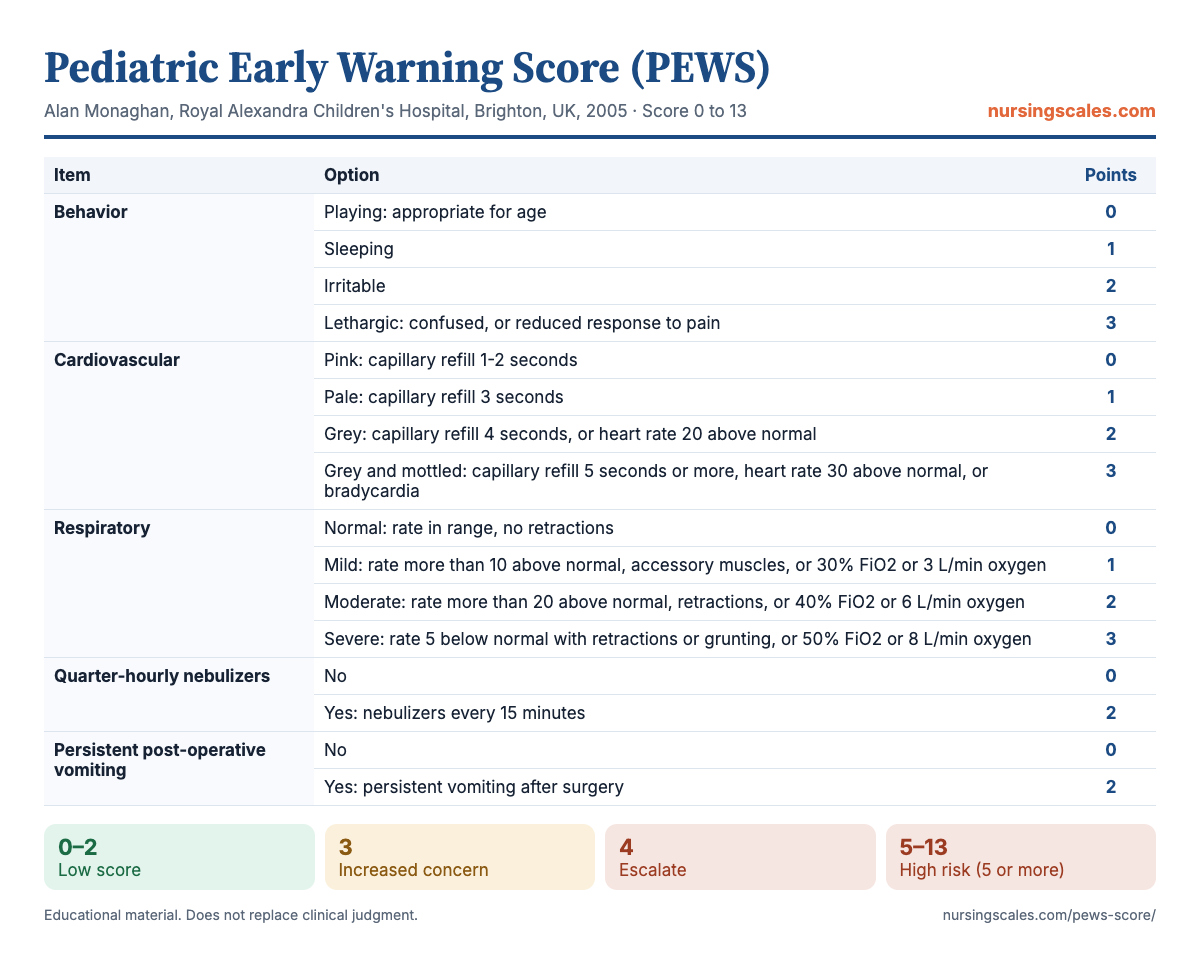
See every item and its points as a table
| Item | Option | Points |
|---|---|---|
| Behavior | Playing: Appropriate for age | 0 |
| Sleeping | 1 | |
| Irritable | 2 | |
| Lethargic: Confused, or reduced response to pain | 3 | |
| Cardiovascular | Pink: Capillary refill 1-2 seconds | 0 |
| Pale: Capillary refill 3 seconds | 1 | |
| Grey: Capillary refill 4 seconds, or heart rate 20 above normal | 2 | |
| Grey and mottled: Capillary refill 5 seconds or more, heart rate 30 above normal, or bradycardia | 3 | |
| Respiratory | Normal: Rate in range, no retractions | 0 |
| Mild: Rate more than 10 above normal, accessory muscles, or 30% FiO2 or 3 L/min oxygen | 1 | |
| Moderate: Rate more than 20 above normal, retractions, or 40% FiO2 or 6 L/min oxygen | 2 | |
| Severe: Rate 5 below normal with retractions or grunting, or 50% FiO2 or 8 L/min oxygen | 3 | |
| Quarter-hourly nebulizers | No | 0 |
| Yes: Nebulizers every 15 minutes | 2 | |
| Persistent post-operative vomiting | No | 0 |
| Yes: Persistent vomiting after surgery | 2 |
When to use it
- Every set of vital signs on a general pediatric ward
- On admission from the emergency department
- After surgery or a procedure under sedation
- After transfer out of the PICU
- When the child looks worse or a parent says the child is not themselves
- Deciding how often to repeat observations
How to score it step by step
- Observe behavior first, before you wake or handle the child.
- Check color, capillary refill and heart rate against the normal range for age.
- Count the respiratory rate for a full minute and note effort and oxygen need.
- Score each category 0-3, taking the highest row that matches any finding.
- Add 2 points for quarter-hourly nebulizers and 2 for persistent post-operative vomiting, if present.
- Compare with the last score, escalate per your policy, and document the score and actions.
Common mistakes
- Using adult vital sign ranges instead of the normal range for the child's age
- Scoring behavior after waking or upsetting the child
- Picking the lower row when one finding fits a higher row
- Waiting for the total to rise when one category already scores 3
- Dismissing a parent's concern because the score is low
Example case
Patient. Mia, 6, admitted with an asthma exacerbation, reassessed at 03:00.
- Irritable (2 points)
- Pale, capillary refill 3 seconds (1 point)
- Respiratory rate more than 20 above normal with retractions (2 points)
- Needs nebulizers every 15 minutes (2 points)
- No post-operative vomiting (0 points)
Score: 7. A PEWS of 7 is in the high-risk range (5 or more).
Nursing actions:
- Call the provider or rapid response team per policy
- Check oxygen saturation and give oxygen as ordered
- Increase the frequency of observations
- Keep the parent at the bedside and explain what is happening
- Document the score, the escalation and the response
Frequently asked questions
What is a normal PEWS score?
A score of 0-2 is usually low concern. Most hospitals escalate at 3 or 4, or when any single category scores 3. A score of 5 or more is high risk. Follow your hospital's thresholds.
What is the highest PEWS score?
In the Brighton PEWS the maximum is 13: up to 3 points each for behavior, cardiovascular and respiratory, plus 2 for quarter-hourly nebulizers and 2 for persistent post-operative vomiting.
Why do I need age-specific normal ranges?
Normal heart and respiratory rates change a lot from infancy to adolescence. The cardiovascular and respiratory rows score how far the child is from the normal range for their age.
Is there one official PEWS?
No. The Brighton PEWS is the original and most cited, but many hospitals use modified versions and their own escalation rules.
Should I escalate if the score is low but I am worried?
Yes. Nurse and parent concern are valid reasons to call for help. The score supports your judgment; it does not replace it.
Related scales and guides
All scales:
Sources: Monaghan's PEWS table (supplement, Pediatric Quality & Safety 2020) · Fuijkschot et al. Modified PEWS, PLOS ONE 2013 · Brighton PEWS as predictor of PICU admission, Arch Argent Pediatr 2020 · MD Anderson: Pediatric Early Warning Score algorithm (US modified PEWS). Explanations and example case written by our editorial team. Reviewed September 30, 2026.