How much pain right now?
Ask: "On a scale of 0 to 10, where 0 is no pain and 10 is the worst pain you can imagine, what number is your pain right now?"
Result
0range 0 to 10
Supports, never replaces, clinical judgment and your facility's protocols. · Reviewed September 30, 2026 by the editorial team under our editorial policy · No single original author; the NIH Clinical Center version cites McCaffery & Beebe, 1993
What it measures
The 0-10 scale measures pain intensity as the patient experiences it. Pain is subjective, so the patient's own rating is the reference standard when they can give one. A number lets you set a comfort goal, decide when to act, and show whether treatment helped by comparing scores over time.
Used for: Adults and children about 9 years and older who understand numbers and can self-report pain.
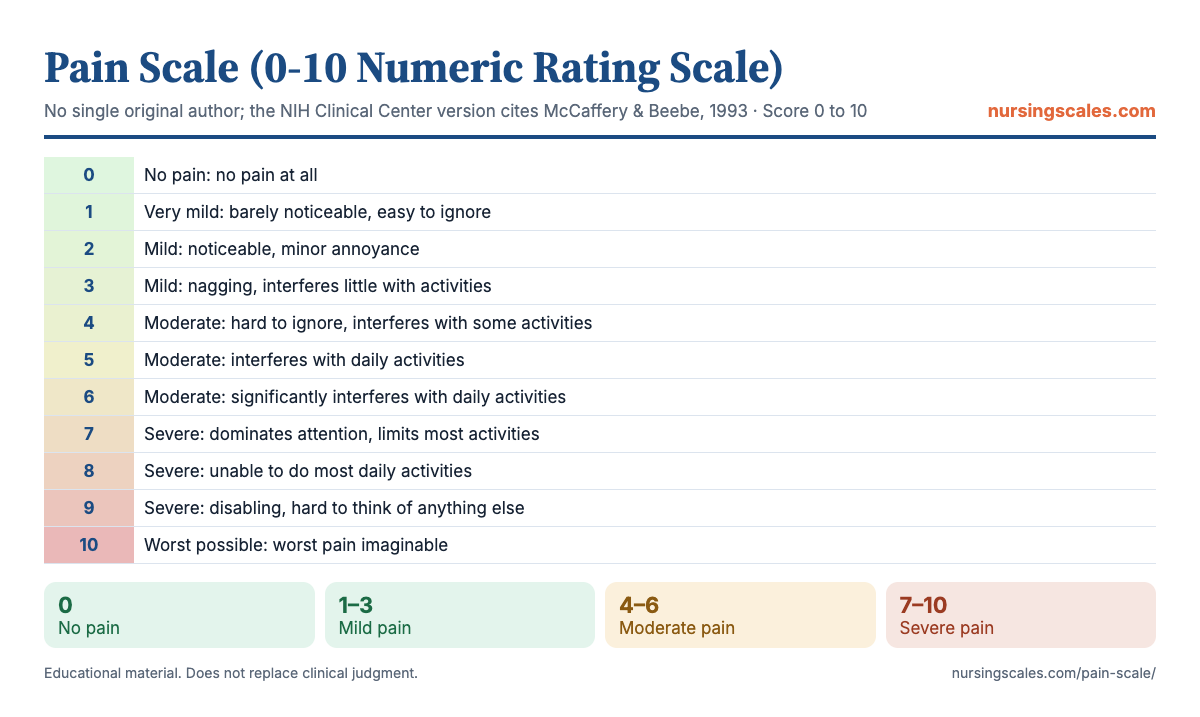
Pain Scale (0-10 Numeric Rating Scale) interpretation
| Score | Result | What it means |
|---|---|---|
| 0 | No pain | The patient reports no pain. Keep reassessing on schedule and with any change in condition. |
| 1–3 | Mild pain | Mild pain that interferes little with activities. Compare with the patient's comfort goal and use comfort measures or ordered treatment as needed. |
| 4–6 | Moderate pain | Moderate pain that interferes with daily activities. Treat per orders or notify the provider, then reassess within your policy's time frame. |
| 7–10 | Severe pain | Severe pain that limits most activities. Act promptly, look for a new or worsening cause, notify the provider, and reassess closely. |
Versions and other cut-offs: Cut-offs vary: 1-3 mild, 4-6 moderate, 7-10 severe is the most common, but some studies use 4-7 as moderate and 8-10 as severe. For children about 3 and older who cannot use numbers, use the Wong-Baker FACES scale (faces scored 0, 2, 4, 6, 8, 10; licensed images). For infants, young children and nonverbal patients, use a behavioral tool such as FLACC. The per-number descriptions here are a guide; the patient's own number always counts.
Pain Scale (0-10 Numeric Rating Scale) chart and printable PDF
When to use it
- Admission and every routine pain assessment
- Before and after giving pain medication or a nonpharmacologic intervention
- After surgery, injury or a painful procedure
- Any new or changed pain report
- Setting and tracking a comfort-function goal with the patient
- Monitoring chronic pain over time
How to score it step by step
- Confirm the patient can understand and use numbers; if not, choose FACES or a behavioral scale.
- Explain the anchors: 0 is no pain and 10 is the worst pain imaginable.
- Ask for the current number, and if useful the worst and best in the last 24 hours.
- Assess location, quality, onset and what makes it better or worse.
- Document the number, the patient's comfort goal and your intervention.
- Reassess after the intervention within your policy's time frame and record the new number.
Common mistakes
- Replacing the patient's number with your own estimate based on how they look
- Not explaining the anchors, so patients rate on different scales each time
- Recording a number without location, context or the action taken
- Using the numeric scale with young children or confused patients who cannot use it reliably
- Skipping the reassessment after treatment
Example case
Patient. Maria, 58, day 1 after a knee replacement.
- Patient rates her knee pain as 7 out of 10 at rest (7 points)
Score: 7. A rating of 7 means severe pain, above her stated comfort goal of 3.
Nursing actions:
- Give ordered analgesia or notify the provider if orders are not adequate
- Add ice, elevation and repositioning as ordered
- Reassess the rating after the intervention and document it
- Check the dressing, circulation and sensation of the leg
Frequently asked questions
What is a normal score on the 0-10 pain scale?
0 means no pain. 1-3 is mild, 4-6 moderate and 7-10 severe. There is no single normal number: compare the score with the patient's own comfort goal and your facility's treatment threshold.
What does each number on the pain scale 1-10 mean?
1-3 is mild pain that you notice but can work around. 4-6 is moderate pain that makes daily activities hard. 7-9 is severe pain that limits most activities. 10 is the worst pain the person can imagine.
Is 5 a lot of pain on a scale of 1 to 10?
A 5 falls in the moderate range. It usually interferes with daily activities and deserves treatment and a reassessment.
When should I use FACES or FLACC instead?
Use Wong-Baker FACES for children about 3 and older, or adults, who can point to a face but not a number. Use FLACC for infants, young children, and patients who cannot self-report.
What change in score is meaningful?
In chronic pain studies, a drop of about 2 points or 30% is often treated as clinically important. Ask the patient whether the change matters to them, too.
Related scales and guides
All scales:
Sources: NIH Clinical Center 0-10 Numeric Rating Scale (WA DSHS copy) · Shirley Ryan AbilityLab: Numeric Pain Rating Scale · Nursing Fundamentals: Pain Assessment Methods · Wong-Baker FACES Foundation. Explanations and example case written by our editorial team. Reviewed September 30, 2026.