1a. Level of consciousness
Score 3 only if the patient makes no movement other than reflexive posturing in response to noxious stimulation.
1b. LOC questions (month and age)
Ask the month and the patient's age. Score only the first answer, give no partial credit, and do not coach. Aphasic or stuporous patients who cannot understand score 2; intubated patients or those with severe dysarthria for other reasons score 1.
1c. LOC commands
Ask the patient to open and close the eyes, then grip and release the non-paretic hand. Give credit for an unequivocal attempt even if weakness prevents completion. You may pantomime if the patient does not respond to spoken commands.
2. Best gaze
Test horizontal eye movements only, voluntarily or with oculocephalic maneuvers. An isolated peripheral nerve palsy (CN III, IV or VI) scores 1.
3. Visual fields
Test upper and lower quadrants by confrontation, using finger counting or visual threat. Score 3 for any bilateral blindness, including cortical blindness.
4. Facial palsy
Ask or pantomime the patient to show teeth, raise the eyebrows and close the eyes. Use noxious stimulus to check grimace symmetry in poorly responsive patients.
5a. Motor arm, left
Extend the arm palms down at 90 degrees if sitting or 45 degrees if supine and count to 10. If the arm is amputated or the shoulder is fused, the form records UN (untestable) with an explanation; UN adds no points to the total.
5b. Motor arm, right
Test each arm separately, starting with the non-paretic side. If the arm is amputated or the shoulder is fused, the form records UN (untestable) with an explanation; UN adds no points to the total.
6a. Motor leg, left
With the patient supine, hold the leg at 30 degrees and count to 5. If the leg is amputated or the hip is fused, the form records UN (untestable) with an explanation; UN adds no points to the total.
6b. Motor leg, right
Test each leg separately. If the leg is amputated or the hip is fused, the form records UN (untestable) with an explanation; UN adds no points to the total.
7. Limb ataxia
Use finger-nose-finger and heel-shin tests on both sides. Score ataxia only if it is out of proportion to weakness; score 0 if the patient cannot understand or is paralyzed. Amputation or joint fusion is recorded as UN and adds no points.
8. Sensory
Test pinprick on the face, arms, trunk and legs, or withdrawal from noxious stimulus if the patient is obtunded or aphasic. A patient in coma (1a = 3) automatically scores 2.
9. Best language
Have the patient describe the standard picture, name the items and read the sentences from the NIHSS stimulus sheet. A patient in coma (1a = 3) automatically scores 3.
10. Dysarthria
Have the patient read or repeat the words from the stimulus list. If the patient is intubated or has another physical barrier to speech, the form records UN with an explanation; UN adds no points.
11. Extinction and inattention
Look for neglect during the earlier items and test double simultaneous stimulation (visual, tactile, auditory, spatial). This item is never untestable; score it only if an abnormality is present.
Result
0range 0 to 42
Review or change your answers
Supports, never replaces, clinical judgment and your facility's protocols. · Reviewed September 30, 2026 by the editorial team under our editorial policy · Brott, Adams, Olinger et al., 1989 (National Institute of Neurological Disorders and Stroke)
What it measures
The NIHSS is a standardized bedside neuro exam that rates level of consciousness, gaze, visual fields, facial movement, arm and leg strength, coordination, sensation, language, speech and neglect. It gives the whole stroke team one shared number to track change over time, support treatment decisions such as thrombolysis or thrombectomy workup, and estimate prognosis. Serial scores help you catch early neurological worsening.
Used for: Adults with suspected or confirmed acute stroke, in the emergency department, stroke unit, ICU or during follow-up neuro checks. Examiners should complete NIHSS certification training.
NIH Stroke Scale (NIHSS) interpretation
| Score | Result | What it means |
|---|---|---|
| 0 | No stroke symptoms | No measurable deficit on the NIHSS. A normal score does not rule out stroke, especially posterior circulation stroke, so keep assessing if symptoms persist. |
| 1–4 | Minor stroke | Mild deficits. Treat it as a stroke until proven otherwise: activate your stroke protocol and watch closely, because a low score can still hide a disabling deficit. |
| 5–15 | Moderate stroke | Clear neurological deficits. Follow your stroke pathway without delay, repeat the NIHSS at the intervals your protocol sets and report any rise promptly. |
| 16–20 | Moderate to severe stroke | Major deficits that suggest a large area of brain injury. Expect close monitoring of airway, swallowing and neuro status, and escalate any worsening right away. |
| 21–42 | Severe stroke | Severe, widespread deficits. Prioritize airway protection, aspiration precautions and frequent neuro checks, and keep the provider informed of every change. |
Versions and other cut-offs: Severity bands are not set by a guideline and differ by source. Some use 0-5 minor, 6-15 moderate and 16 or more severe, and others use finer bands (for example 6-10 mild, 11-15 moderate, over 20 very severe). A modified NIHSS (mNIHSS, 11 items) and a pediatric version (PedNIHSS) also exist.
NIH Stroke Scale (NIHSS) chart and printable PDF
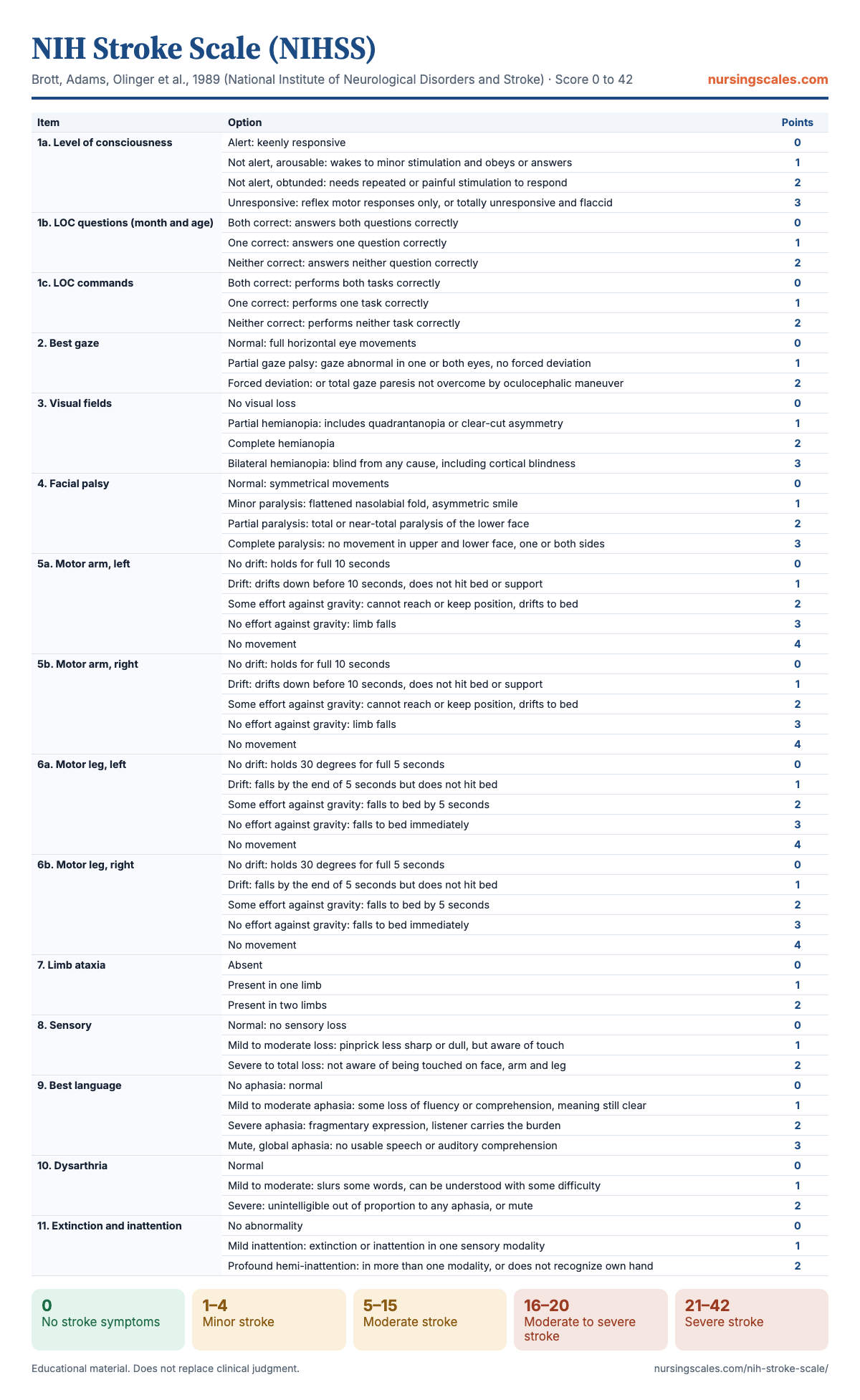
See every item and its points as a table
| Item | Option | Points |
|---|---|---|
| 1a. Level of consciousness | Alert: Keenly responsive | 0 |
| Not alert, arousable: Wakes to minor stimulation and obeys or answers | 1 | |
| Not alert, obtunded: Needs repeated or painful stimulation to respond | 2 | |
| Unresponsive: Reflex motor responses only, or totally unresponsive and flaccid | 3 | |
| 1b. LOC questions (month and age) | Both correct: Answers both questions correctly | 0 |
| One correct: Answers one question correctly | 1 | |
| Neither correct: Answers neither question correctly | 2 | |
| 1c. LOC commands | Both correct: Performs both tasks correctly | 0 |
| One correct: Performs one task correctly | 1 | |
| Neither correct: Performs neither task correctly | 2 | |
| 2. Best gaze | Normal: Full horizontal eye movements | 0 |
| Partial gaze palsy: Gaze abnormal in one or both eyes, no forced deviation | 1 | |
| Forced deviation: Or total gaze paresis not overcome by oculocephalic maneuver | 2 | |
| 3. Visual fields | No visual loss | 0 |
| Partial hemianopia: Includes quadrantanopia or clear-cut asymmetry | 1 | |
| Complete hemianopia | 2 | |
| Bilateral hemianopia: Blind from any cause, including cortical blindness | 3 | |
| 4. Facial palsy | Normal: Symmetrical movements | 0 |
| Minor paralysis: Flattened nasolabial fold, asymmetric smile | 1 | |
| Partial paralysis: Total or near-total paralysis of the lower face | 2 | |
| Complete paralysis: No movement in upper and lower face, one or both sides | 3 | |
| 5a. Motor arm, left | No drift: Holds for full 10 seconds | 0 |
| Drift: Drifts down before 10 seconds, does not hit bed or support | 1 | |
| Some effort against gravity: Cannot reach or keep position, drifts to bed | 2 | |
| No effort against gravity: Limb falls | 3 | |
| No movement | 4 | |
| 5b. Motor arm, right | No drift: Holds for full 10 seconds | 0 |
| Drift: Drifts down before 10 seconds, does not hit bed or support | 1 | |
| Some effort against gravity: Cannot reach or keep position, drifts to bed | 2 | |
| No effort against gravity: Limb falls | 3 | |
| No movement | 4 | |
| 6a. Motor leg, left | No drift: Holds 30 degrees for full 5 seconds | 0 |
| Drift: Falls by the end of 5 seconds but does not hit bed | 1 | |
| Some effort against gravity: Falls to bed by 5 seconds | 2 | |
| No effort against gravity: Falls to bed immediately | 3 | |
| No movement | 4 | |
| 6b. Motor leg, right | No drift: Holds 30 degrees for full 5 seconds | 0 |
| Drift: Falls by the end of 5 seconds but does not hit bed | 1 | |
| Some effort against gravity: Falls to bed by 5 seconds | 2 | |
| No effort against gravity: Falls to bed immediately | 3 | |
| No movement | 4 | |
| 7. Limb ataxia | Absent | 0 |
| Present in one limb | 1 | |
| Present in two limbs | 2 | |
| 8. Sensory | Normal: No sensory loss | 0 |
| Mild to moderate loss: Pinprick less sharp or dull, but aware of touch | 1 | |
| Severe to total loss: Not aware of being touched on face, arm and leg | 2 | |
| 9. Best language | No aphasia: Normal | 0 |
| Mild to moderate aphasia: Some loss of fluency or comprehension, meaning still clear | 1 | |
| Severe aphasia: Fragmentary expression, listener carries the burden | 2 | |
| Mute, global aphasia: No usable speech or auditory comprehension | 3 | |
| 10. Dysarthria | Normal | 0 |
| Mild to moderate: Slurs some words, can be understood with some difficulty | 1 | |
| Severe: Unintelligible out of proportion to any aphasia, or mute | 2 | |
| 11. Extinction and inattention | No abnormality | 0 |
| Mild inattention: Extinction or inattention in one sensory modality | 1 | |
| Profound hemi-inattention: In more than one modality, or does not recognize own hand | 2 |
When to use it
- On arrival of any patient with suspected acute stroke, as the baseline exam
- Before and after thrombolysis, at the intervals set by your stroke protocol
- Before and after endovascular thrombectomy
- During routine neuro checks on a stroke unit or neuro ICU
- Whenever you suspect neurological worsening
- At discharge or transfer, to document the patient's deficit
How to score it step by step
- Complete NIHSS training and certification before you score patients independently.
- Score the items in the listed order, 1a through 11, and do not go back to change an earlier score.
- Record what the patient actually does, not what you think the patient could do, and do not coach.
- Score the first attempt on items that call for it, such as 1b and 1c, and apply the coma rules for items 8 and 9 when 1a is 3.
- Mark untestable limbs, speech or coordination as UN with a written reason; UN adds no points.
- Add the item scores, document the total and time, and report changes to the provider per protocol.
Common mistakes
- Coaching the patient or giving partial credit on the LOC questions.
- Scoring ataxia in a paralyzed or confused patient instead of scoring 0.
- Changing an earlier item after seeing later findings instead of scoring in order.
- Scoring what you expect from the diagnosis rather than what you observe.
- Assuming a low score means a mild stroke, and missing disabling deficits such as isolated aphasia or posterior circulation signs.
Example case
Patient. A 68-year-old man arrives 90 minutes after his wife noticed slurred speech and right-sided weakness.
- 1a Level of consciousness: alert (+0)
- 1b LOC questions: gives the right age but the wrong month (+1)
- 1c LOC commands: performs both tasks (+0)
- 2 Best gaze: partial gaze palsy to the left (+1)
- 3 Visual fields: partial right hemianopia (+1)
- 4 Facial palsy: near-total paralysis of the lower right face (+2)
- 5a Motor arm, left: no drift (+0)
- 5b Motor arm, right: some effort against gravity, drifts to bed (+2)
- 6a Motor leg, left: no drift (+0)
- 6b Motor leg, right: drifts by 5 seconds without hitting bed (+1)
- 7 Limb ataxia: absent (+0)
- 8 Sensory: pinprick feels dull on the right side (+1)
- 9 Best language: word-finding difficulty, meaning still clear (+1)
- 10 Dysarthria: slurs some words, understood with effort (+1)
- 11 Extinction and inattention: no abnormality (+0)
Score: 11. An NIHSS of 11 falls in the moderate stroke range, with a left hemisphere pattern (right weakness, aphasia, right field cut).
Nursing actions:
- Activate the stroke alert and communicate the time last known well.
- Keep the patient NPO until a swallow screen is done.
- Repeat the NIHSS and vital signs at the intervals your protocol sets, before and after any treatment.
- Report any increase in score to the provider right away.
- Document the total, each item score and the time of the exam.
Frequently asked questions
What is a normal NIH Stroke Scale score, and what score is severe?
A normal score is 0. In the most cited bands, 1-4 is a minor stroke, 5-15 moderate, 16-20 moderate to severe and 21-42 severe. The higher the score, the greater the deficit.
How long does the NIHSS take?
A trained examiner usually finishes it in about 5 to 8 minutes. Speed comes with practice and certification.
Do nurses need certification to perform the NIHSS?
Most stroke centers require NIHSS certification for nurses and providers who score it, with periodic recertification. Check your facility's policy.
What does UN mean on the NIHSS?
UN means untestable. It applies to a limb that is amputated or has a fused joint, and to dysarthria in an intubated patient or one with another physical barrier to speech. You write the reason, and UN adds no points.
How much change in the NIHSS is significant?
Many protocols treat a rise of 2 or more points as neurological worsening that needs prompt provider notification, but thresholds vary. Follow your facility's protocol.
Can a patient with a low NIHSS score still have a serious stroke?
Yes. The scale weighs anterior circulation deficits more heavily and can underscore posterior circulation strokes, and a single deficit such as aphasia can be disabling with a low total.
Related scales and guides
All scales:
Sources: NINDS: NIH Stroke Scale (official form) · Brott et al. 1989, Stroke: original NIHSS article · Kogan et al. 2020, BMC Med Inform Decis Mak: NIHSS severity categories · Cleveland Clinic: NIH Stroke Scale. Explanations and example case written by our editorial team. Reviewed September 30, 2026.