History of falling
Score yes if the patient fell during this admission or has a recent history of falls, such as a fall that led to this admission.
Secondary diagnosis
Score yes if the chart lists more than one medical diagnosis.
Ambulatory aid
Score what the patient actually uses to walk. A patient on bed rest or who always walks with a nurse scores 0.
IV therapy / IV access
Score yes if the patient has an IV line or saline or heparin lock in place.
Gait
Watch the patient stand up and walk a few steps.
Mental status
Ask the patient if they can go to the bathroom alone or need help. Compare the answer with their actual ability and your orders.
Result
0range 0 to 125
Review or change your answers
Supports, never replaces, clinical judgment and your facility's protocols. · Reviewed September 30, 2026 by the editorial team under our editorial policy · Janice M. Morse, 1989
What it measures
The Morse Fall Scale scores six factors linked to falls: fall history, secondary diagnosis, use of an ambulatory aid, IV therapy, gait and mental status. It takes a few minutes and gives a number you can track over the stay. Use it to decide which patients need fall precautions and to tailor them to the factors that scored.
Used for: Adult inpatients in acute care, rehabilitation and long-term care. It is not validated for children.
Morse Fall Scale interpretation
| Score | Result | What it means |
|---|---|---|
| 0–24 | Low risk | Low fall risk. Use standard fall precautions, such as a safe room, call light in reach and nonskid footwear. |
| 25–44 | Moderate risk | Moderate fall risk. Add fall prevention measures aimed at the factors that scored, per your facility protocol. |
| 45–125 | High risk | High fall risk. Start your facility's high-risk fall protocol, such as bed alarm, scheduled toileting, assisted ambulation and close monitoring. |
Versions and other cut-offs: Morse stated that each institution should set its own cut-offs based on its patients, so bands vary. The most common US bands are 0-24 low, 25-44 moderate and 45 or more high. Some facilities use 0-24 no risk, 25-50 low risk and 51 or more high risk.
Nursing interventions by Morse Fall Scale score
Apply universal fall precautions to every patient, then add targeted interventions for the specific Morse items that scored.
0–24 Low risk
- Orient the patient to the room and have them show you how to use the call light.
- Keep the call light and personal items within reach.
- Keep the bed in low position with the brakes locked when the patient is in bed.
- Make sure the patient wears nonslip, well-fitting footwear.
- Use night lights, and keep floors clean, dry and free of clutter.
- Reassess fall risk on your facility schedule and after any change in condition or medications.
25–44 Moderate risk
- Continue all universal fall precautions.
- Target the items that scored: for gait or ambulatory aid problems, keep the walker or cane within reach and request a PT or OT referral if needed.
- For an IV or heparin lock, help the patient manage tubing when getting up.
- Round on a schedule and offer toileting help before the patient tries to get up alone.
- Ask the pharmacist to review medications that raise fall risk.
- Teach the patient and family to call for help before getting out of bed.
45–125 High risk
- Start your facility's high-risk fall protocol on top of universal precautions.
- Round more often and use a scheduled toileting plan.
- Assist with all transfers and ambulation, using safe patient handling equipment.
- Screen for delirium or confusion and increase supervision if mental status is altered.
- Request PT or OT evaluation and a pharmacist review of fall-risk medications.
- Keep the bed in lowest position and consider floor mats if the patient is at risk of injury from a fall.
- Flag high fall risk in the chart and at shift handoff, and review the plan with the patient and family.
Interventions follow AHRQ Fall Prevention Toolkit: universal fall precautions and targeted interventions, AHRQ Fall Prevention Toolkit: Morse Fall Scale. Your facility's protocol and the provider's orders take priority.
Morse Fall Scale chart and printable PDF
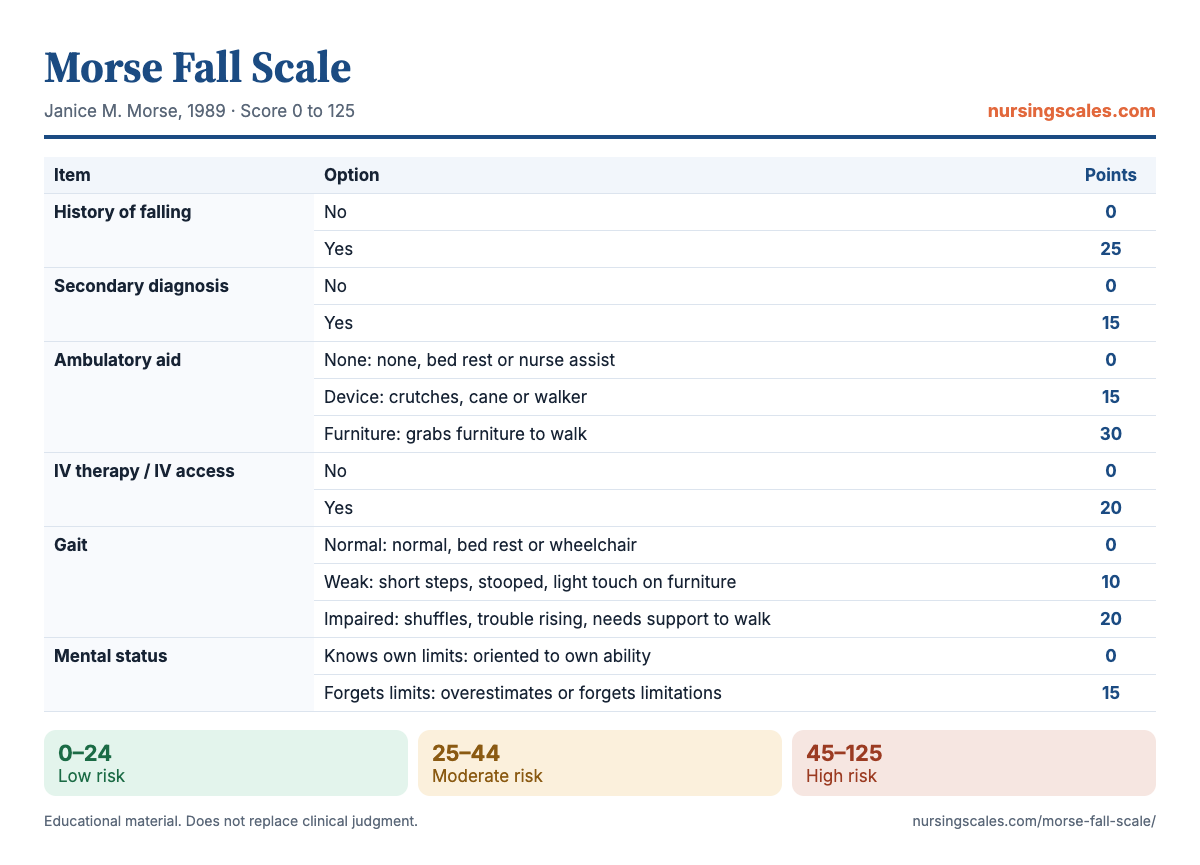
See every item and its points as a table
| Item | Option | Points |
|---|---|---|
| History of falling | No | 0 |
| Yes | 25 | |
| Secondary diagnosis | No | 0 |
| Yes | 15 | |
| Ambulatory aid | None: None, bed rest or nurse assist | 0 |
| Device: Crutches, cane or walker | 15 | |
| Furniture: Grabs furniture to walk | 30 | |
| IV therapy / IV access | No | 0 |
| Yes | 20 | |
| Gait | Normal: Normal, bed rest or wheelchair | 0 |
| Weak: Short steps, stooped, light touch on furniture | 10 | |
| Impaired: Shuffles, trouble rising, needs support to walk | 20 | |
| Mental status | Knows own limits: Oriented to own ability | 0 |
| Forgets limits: Overestimates or forgets limitations | 15 |
When to use it
- On admission to an inpatient unit
- Every shift or daily, as your facility requires
- After any fall
- On transfer to another unit
- When the patient's condition changes, such as new sedating medication, surgery or confusion
How to score it step by step
- Review the chart for falls, diagnoses and IV access.
- Ask about recent falls and whether the patient needs help to the bathroom.
- Watch the patient rise and walk a few steps to rate gait and aid use.
- Score each of the six items and add them for a total from 0 to 125.
- Match the total to your facility's risk bands and start the matching precautions.
- Document the score and interventions, and rescore on schedule or after any change.
Common mistakes
- Scoring gait from the chart without watching the patient walk
- Scoring a patient on bed rest as impaired gait; bed rest scores 0
- Missing an IV or saline lock that is still in place
- Scoring mental status by orientation to time and place instead of awareness of own limits
- Using one national cut-off when your facility has set its own bands
Example case
Patient. Mrs. L., 81, admitted after a fall at home with a urinary tract infection. She has heart failure, uses a walker and has an IV line.
- History of falling: yes, fall before admission (25)
- Secondary diagnosis: yes, UTI and heart failure (15)
- Ambulatory aid: walker (15)
- IV therapy: yes, IV line in place (20)
- Gait: weak, short steps and stooped (10)
- Mental status: knows own limits, calls for help (0)
Score: 85. A total of 85 places Mrs. L. at high risk for falls.
Nursing actions:
- Start the high-risk fall protocol, including a bed or chair alarm if used on your unit
- Keep the walker and call light within reach
- Offer scheduled toileting and assist with every transfer
- Review medications with the pharmacist and provider for fall risk
- Rescore every shift and after any change
Frequently asked questions
What Morse Fall Scale score is normal and what score is high risk?
In most US hospitals, 0-24 is low risk, 25-44 is moderate risk and 45 or more is high risk. Always use the bands your facility has adopted.
What is the maximum Morse Fall Scale score?
The maximum is 125: fall history 25, secondary diagnosis 15, ambulatory aid 30, IV 20, gait 20 and mental status 15.
How do I score a patient on bed rest?
A patient on bed rest scores 0 for ambulatory aid and 0 for gait. Fall history, diagnoses, IV and mental status still count.
How is mental status scored on the Morse Fall Scale?
It rates whether the patient knows their own limits, not orientation. A patient who is oriented but tries to walk alone despite needing help scores 15.
Can I use the Morse Fall Scale for children?
No. Use a pediatric tool such as the Humpty Dumpty Falls Scale for children.
Related scales and guides
All scales:
Sources: AHRQ Fall Prevention Toolkit: Morse Fall Scale · Morse Fall Scale form with risk levels · ScienceDirect Topics: Morse Fall Scale. Explanations and example case written by our editorial team. Reviewed September 30, 2026.